Posted on

The Paradox of Poverty : a Book Review

The Paradox of Poverty: Why are the poor in spirit “Blessed”:  

Quote from the publisher: ““Blessed are the poor in spirit,” Jesus said, “for theirs is the kingdom of heaven.” And we smile, nod, and think: “Lovely thought.” But if we’re paying attention, it’s a shocking, almost offensive thought. The grieving, the broken hearted, the marginalized, the stigmatized―all blessed, all happy? In The Paradox of Poverty, Susan Pitchford examines the ways in which followers of Christ have understood “poverty of spirit,” and the traditions that have formed around their attempts to follow Jesus on this radical path. 

  Over the centuries, those who have heard Jesus have learned the truth of his promise that we will find the greatest happiness, our deepest fulfilment―the kingdom of heaven, in fact, our blessedness and our belovedness―in the things that seem to impoverish our souls. The Paradox of Poverty looks at some of the wisdom traditions that have formed this understanding: the Scriptures, the desert mothers and fathers, the Franciscans, liberation theologians, prosperity gospel preachers, the 12-Step movement, and more. At both individual and collective levels, these traditions help us understand that varied kinds of poverty can become a “blessing” by bringing us to know our belovedness in God.” 

My interest mounted as I discovered the breadth and depth to which the writer had researched the “Paradox of Poverty of Spirit”. Susan Pritchard has produced a wealth of information and thought-provoking pages. This is a book which I would want to read again and keep for future reference. The writer shows how we become distracted from the meaning Christ set out for us in the Beatitudes. I commend this book for its insight and richness. 

Text © Michael Butler.  A Julian Meetings member. 

Image © Liturgical Press.

THE PARADOX OF POVERTY

Susan Pritchard

Published by Liturgical Press, 2025, paperback/e-book/ Kindle. 

ISBN  9798400802102 

Also available from Amazon

We invite readers to suggest further books for review, and are looking for further member reviewers. Contact us on https://thejulianmeetings.net/contact-for-book-reviews/

We invite readers to contribute to the Blog. Contact us on https://thejulianmeetings.net/contact-for-blog/

The Julian Meetings support in-person and online groups around the country. We make teaching on Contemplative Prayer and Meditation as easily and widely accessible as we can. Articles and reviews express the views only of their respective authors. 

Posted on

Remembering Julian of Norwich near her Anniversary

Julian of Norwich – reflections over the years. 

Our meetings are named after Julian of Norwich, but she is not our primary focus. The churches remember her on the 8th of May, the anniversary of her stream of mystical experiences in 1373. Following the Revelations, Julian pondered them for twenty years, challenging God and gaining clarity. Julian’s final text was hidden for many years, through the Reformation persecutions in England and the French revolution. Finally, a Presbyterian woman, Grace Warrack, hunted out an old manuscript in the British Library and copied it by hand. Sheila Upjohn investigated the story, wrote a book about it, and alluded to it in her April 2018 article. 

Here are some excerpts from our treasure trove of magazines

She retained a positive outlook while remaining real.

She is a “happy mystic”, and her writings are full of ‘joyous calm’ in spite of the serious challenges she experienced and discussed with God 

 © Martin Israel August 2003

The book addresses contemporary concerns.

“Her book was ‘rediscovered’ by a woman scholar at just the right time, when women were beginning to have a voice and be listened to. It was immediately popular. Here was a book by an English woman, not a foreign mystic. One of us. And her message is one of hope and optimism, not doubt and despair. Julian’s book breathes an atmosphere of common sense, a balanced mind,a loving heart, a closeness to the ordinary, that we all need to hear.”  

     “She is conversant with the idea of God as Mother, most likely through her own experience of motherhood. Jesus feeds us and teaches us as a mother feeds and teaches her child; God wraps us in goodness as a mother wraps up her infant; Jesus is courteous and friendly in demeanour, not some judge who is easily offended”  

     “She would have seen the seamy side of life, had contact with tradesmen, prostitutes, rogues. Her mildness is noticeable in that she condemns no one, and sees God as non condemnatory too. A life of prayer and listening enabled her to see that sin is not always where we think it is, and indeed ‘all shall be well’ despite our faults and failings. 

     “in her cell Julian wrestles with the big questions of life: sin, the humanity of Christ, the place of suffering, what is love and how it is shown, our eternal destiny and God’s Providence”. 

     “If we want, Julian can be our friend and teacher, opening our eyes to new ways of seeing and understanding life, God and ourselves. She can teach us about the value of silence and prayer, of keeping going when there seems to be no feedback. And Julian is characterised by her wonderful sense of gratitude. God is good. The meaning of life is love. And in accepting one another prayerfully and non-judgementally we accept and love the whole of humanity. Truly ‘All shall be well.’ 

© Elizabeth Obbard, Julian of Norwich–woman of Faith and Prayer. August 2008.

During the Coronavirus lock-down in 2020, Julian’s example became particularly relevent:

“Perhaps we can follow Julian by filling time with thoughts of the love of God rather than being led off-track by the media circus. All that Julian experienced led her to write her wonderful Revelations of Divine Love, so full of insight and reflection. The God she shows us in the suffering and compassionate Jesus is the same God for us. ‘He did not say, ‘you shall not be tempest-tossed, you shall not be work – weary, you shall not be discomforted’. But he said ‘you shall not be overcome’.”  

(August 2020 © Gill Butterworth, citing Julian’s longer book, RDF Chapter 68). 

In December 2023, Margaret Coles compared Julian of Norwich with a gifted, tenacious journalist: 

Dangerous  

It was a dangerous and perforce secret mission. While the medieval church was preaching sin, punishment, purgatory and hellfire, Julian was writing about God’s unconditional love and merciful compassion. She wrote that God was never angry, that he looked upon his darling children ‘with pity, not with blame’, had forgiven us for all wrongdoing, past, present and future, and was for ever coming towards us with his mercy and love. Julian knew full well the risk she was taking. Had she been discovered she would have had to recant or be burnt at the stake.  

Persistent  

… She had the integrity to risk her life for the story, as do many modern-day journalists. Julian is a reliable witness, a diligent fact-checker who dared to say, at a press conference with God, ‘Sorry, I didn’t quite get that point. Would you mind clarifying it?’ Add to her extraordinary courage and integrity a thoroughness and rigorous attention to detail and pains-taking efforts to describe precisely what she was shown, a she understood that every detail counted.  

Not an easy task  

Julian confronted the toughest questions, getting to grips with the puzzling and sometimes disturbing knowledge entrusted to her – deep, mysterious themes that take some unravelling. What to make of ‘sin is behoovable’ – translatable as ‘appropriate’ or ‘necessary’ or ‘sin shall be a glory’ – when you support the church’s condemnation of sin? She wrote it all down faithfully, with no fudging. The answer, she discovered, is that the pain caused by sin can become a source of self-knowledge and humility and an acceptance of God’s forgiveness and love.  

An honest witness  

Julian’s best known saying is ‘All shall be well, and all manner of things shall be well’, but she is no Pollyanna. She lived through war, plague, famine and social unrest. She viewed the world through the little window of her anchor-hold, to which people brought their cares, seeking kindness and understanding. Trust is hard to win and easy to lose. Julian’s honest voice is a witness who helps us, in a world of pain and uncertainty, find the courage to dare to trust that we have the certainty of God’s love. © Margaret Coles 

All the editions of the magazine are easily available on the web site. There is inspiration, challenge, history, and the testimony of many who have found again a living encounter with God. While we recall Julian of Norwich and read her words, in silence, alone or in a meeting, we meet her God afresh in our own age. 

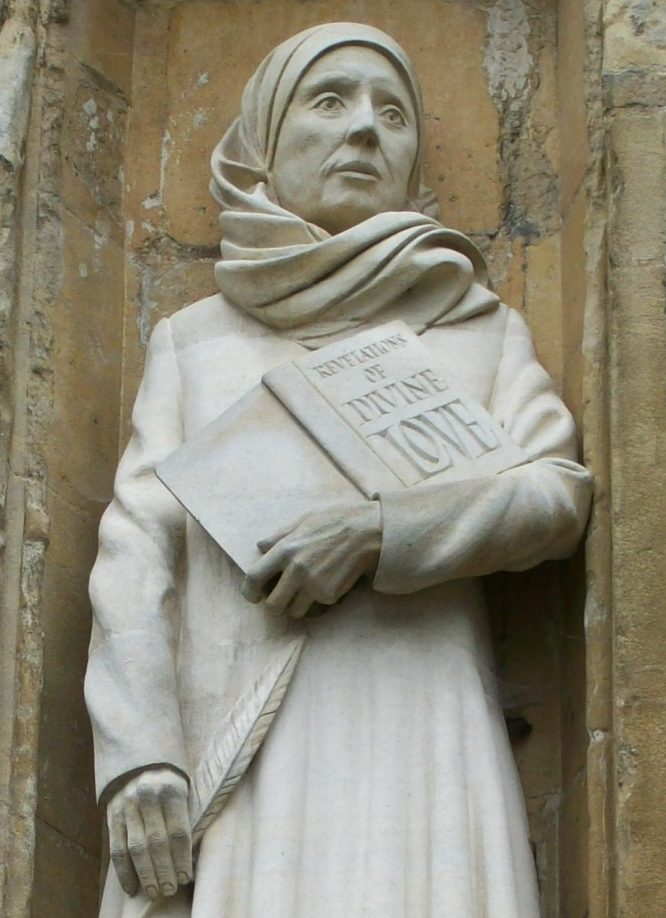
Text ©Philip Tyers, blog editor. Image from Wiki Commons, photograph of statue outside Norwich Cathedral by David Holgate, 2000. 

We welcome contributions to the blog. Please go to our contact page:

https://thejulianmeetings.net/contact-for-blog/  

We invite readers to suggest further books for review, and are looking for further member reviewers. Contact us on https://thejulianmeetings.net/contact-for-book-reviews/

 The Julian Meetings support in-person and online groups around the country. We make teaching on Contemplative Prayer and Meditation as easily and widely accessible as we can. Articles and reviews express the views only of their respective authors.  

Posted on

Musing on Lent and Easter music. 

crown of thorns with title lent and easter © Blackburn Cathedral

During the installation of Abp. Sarah Mullally, lines were sung from the words of Julian of Norwich. The composer Joanna Marsh had compiled these words in her anthem All Shall Be Well in 2021. Lyrics and music © Joanna Marsh

Without love we may not live 

And in this love our life is everlasting.                                            

Love was without beginning, is and shall be without ending. 

All shall be well and all manner of thing shall be well. 

Ah! Good Lord, how might it all be well? 

For wickedness hath been suffered to rise  
contrary to the Goodness. 

 I it am, the Might and the Goodness of the Fatherhood; 

 I it am, the Wisdom of the Motherhood; 

 I it am, the Light and the Grace that is all blessed Love. 

The Blackburn Chamber Choir sang a programme of music for Lent and Easter. Various pieces gave different views of God and his work with us.  

One prayed that God “will not hide his face from us or cast us off in displeasure.” It pleaded with God to forgive all our sins. Another, by the same composer (Richard Farrant d. 1580), asked God to remember his tender mercy and loving kindness, instead of “the sins and offenses of our youth.”  

A twentieth century piece, “Solus ad Victinam”, by Kenneth Leighton (d.1988) used words by Peter Abelard who died in 1142. It reflected on Christ giving himself as a sacrifice for our sin. It asked that we will suffer Christ’s pain for the 3 days. By doing so, we aim to win his mercy. This allows us to share his glory and “the laughter of his Easter day”.

These concepts seem alien today. The idea of pleading for forgiveness seems foreign. The sense that God is displeased with us and would punish us is also unfamiliar. The yearning to suffer with Christ is even more so.  

Our Bishop said that Jesus had sought us. He saved us. Then, He sat down after completing His task (Hebrews 1:3). God is all loving kindness. We do not need to plead for what he has already given. 

Another more popular piece from the Romantic era (Mendlesson d. 1847), asked God to listen because the godless and wicked oppress the writer. It then yearned for ‘the wings of a dove: far away would I rove… In the wilderness build me a nest to remain there for ever at rest’. It felt like sheer escapism, more the self-indulgence of the composer than the spiritual resourcing of the listeners.  

Do we come to Julian meetings or meditate at home, to have time ‘at rest’? Or do we meditate because, as another piece (Ubi Caritas Ola Gujielo b. 1978) reminded us, “where love is, there is God,” who binds us together in unity? in Christ we are one with each other and with God. We come to experience that, not merely assert it .  

Richard Rohr and others expand that unity. In Christ, we are one with people of any ethnic background. We are one with those who speak any language. We are united with people of any religion. We are at one with both the poor and the rich. We are at one with God. Despite our current wars, we are at one with Ukrainian and Russian, American, Israeli, Palestinian and Iranian.  The is no duality between God and people, and no ‘us’ and ‘them’ between people groups.

The broad range of Christian prayers use many pictures of God and his action on us. In silence, we allow God simply to be himself. We open ourselves to a new, simple vision. We discover the tranquility underlying the discords and upsets of the world. We also drop the chaos of our minds. This is not to ‘remain forever at rest,’ but to face with confidence whatever comes next. 

Text © Philip Tyers.  

Image © Blackburn Cathedral, used with permission

 The Julian Meetings support in-person and online groups around the country. We make teaching on Contemplative Prayer and Meditation as easily and widely accessible as we can. Articles and reviews express the views only of their respective authors.

Posted on

Job – the Problem of Suffering and the Problem of God.

tree segments showing damage in the rings Copyright p tyers

Janet has written about how reflecting on the book of Job helped her come to terms with grief. We invite our readers to write reflections on topics that join prayer and life. We would also like to hear about your groups. We hope to publish the next blog at Easter. Philip Tyers, Editor

The photo shows suffering endured by a tree over many years,  invisible to outsiders.  

Janet writes:

Many years ago, as a family, we suffered a grievous loss. It was a body blow of the most radical kind, a happening which severely questions belief. I do not think that I asked, “Why did this happen to me?” Suffering happens to most if not all people at some time in their lives. It caused me to ask questions about the roots of suffering.  

Fortunately, I came across a book, which provided some answers. Harold Kushner was a rabbi. He had suffered the death of a son. His son was born with an incurable and rare disease. The son died when he was fourteen. Kushner, inevitably, had mused upon this death, had asked questions of God. It was his chapter on the book of Job that helped me most. Kushner made three statements: 

  1. God is all- powerful and causes everything that happens in this world. Nothing happens without him willing it. 
  1. God is just and fair, and stands for people getting what they deserve, so that the good prosper and the wicked perish. 
  1. Job is a good person. 

He postulated that we cannot make sense of all these statements. We must sacrifice one in order to believe in the other two. His answer, which has become mine, is that God is not all-powerful. There are things which God cannot control. When disasters of any kind occur, we should not regard them as “acts of God” but turn to God to help us to live through them. God does this in many profound ways. That is a simplistic and inadequate comment on this wise book, but it helped me, as it has helped others for many years.  

This returned me to the Book of Job itself. It has been called the “most wonderful poem of any age and language; our first, oldest statement of the never ending problem – man’s destiny and God’s way with him in this world” (Thomas Carlyle). The saga of Job’s suffering, the arguments of his friends and the magisterial arguments of God need to be read repeatedly.  

Recently, I came across Andy Roland’s ‘The Book of Job.’ The author has abbreviated the text and arranged it for private reading, for group study and for public performance. The concluding chapter discusses the meaning of Job as the author finds it. He suggests, as does Kushner, that it not only discusses the problem of suffering but also the problem of God.  

A reading of all three books requires deep and searching thought and helps us to  

  • “Forgive the world for not being perfect,  
  • Forgive God for not making a perfect world,  
  • Reach out to the people around us  
  • Go on living despite it all” (Kushner). 

REFERENCES: 

Harold Kushner: When Bad Things Happen to Good People. Pan Books; 1st published 1981, and again with new introduction 2002. ISBN 9780330490559 Also available on Kindle.

Author unknown: The Book of Job – The Bible. 

Andy Roland: The Book of Job. Filament publishing. 2019 ISBN 9781913192501  Also available on Kindle.

Photo © Philip Tyers 2026

 Text ©Janet Robinson 2026. 

Editor: Philip Tyers

Posted on

Silence Is

Often, silence is approached via activity –  

the seeking of something in tandem with the resistance of other thing(s).  

Yet, silence is not the pursuit of a state but indeed  

a cessation of activity that reveals the innate ground of being. 

 Later, our mind attempts to describe That with words such as  

stillness, peace, truth, love, beauty  

or indeed silence. 

Silence isn’t audio-centric here. 

 It is a word chosen to poetically articulate  

That within which all of It’s modulations arise.  

When the soul ceases the reification of itself  

and surrenders into That which it borrows its presence from; Silence Is. 

When we die to ourselves  

and let the weather patterns of creation come and go, 

 there is only Itself.  

When we are reborn as/in experience,  

we describe That whence we came from as Silence. 

 Yet, unlike experience, Silence never truly comes or goes –  

it is the ever-present canvas upon which all experiences arise.  

Thus, we needn’t turn away from experience  

but simply recognise its substance;  

revealing that there is only, 

has only,  

can only,  

will only (Be)  

Silence and its modulations. 

Surrender is to Silence as fire is to wood. 

©Jamie Robson https://jamierobson.com

Posted on

A Reflection for Advent

Lead-in at a Julian Meeting in Australia in December 2013 

An Advent message in the Book of Lamentations? Unlikely as it seems, some verses seem to hold a messianic significance.  

In Lamentations the first four chapters are written in acrostic form: each verse – or in chapter 3, each triplet of verses – starts in order with a letter of the Hebrew alphabet. The book, attributed to Jeremiah, comes just after his prophecies. The poetic form of lament is common in the Old Testament, and there are more laments than praises in the Psalms.  

Jeremiah and Lamentations is a tale of judgment on God’s chosen people because of their sin and rebellion. However there are promises that some will be saved, that God has not utterly abandoned them and they will be restored. Their very existence was testimony to God keeping his promises. While the people agreed that they deserved punishment, they were impatient for the good bits of the prophecy to take place.  

Chapter 3: 22-26: Because of the LORD’s great love we are not consumed, for his compassions never fail. they are new every morning: great is your faithfulness. I say to myself, The LORD is my portion; therefore I will wait for him.The LORD is good to those whose hope is in him, to the one who seeks him; it is good to wait quietly for the salvation of the LORD.  

Jeremiah is expressing his hope in God. Prophecies can have multiple fulfilments and so the prophecy fulfilled in Jeremiah’s time has its ultimate fulfilment in the birth of Jesus Christ.  

Advent is a season of preparation and waiting. We wait for the One who brings salvation to the world. An angel tells Joseph, Mary’s betrothed, in a dream you are to name him Jesus, because he will save his people from their sins. (Matthew 1:21)  

It is good to wait quietly for the salvation of the LORD.  

Two things come together to make Christmas necessary. The first is our need to be saved – not a popular idea today. We are self-made men and women who can chart our own course and settle our own destiny. We believe the hollow promise that ‘anyone can change the world.’ But it just isn’t true. We don’t all have the opportunity, the ability, or the desire to do that. Our desire is the problem – not only do we desire the wrong things, but we do not desire the One who made us, do not desire to know Him or honour Him. We cannot escape our web of guilt, decay and death. We cannot change ourselves, let alone the world. And we need someone to save us.  

Yet that alone would not explain Christmas. We could have been left to take the consequences of our own decisions. But Christmas is necessary because God won’t give up on us. He is true to Himself, and won’t abandon us. His determination to rescue his people, to eventually gather them round His throne and shower them with his blessings, is the great explanation of why Mary fell pregnant and Christ was born.  

So let us focus on God’s gracious gift of love and salvation that came to us in Jesus Christ, our Lord and Saviour.  

I conclude with the beautiful words from Isaiah 9:6,7. Notice how often the word “will” appears in this passage. These are the Lord’s precious promises to us, to encourage us in a confused and turbulent world.  

For unto us a child is born,  

to us a son is given,  

and the government will be on his shoulders.  

And he will be called  

Wonderful Counsellor, Mighty God,  

Everlasting Father, Prince of Peace.  

Of the increase of his government and peace  

there will be no end.  

He will reign on David’s throne  

and over his kingdom,  

establishing and upholding it  

with justice and righteousness  

from that time on and forever.  

The zeal of the LORD Almighty  

will accomplish this.  

©John Ryall 

Photo https://www.pexels.com/@nubikini/

Posted on

Pondering the Julian Meetings

But when the Lord comes, will he find faith on earth? Luke 18:8

I was sitting in my allotment, pondering what I should be doing. I noticed that there was a slight slope and the earth at the top kept on wandering down to the bottom, where the shed is. The soil had enveloped the bottom of the shed and it was rotting. So I loaded the wheelbarrow up with the excess soil and took it to the beds higher up. It sounded like a command. Prevent soil erosion!. I made sides for the beds to keep the soil still.

I also heard it as a call to the next stage of my life. What acts as a barrier to prevent the continuing erosion of the soil of faith? Prayer. Maintaining the continual link with God. I could be like marram grass, anchoring the shifting sands of faith, giving my neighbours something to cling to. That is one reason I asked the Dean whether I could start a contemplative prayer group in Blackburn Cathedral. He put the Canon Missioner onto me, and we agreed a monthly time, and started up. 

Recently, the Archbishop, Stephen Cotterill, conducted a series called ‘faith in the North’, where he visits each diocese with instruction on the Lord’s Prayer. It is one of the few bits of the Bible many people have memorised. He said that it is a guide not only for prayer, but also for Christian living. The first word is ‘Our’. A Christian lives in the presence of other people, and FOR other people. And God if father of all people. His kingdom invites all to benefit, ‘on earth as in heaven’. 

Matthew precedes it with Jesus’ instructions on private prayer. There seems an implicit with those who make a show of prayer within a religious culture. Today in England we have a predominantly non religious culture. There are sizable pockets of Muslims and other where things are different, but the main flavour of our society excludes religion. That does not mean that we should therefore change Jesus’ teachings. The cathedral itself is a private space, where one can be hidden. The staff and congregation do all they can to ensure open public access and run events that encourage all sorts of people to come in. 

In the contemplative prayer group we come together and sit down. Each of us goes into our private space inside, and closes the door. We focus on God, knowing that around us others are doing the same. Instead of being closed off, we come together into the shared space, but each is in their own heart, where we always meet not only our Lord and ourselves, but The World. By going in, we reach out. And when we go out, we reach in. It is by paying serious attention to what is going on around us, seeing how it is all held in God, that we meet God as He is. We find he is in our individual hearts and in everyone else too.The Creator is always at work. By tuning in to the One, we find the All.

So what is the future of Julian meetings? Our founder pondered this in her Fiftieth Anniversary address, She recalled how in the early days, she had contacted the other groups exploring and teaching Contemplative Prayer. She found they were elderly and dwindling. She asked us whether we felt we should continue, and gave us silence to invite the Spirit to guide us.

The future will start where we are. My impression is that we are a group of individuals, continuing silent prayer, and some of us are lucky enough to belong to a group. The improving material on our web page is our gift to the Church, especially to those exploring silent prayer.

I’m not sure about the future concrete fulfilment of the coming of the Lord. I have always felt he is here and now, in a different mode to Judah AD 30, but as real. I expect this to continue. But to answer the hypothetical question, “if he came, would he find faith on earth?”, Julian meetings do their bit to ensure the answer ‘yes’. We do not impose faith. We open ourselves to the One in whom faith may be had. We discover, in the silence, what he has to offer. We give ourselves to the waiting, turning back again and again as our attention drifts, to the source of life itself. We are like Marram grass, anchoring the sand dune of faith against erosion.

Text and image ©Philip Tyers

Blackburn Cathedral Contemplative Prayer Meeting

November 2025

NB Philip Tyers is a JM member. The Blackburn Cathedral Contemplative Prayer Group is not a registered Julian Meeting but is organised on similar principles as appropriate for the Cathedral.

Posted on

All Saints and All Souls, Reflecting on Loss and Grief.

Nothing is Lost

When my friend was in the final stages of dementia and both speech and cognition were lost, I wondered what it must be like to lose control of one’s mind. Was it like a deep state of meditation where one is beyond thought? Where do all the memories go, all the relationships and experiences of a lifetime? I found these deeply comforting and appropriate words in a book by John O’ Donohue, where he wrote this blessing following a chapter on the subject of absence in all its forms:

May you know that absence is alive with hidden presence, that nothing is ever lost or forgotten.                                                          

May the absences in your life grow full of eternal echo.                  

May you sense around you the secret Elsewhere where the presences that have left you dwell.                                                      

May you be generous in your embrace of loss.                                  

May the sore well of grief turn into a seamless flow of presence.                                       

May you be embraced by God in whom dawn and twilight are one.

May your longing inhabit its dreams within the Great Belonging.

As I meditate on these words it reminds me that when I come to God in stillness and silence, all my experiences of life, love and loss are always present in the vast, eternal Presence which holds all of creation, beyond time and space, in peaceful and loving embrace. Nothing is ever lost, I am never alone, and there is nothing to fear.

From:         ‘Walking in wonder’ John O’Donohue

photo and text © K Marsh

All Saints’ Day, also known as All Hallows’ Day, the Feast of All Saints, the Feast of All Hallows, is observed by Christians from the eve 31st October and November 1st in honour of all the saints of the Church.

All Souls’ Day, also called The Commemoration of All the Faithful Departed, is a day of prayer and remembrance for all the faithful departed. Observed by Christians on 2 November.

Allhallowtide includes the three days from October 31st to November 3rd inclusive,

NB Dates can vary depending on the tradition of the particular Church. This is in accordance with the Western Christian tradition.

Posted on

Laughing with God a poem by Hafiz

Two Giant Fat People (by Hafiz a 14thC Persian poet and mystic see links at the end for details)

God and I have become
Like two giant fat people
Living in a tiny boat.

We keep
Bumping into each other
And laughing.

Image generated by AI

From Read the Spirit A review of Daniel Ladinsky’s A Year with Hafiz: Daily Contemplations.

“‘In the 19th Century, (Ralph Waldo) Emerson wrote that one of Hafiz’s greatest gifts was “his intellectual liberty, which is a certificate of profound thought. We accept the religions and politics into which we fall; and it is only a few delicate spirits who are sufficient to see that the whole web of convention is the imbecility of those whom it entangles—that the mind suffers no religion and no empire but its own. It indicates this respect to absolute truth by the use it makes of the symbols that are most stable and revered, and therefore is always provoking the accusation of irreligion.”

Below a blog post reflecting on the poem. Well worth reading.

Posted on

Overcoming Distraction in Contemplative Prayer

The practice of contemplative prayer in the face of distraction


So here in the midst of the world
With all its present pain and madness
You are not the sponge soaking up carbon emissions
Rather you are the channel of God‟s peace
Let that peace arise within you
Deeper than the sea of your own need or desire
Let that peace be a purity
A swept room
A tidied house
A simple order
An inner spaciousness
A forgiven, merciful place
Released from clawing need
Let go of the castles you have dug for yourself in the churned sand
Be washed flat by the beauty of the incoming waves
Let God‟s goodness in
Like a sparkling incoming tide
Smoothing the sand
And leaving a sheen of silver
Now you have cleared your near distance of the debris of your mind

See the expanse
Where heaven and earth meet
And all, all from east to west
From north to south
Is filled with light


Richard Carter
From ‘The City is my Monastery’
published by Canterbury Press ISBN: 9781786222138
© Used with permission. August 2024 Magazine.