Posted on

I Ease You

The Gospel discovered by the Seventeenth Century poet, George Herbert, was that Jesus eases us. He had suffered ‘a great affliction’ that broke him. He found that Jesus eased him, and described the discovery in his delightful poem, ‘Jesu’. In silent prayer, we too find that Jesus eases us. We trust that his easing can be experienced, not only by us, but by all.  

Centuries before, Abraham too had experienced a crisis.  He had been promised children, but expected to die childless. God repeated his promise. “Abram believed the LORD, and he credited it to him as righteousness”  Genesis 15:6. The accompanying picture is ‘Abraham’ by Ronald Rae.  It shows an almost cartoon face, peeking shyly at the sky, as if pondering the stars that symbolised the number of descendants he would have. The fragility of the facial expression contrasts with the solidity and size of the rock into which it is carved. Beside it is a fingerpost implying ‘walk’, and a bench implying ‘rest’. There is a right time for each.

Here is George Herbert’s poem. In his day, the letter ‘J’ had only recently been differentiated from the letter ‘I’. 

Jesu is in my heart, his sacred name 

Is deeply carved there: but th’other week 

A great affliction broke the little frame, 

Ev’n all to pieces: which I went to seek: 

And first I found the corner, where was J, 

After, where ES, and next where U was graved, 

When I had got these parcels, instantly 

I sat me down to spell them, and perceived 

That to my broken heart he was I ease you

                                And to the whole is J E S U. 

George Herbert , from his collection “The Temple”, 1633. 

Behind the silence which is the key part of a Julian meeting, there may be consideration of Scripture. Here Marian Sale of the Isle of Man Julian meeting, shares an article she wrote for the group. She takes key lines from a section of the bible and reflects on them using other verses and her own experience. This invites the reader to take time to ponder and let each verse sink in, rather than just flash past.  

ECCLESIASTES CHAPTER 3.  

There is a time for everything: 

1) A time to be born and a time to die.  

In John 3:4 Jesus tells us that “no one comes to see the kingdom of God unless he be born again.” Some people call themselves “born again Christians”. This can happen at any age and it does not have to be once only, like St Paul on the road to Damascus (Acts 9). Perhaps some might not experience this until they are on their death beds. The spiritual writers tell us we are likely to experience “little deaths” throughout our lives. The seed has to die to become a plant (Jn.2:24). We have to die from childhood in order to become adult. We die a bit every day. I do not intend to enter the thorny questions of euthanasia, suicide or abortion. 

 2) A time to plant and a time to uproot.  

When talking of the Pharisees, Jesus says “Every plant that my heavenly Father has not planted will be pulled up by the roots (Matt: 15:13). Also “every tree that does not bear good fruit is cut down and thrown into the fire.” (Matt:7:19). When Dutch Elm disease arrived on the Island, the Forestry Commission had a policy of cutting down and burning all diseased trees in order to preserve the rest.  

3) A time to kill and a time to heal. 

Although it says “thou shalt not murder” in the Ten Commandments, if a terrorist runs into a school or pop concert, brandishing a gun, it might be sensible to kill him before he commit mass murder  

4) A time to tear down and a time to build. 

Jesus tore down the tables of the money lenders in the Temple. At the moment of Jesus’ death “the curtain of the Temple was torn in two” (Matt 27:51). There is a saying:- “Ask your worst enemy to prune your roses” because the harder they are cut down the stronger the gr th for the following year. The Victorian slums were torn down in order to build more healthy and affordable housing. We still have the heritage of the magnificent mediaeval Cathedrals. 

5) A time to weep and a time to laugh. A time to mourn and a time to dance.  

“Blessed are you who weep now, for you shall laugh” (Luke 6:11). As Jesus was being led away to be crucified, He told his disciples “Do not weep for me, weep for yourselves and for your children”(Lk.23:28). “Weeping may remain for a night, but rejoicing comes in the morning.” (Psalm 30:5). “Those who sow in tears will reap with songs of joy”(Ps. 126:5). Jesus wept at the death of His friend Lazarus (Jn.11:35). It is only natural to weep at the death of our relatives and loved ones, but they would not want us to wear black for years like Queen Victoria.  God turns our mourning into dancing (Ps.30:11) and the prodigal son was welcomed home with dancing (Lk. 15:25).

 6) A time to be silent and a time to speak. 

Jesus remained silent to his accusers in front of Pontius Pilate (Matt 27:14) because He knew His final destination. This was foretold by Isaiah (53:7-8) “He was oppressed and afflicted, yet he did not open his mouth, he was led like a lamb to the slaughter, and as a sheep before his shearers is silent, he did not open his mouth.”

Although Ecclesiastes was written at the time of King Solomon it is equally relevant for today. Time has nothing to do with minutes, hours and years.  Sometimes time flies, sometimes it seems to drag. 

© Marian Sale

Diane Watkins writes:  

I was a member of Beverley Julian meeting. When I was a young person, I wrote a poem which expressed my thoughts and feelings about the mystery of suffering which I include below. I have never shown it to anyone until now. 

Who cares? Who cares? Who cares? 

Yes, who will care 

When all the blood and sweat have flowed and dried 

When furrowed face is quenched with tears run cold 

And anguished heart with anguish is o’er whelmed  

For I care, God, thou knowest how I care, 

And how my caring is to nothing brought 

By others knowing much and caring naught. 

But caring’s not enough- no, we must DO , 

And doing must engage the ravening foe, 

Yet caring not how little we can do, 

And knowing just how little we can know. 

© Diane Watkins 

A sequence of verses for meditation, celebrating our union with Christ: 

I live, no longer I, but Christ who lives in me  (Gal 2:20) 

 In whom all things hold together  (Col 1:17) 

And God is all in all.  (1 Cor. 15:28) 

The Julian Meetings magazine contained a variety of materials; articles, poems, verses, and book reviews. This edition of the Blog partly revives that tradition. Please contact us with your response: https://thejulianmeetings.net/contact-for-blog/ 

 Photograph  © Philip Tyers. ‘Abraham’, by Ronald Rae b. 1946, in the grounds of the Royal Edinburgh Hospital, for mental care. 

The Julian Meetings support in-person and online groups around the country. We make teaching on Contemplative Prayer and Meditation as easily and widely accessible as we can. Articles and reviews express the views only of their respective authors. 

Please send your contributions for publication on the blog using the online form at  https://thejulianmeetings.net/contact-for-blog/ 

Posted on

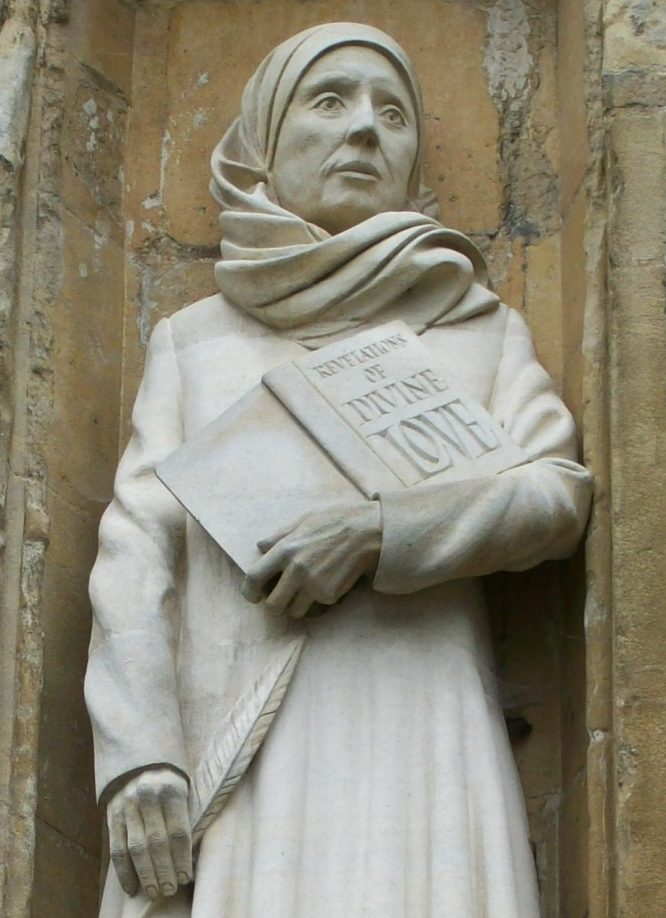
Remembering Julian of Norwich near her Anniversary

Julian of Norwich – reflections over the years. 

Our meetings are named after Julian of Norwich, but she is not our primary focus. The churches remember her on the 8th of May, the anniversary of her stream of mystical experiences in 1373. Following the Revelations, Julian pondered them for twenty years, challenging God and gaining clarity. Julian’s final text was hidden for many years, through the Reformation persecutions in England and the French revolution. Finally, a Presbyterian woman, Grace Warrack, hunted out an old manuscript in the British Library and copied it by hand. Sheila Upjohn investigated the story, wrote a book about it, and alluded to it in her April 2018 article. 

Here are some excerpts from our treasure trove of magazines

She retained a positive outlook while remaining real.

She is a “happy mystic”, and her writings are full of ‘joyous calm’ in spite of the serious challenges she experienced and discussed with God 

 © Martin Israel August 2003

The book addresses contemporary concerns.

“Her book was ‘rediscovered’ by a woman scholar at just the right time, when women were beginning to have a voice and be listened to. It was immediately popular. Here was a book by an English woman, not a foreign mystic. One of us. And her message is one of hope and optimism, not doubt and despair. Julian’s book breathes an atmosphere of common sense, a balanced mind,a loving heart, a closeness to the ordinary, that we all need to hear.”  

     “She is conversant with the idea of God as Mother, most likely through her own experience of motherhood. Jesus feeds us and teaches us as a mother feeds and teaches her child; God wraps us in goodness as a mother wraps up her infant; Jesus is courteous and friendly in demeanour, not some judge who is easily offended”  

     “She would have seen the seamy side of life, had contact with tradesmen, prostitutes, rogues. Her mildness is noticeable in that she condemns no one, and sees God as non condemnatory too. A life of prayer and listening enabled her to see that sin is not always where we think it is, and indeed ‘all shall be well’ despite our faults and failings. 

     “in her cell Julian wrestles with the big questions of life: sin, the humanity of Christ, the place of suffering, what is love and how it is shown, our eternal destiny and God’s Providence”. 

     “If we want, Julian can be our friend and teacher, opening our eyes to new ways of seeing and understanding life, God and ourselves. She can teach us about the value of silence and prayer, of keeping going when there seems to be no feedback. And Julian is characterised by her wonderful sense of gratitude. God is good. The meaning of life is love. And in accepting one another prayerfully and non-judgementally we accept and love the whole of humanity. Truly ‘All shall be well.’ 

© Elizabeth Obbard, Julian of Norwich–woman of Faith and Prayer. August 2008.

During the Coronavirus lock-down in 2020, Julian’s example became particularly relevent:

“Perhaps we can follow Julian by filling time with thoughts of the love of God rather than being led off-track by the media circus. All that Julian experienced led her to write her wonderful Revelations of Divine Love, so full of insight and reflection. The God she shows us in the suffering and compassionate Jesus is the same God for us. ‘He did not say, ‘you shall not be tempest-tossed, you shall not be work – weary, you shall not be discomforted’. But he said ‘you shall not be overcome’.”  

(August 2020 © Gill Butterworth, citing Julian’s longer book, RDF Chapter 68). 

In December 2023, Margaret Coles compared Julian of Norwich with a gifted, tenacious journalist: 

Dangerous  

It was a dangerous and perforce secret mission. While the medieval church was preaching sin, punishment, purgatory and hellfire, Julian was writing about God’s unconditional love and merciful compassion. She wrote that God was never angry, that he looked upon his darling children ‘with pity, not with blame’, had forgiven us for all wrongdoing, past, present and future, and was for ever coming towards us with his mercy and love. Julian knew full well the risk she was taking. Had she been discovered she would have had to recant or be burnt at the stake.  

Persistent  

… She had the integrity to risk her life for the story, as do many modern-day journalists. Julian is a reliable witness, a diligent fact-checker who dared to say, at a press conference with God, ‘Sorry, I didn’t quite get that point. Would you mind clarifying it?’ Add to her extraordinary courage and integrity a thoroughness and rigorous attention to detail and pains-taking efforts to describe precisely what she was shown, a she understood that every detail counted.  

Not an easy task  

Julian confronted the toughest questions, getting to grips with the puzzling and sometimes disturbing knowledge entrusted to her – deep, mysterious themes that take some unravelling. What to make of ‘sin is behoovable’ – translatable as ‘appropriate’ or ‘necessary’ or ‘sin shall be a glory’ – when you support the church’s condemnation of sin? She wrote it all down faithfully, with no fudging. The answer, she discovered, is that the pain caused by sin can become a source of self-knowledge and humility and an acceptance of God’s forgiveness and love.  

An honest witness  

Julian’s best known saying is ‘All shall be well, and all manner of things shall be well’, but she is no Pollyanna. She lived through war, plague, famine and social unrest. She viewed the world through the little window of her anchor-hold, to which people brought their cares, seeking kindness and understanding. Trust is hard to win and easy to lose. Julian’s honest voice is a witness who helps us, in a world of pain and uncertainty, find the courage to dare to trust that we have the certainty of God’s love. © Margaret Coles 

All the editions of the magazine are easily available on the web site. There is inspiration, challenge, history, and the testimony of many who have found again a living encounter with God. While we recall Julian of Norwich and read her words, in silence, alone or in a meeting, we meet her God afresh in our own age. 

Text ©Philip Tyers, blog editor. Image from Wiki Commons, photograph of statue outside Norwich Cathedral by David Holgate, 2000. 

We welcome contributions to the blog. Please go to our contact page:

https://thejulianmeetings.net/contact-for-blog/  

We invite readers to suggest further books for review, and are looking for further member reviewers. Contact us on https://thejulianmeetings.net/contact-for-book-reviews/
 The Julian Meetings support in-person and online groups around the country. We make teaching on Contemplative Prayer and Meditation as easily and widely accessible as we can. Articles and reviews express the views only of their respective authors.  

Posted on

August Magazine

Our August magazine is now available and the printed copy is with our Meetings and individual members. It is our last printed magazine. Details of how we plan to replace it are all in the magazine. You can read it online here together with our April magazine which also contains information about our plans for the future. We do need help to make that future happen. Details are all in the magazine pages 17 & 20.

If you subscribe to this blog to receive new posts as they are published but have not joined our membership please consider becoming a member to to receive news and updates and contribute to the discussions on the future of JM. This is free.