Posted on Leave a comment

The Work of Oneing, Together

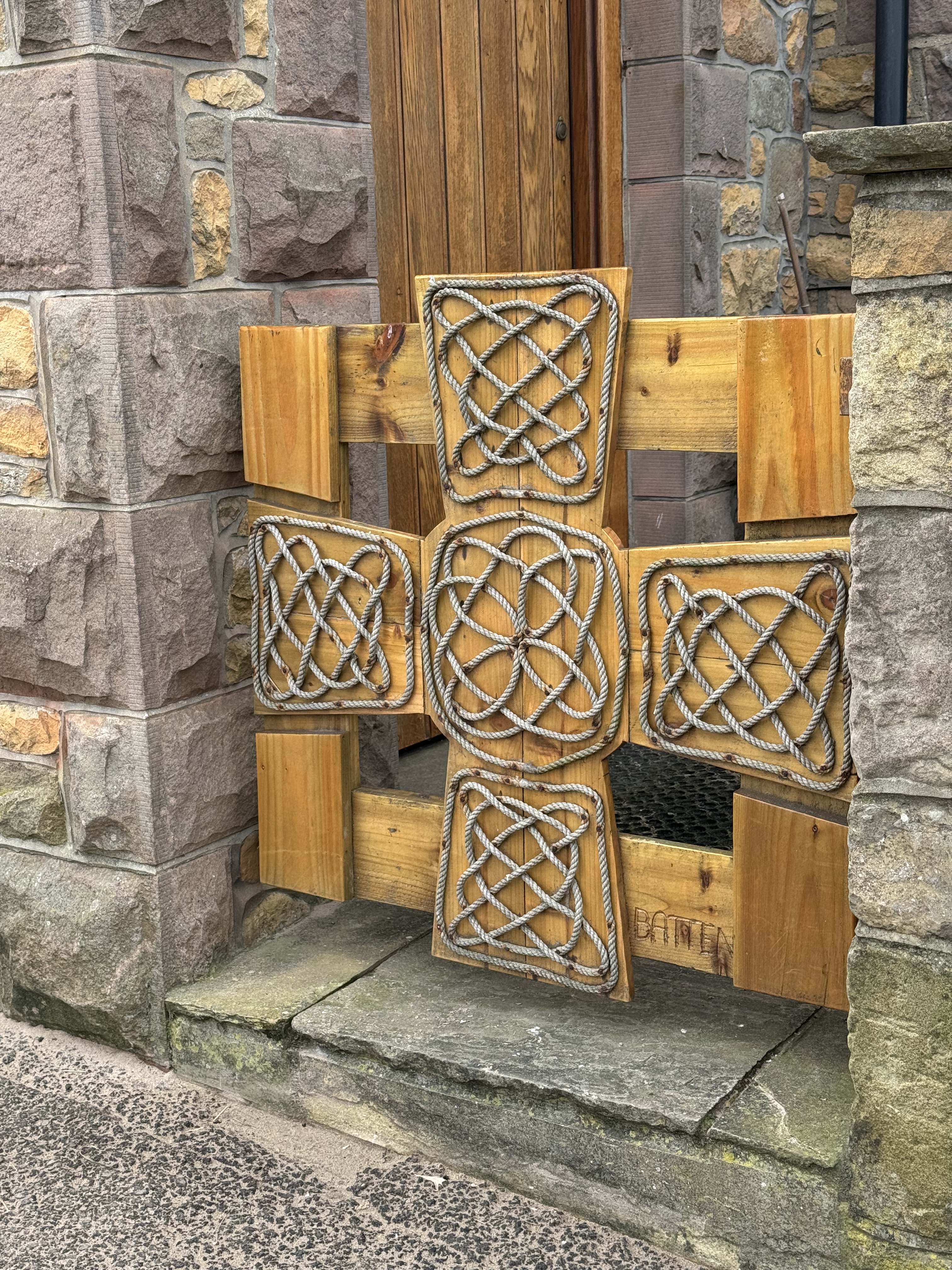
knotted rope cross signifies our uniting in Christ.

We usually intersperse blogs with book reviews. In view of the death of the solitary, Maggie Ross, last month, we hear today from Ruth Mills, who uses terms based on ‘eremos’: the Desert, where Jesus went to be alone with God. Ruth is currently studying with the Community of the Resurrection in Mirfield, Yorkshire.

Solitude in Community

The first time I arrived at a Julian Meeting I was drawn to the paradox of following Mother Julian’s example of sitting in eremitic silence, whilst sitting with others to do so: coming together – to be alone with God.   

Yet in the juxtaposition there is something that is, without doubt, the nature of the Oneing of the soul to God which Julian writes of in her Revelation of Divine Love.   

“The soul is preciously knitted to Him in its making by a knot so subtle and so mighty that it is Oned into God” Julian writes.   And it is because every individual is “oned” to God that. Julian reasons, all of humanity is inextricably linked to one another.  True spiritual togetherness means recognising that human separation is an illusion, and that humanity is inherently fused to the Divine from the moment of creation, expressed through the vivid imagery of a tightly bound knot.  

Those gifted in the craft of knotwork have a fine art-form of working a cord through, around and within itself in a work which bonds, and if done well, with exquisit beauty.  The work of the oneing of one’s soul with God is labour and beauty also, possibly the most wonderful and transformative undertaking of a human life.   

As a vowed celibate to the Single Consecrated Life, my life is, personally, set apart from the secular world for the Glory and the Kingdom of God, and yet the purpose of my consecration is to free me to enter more fully back into the world so that I may enter more fully into the love of Creation and humanity which follows closely in the footsteps of the Lord Jesus.   

But contemplation isn’t a work only reserved for Religious or the Church, it’s a divine work for all humanity, together.  If the Kingdom of God is encounter, communion, and coming together, then the real challenge is this: how do we come near when human constructs set us apart?   

Julian writes “prayer ones the soul to God”.   

In following Julian into silence, we are not merely withdrawing from the outside world in pursuit of stillness. Rather, we are entering into prayer that reaches beyond the confinements of the secular world towards the Creator God who is present in all places. Yes, we turn from distractions, but we do not reject the world. Instead, we turn forward, reaching more deeply into the ever-present Kingdom of God, which has already arrived and encompasses us in every place and time. 

Julian’s eremitic life was situated within the movement of the church and the people around her, setting her apart in radical solitude for prayer for the world yet gifting connection with those who sought her counsel through her cell window.  It was a position of hermitic ‘being’ pointing all souls towards the Glory of God: a work of sewing together the souls and Creator in the work of salvific oneing, not only through divine ecstatic intimacy, but in divine disruptive participation. 

From Julian’s Anchorhold to our meeting room.   

Like all skillful craft forms, we need a mentor and guide to sit alongside us, to work beside us, teaching and steadying our hands as we learn to fine-tune our spiritual practice. Here, Julian serves as our master weaver, guiding us in the art of being “oned.” 

This paradox reveals itself for the Glory of God. In our sitting together eremitically, we are silent in the shared work of Oneing – of weaving that binding knot of union with the Divine. 

A worthy work indeed. 

Text and Photograph ©Ruth Mills 

Photograph: knotted Celtic gate at the fishing village of Beadnell Bay, Northumbria. “This is my own photo- I’ve been walking the St Aidan’s way with Newcastle diocese and was in one of the villages we passed through in May- I was really stunned by it”.   

Martha Reeves (born 1941) died peacefully on June 11, 2026 in Oxford. She was a vowed Anglican solitary (or anchorite) and author of books on spirituality, for example ‘Silence, a user’s guide’. Her pen name was Maggie Ross. She In an interview with Church Times she wrote “communities are only as healthy as the solitudes that make them up; and that a life that is prayer is about being, not doing”. Her gravestone reads: ‘Sr Martha Emilie ReevesIn Silence Beholding ‘, a part quotation from her book ‘Writing the icon of the heart‘. She had written her own blog since 2006. She opened her 2020 article on “Silent Knowing” by quoting Graham Ward: “all theology must emerge from silence and result in silence”. 

“As far as my study of scripture goes, I have found that to love Christ above all things will involve three things: warmth and song and sweetness. And these three, as far as I know from personal experience cannot exist for long without there being great quiet.” Richard Rolle, The Fire of Love, C15, cited by Janet Rolinson

“Many children seek not to just learn about and think about God, but to experience God as the ground of their being. Meditation is one way of experiencing the presence of Jesus within. Meditation provides children with an opportunity to undertake a journey of silence and stillness as one way of helping them cope with the pressures of life”.© Gail Ballinger – August 2005 JM magazine p. 5.

The Julian Meetings support in-person and online groups around the country. We make teaching on Contemplative Prayer and Meditation as easily and widely accessible as we can. Articles and reviews express the views only of their respective authors. 

Please send your comments or contributions for publication on the blog to  https://thejulianmeetings.net/contact-for-blog/  

Posted on

Stillness Is Deeper Than Silence 

Stillness among noise

The Julian meetings practice Christian meditation/contemplative prayer, and this web site consists of a treasury of material supporting that practice. Here one of our members contributes from his rich experience of stillness even amid demanding, even life threatening, situations.

We often speak about silence as though it is something we must achieve. We sit down, close our eyes, and then discover that the mind has not received the instruction. Thoughts arrive. Sounds continue. Memories, worries, ideas, feelings, and distractions move around us. 

That can lead people to think they are failing at silent prayer. 

But perhaps stillness is deeper than silence. 

The silence of a Julian Meeting is not, I think, a demand that we somehow empty the mind by force. Very few people can do that. Perhaps nobody can do it completely. The mind moves. It produces thoughts in the same way the body breathes and the ears hear. The problem is not that thoughts arise. The question is what we do with them. 

Do we chase them? Do we argue with them? Do we try to push them away? Or can we simply allow them to be present, without making them the centre of our attention? 

This is where contemplative prayer becomes both gentle and demanding. It asks very little from us in one sense: just sit, be present, and wait upon God. But in another sense it asks a great deal, because it asks us not to control the experience. 

Meister Eckhart and other Christian contemplative writers often point us towards this kind of detachment: not coldness, not indifference, but freedom from the need to grasp everything that passes through the mind. In that spirit, stillness is not the absence of thought. It is the grace of not being ruled by every thought. 

Another word for this may be equanimity: a balanced presence, neither grasping nor resisting. In Christian terms, I do not mean a self-made calm, achieved by effort alone. I mean something received and practised: a grace that helps us remain present before God amid whatever moves around us and within us. 

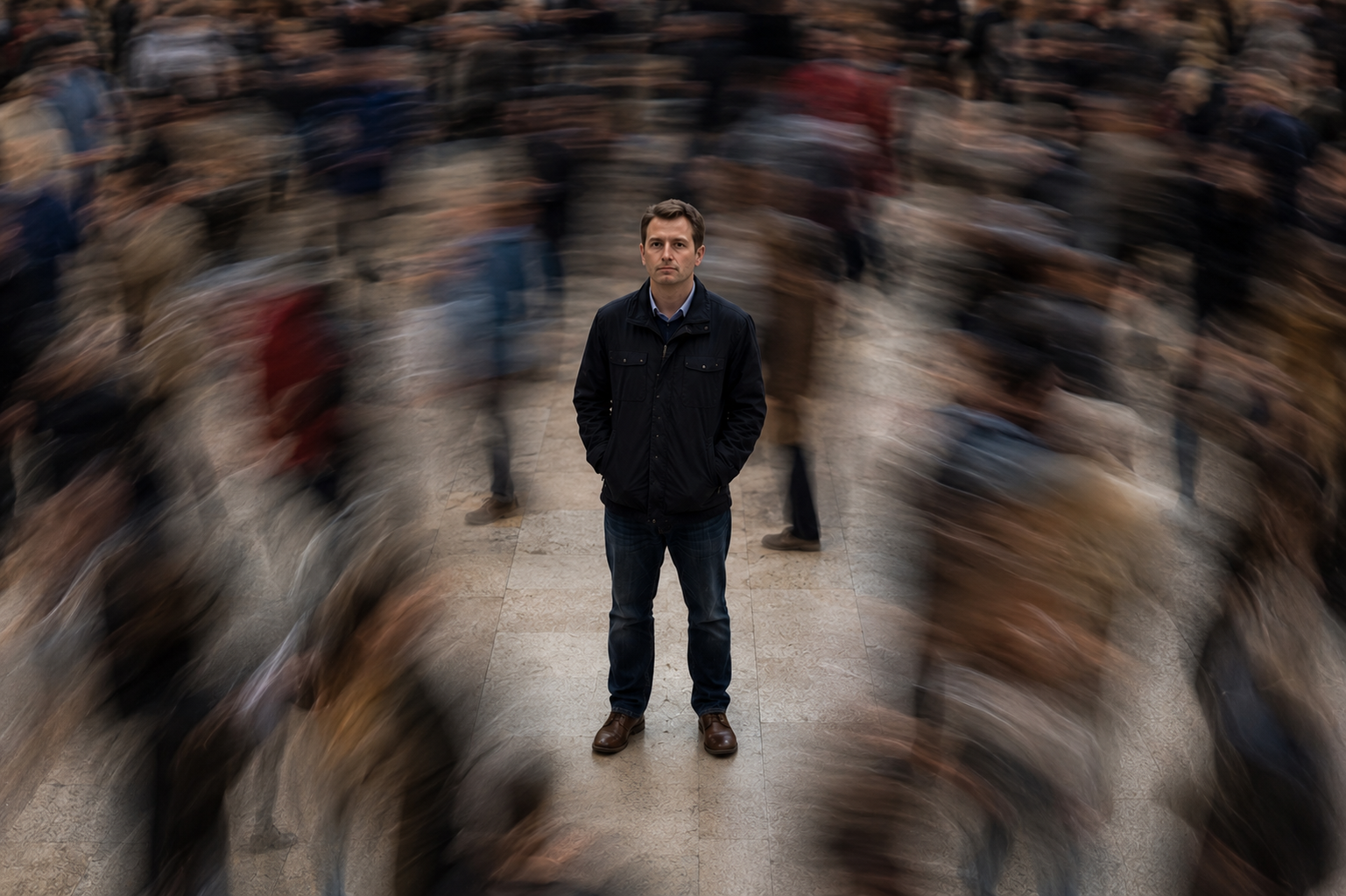
This is why I find the image of the still person in the long-exposure photograph so helpful. Around them, the world rushes past. People move, lights blur, the street is full of activity. Yet the person remains still. The movement has not disappeared. The stillness is not created by removing the movement. The stillness is found within it. 

That is often what our inner life is like. 

We may come to silent prayer with a mind full of movement. We may be tired, distracted, anxious, or restless. We may be very aware of the sounds in the room, the noises outside, or the unfinished business of the day. Yet none of that prevents stillness. It only gives us the place where stillness may be practised. 

I have found this to be true beyond the meeting room as well. There have been moments in my own life, in difficult and noisy circumstances, where I have discovered that stillness was possible even when quiet was not. I do not always manage it. Far from it. There are many times when I have followed the wrong thought, fed the wrong feeling, or made the noise louder by engaging with it. That, perhaps, is a reflection for another time. 

For now, the point is simpler. 

If thoughts arise in prayer, we need not punish ourselves. If we suddenly realise we have been carried away by them, we can gently return. No drama is needed. No failure has occurred. We return to stillness as often as necessary. 

Perhaps this is one way of understanding grace. Not as a dramatic feeling, nor as a special experience we must seek, but as the quiet strength to remain present before God amid everything that moves around us and within us. 

So the challenge may be this: not only to sit in silence during a Julian Meeting, but to carry something of that stillness into life. 

Into the street. Into the workplace. Into family life. Into uncertainty. Into noise. 

Stillness is not the absence of noise. 

Stillness is deeper than silence. 

“Be still, and know that I am God.” 
Psalm 46:10 

Text ©️ Ian Beers. Image created using Artificial Intelligence from prompts by Ian Beers 

The following recent quotations might inspire and deepen our contemplative prayer both alone and together:

Quaker Peace Testimony

Quakers find our faith moves us to love rather than war, even when that is risky. In 1928, British Quakers described their experience of the spirit of Christ in worship:

“In silence, without rite or symbol, we have known the Spirit of Christ so convincingly present in our quiet meetings that his grace dispels our faithlessness, our unwillingness, our fears, and sets our hearts aflame with the joy of adoration. We have thus felt the power of the spirit renewing and recreating our love and friendship for all our fellows.”

Facebook entry 25th June 2026 ©️ Quakers in Britain.

Sue Derbyshire and Gail Ballinger of Winchester Julian Meeting recommended the following: 

Meditation practice can turn me into a sponge. The true nature of a sponge is that it gathers water and it releases water.   It does not hold onto, own, or create water.  In meditation I am filled with the grace of God, the flowing waters of life.  

Hence, the only goal I can truly name for my meditation practice is this :  to let myself be filled over and over, so that I can act as a streaming, saturated sponge, leaking Love in a dry and dusty world. 

From ‘Hands like   Roots ‘ Notes on an Entangled Contemplative Life ‘   ©️ Therese Des Camp. Published by Santos  March 2025.   

Prayer always moves something Matthew 17:20 :

Prayer is where mustard‑seed faith begins to grow.

Sometimes God moves the mountain.

Sometimes He strengthens us to climb it.

Sometimes He reshapes the landscape entirely.

But prayer always moves something.

©️ Jess Soames, Mission Aviation Fellowship. Used with permission.

In contemplative prayer we seek consonance not only on our own behalf, but for our dissonant world.  

The Cathedral organ was being tuned. Each pipe in turn was compared with another correctly tuned pipe, and adjusted. Most of the contemplative prayer group retired to a room out of earshot and listened to an article by Evelyn Underhill that introduced our meditation.  

One stayed behind in the chapel beneath the pipes. He said afterwards, “ The whole point, as it struck me, of the tuning of the organ is to create consonance out of dissonance; and I hope that we embody that.” 

©️Philip Tyers, Julian Meetings member.

The Julian Meetings support in-person and online groups around the country. We make teaching on Contemplative Prayer and Meditation as easily and widely accessible as we can. Articles and reviews express the views only of their respective authors. 

Please send your contributions for publication on the blog to  https://thejulianmeetings.net/contact-for-blog/ 

We invite readers to suggest books for review, and are looking for further member reviewers. We also welcome key points you learned from books you read, whether published recently or years ago.

Posted on

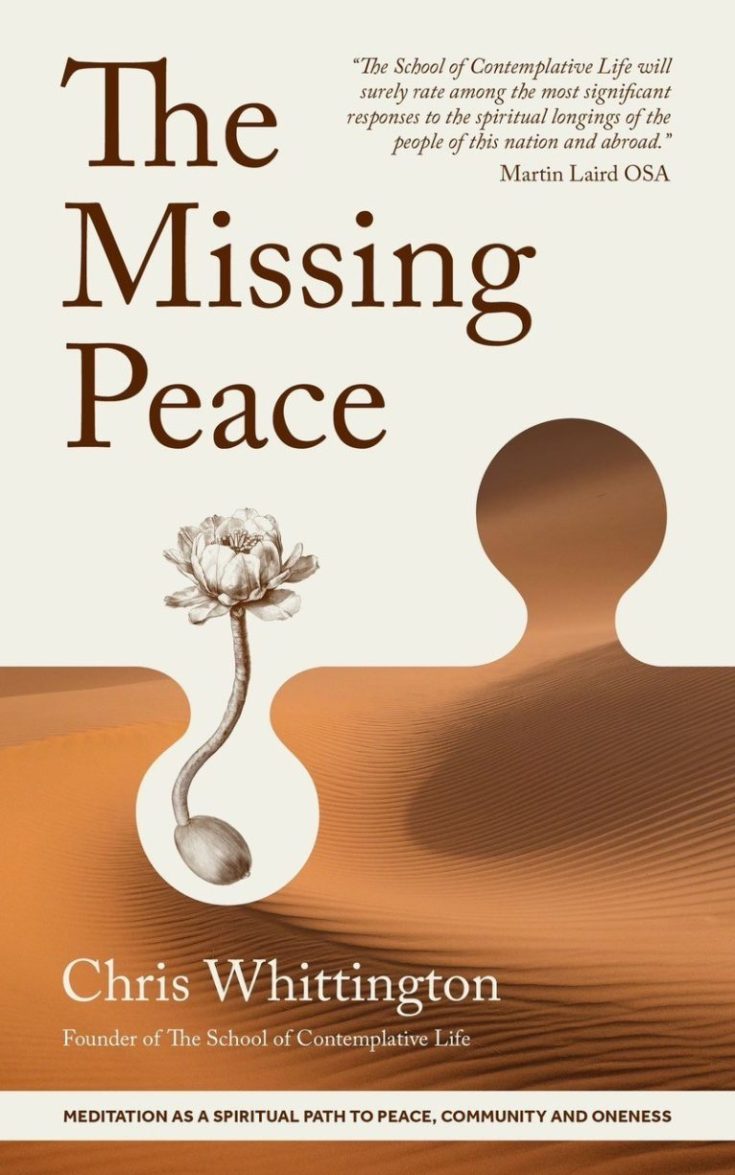
The Missing Peace: Book Review

Meditation as a spiritual path to peace, community and oneness.

Chris Whittington, the author of this book asserted  “To all intents and purposes, the teaching and practice of meditation, of silent prayer, has all but disappeared from institutional churches”(p.1). 

‘I was encountering (material) which was at the same time both utterly irresistible and profoundly disorientating… Alongside texts from the Christian contemplative tradition, I’d been studying texts from other traditions, particularly those of Zen and Tibetan Buddhism, Advaita Vedanta and Sufi Islam. I told the Abbot it seemed as if a single voice was shining through everything I was reading… he just smiled and quietly said, ‘Yes’. (p.2). 

The lack of tuition in silent prayer had concerned Hilary Wakeman when she initiated the Julian Meetings in 1973. She sought advice from church leaders, then from representatives of several contemplative prayer groups who had been running for 50 years or more. Chris had Prinknash Abbey on hand, and at the age of 18, spoke to the Abbot. 

Through his title, Chris is asserting that he has found the piece that will complete the jigsaw of our lives, and help us to discover the Peace that comes from God.

This book assembles the talks Chris has given to teach ‘meditation from the Christian wisdom tradition as a spiritual path to peace, community and oneness – as a way of clearing space to encounter the divine nature of life’. (p.128). 

Each chapter lasts between one and three pages. They are practical, showing how contemplative prayer heals our daily living. Each quotation is identified at the foot of the page. A quick flick through reveals the breadth of resources, ancient and contemporary, that he has used including Rowan Williams, Martin Laird OSA, the Cloud of Unknowing, Julian of Norwich, the Desert Fathers, and Wendy Beckett. The book is prefaced by commendations from a reliable range of writers. 

To Chris, everything follows from the simple practice taught to him by Fr. Alphege, OSB: ‘Let the prayer word and your breath flow together gently and rest there’ (p. 22). His book shows how this can benefit every aspect of our lives.  

I recommend this book as an accessible resource about the living Christian tradition of contemplative prayer and meditation.  

© Philip Tyers 

Member of The Julian Meetings 

The Missing Peace: Chris Whittington: Norwich, Canterbury Press, 2025. ISBN 978-1-78622-679-2, paperback, e-book and audiobook.  £12.99/£19.99 

We invite readers to suggest further books for review, and are looking for further member reviewers. For this or to offer a contribution for the blog, visit https://thejulianmeetings.net/contact-for-blog/  

The Julian Meetings support in-person and online groups around the country. We make teaching on Contemplative Prayer and Meditation as easily and widely accessible as we can. Articles and reviews express the views only of their respective authors. 

Posted on

I Ease You

The Gospel discovered by the Seventeenth Century poet, George Herbert, was that Jesus eases us. He had suffered ‘a great affliction’ that broke him. He found that Jesus eased him, and described the discovery in his delightful poem, ‘Jesu’. In silent prayer, we too find that Jesus eases us. We trust that his easing can be experienced, not only by us, but by all.  

Centuries before, Abraham too had experienced a crisis.  He had been promised children, but expected to die childless. God repeated his promise. “Abram believed the LORD, and he credited it to him as righteousness”  Genesis 15:6. The accompanying picture is ‘Abraham’ by Ronald Rae.  It shows an almost cartoon face, peeking shyly at the sky, as if pondering the stars that symbolised the number of descendants he would have. The fragility of the facial expression contrasts with the solidity and size of the rock into which it is carved. Beside it is a fingerpost implying ‘walk’, and a bench implying ‘rest’. There is a right time for each.

Here is George Herbert’s poem. In his day, the letter ‘J’ had only recently been differentiated from the letter ‘I’. 

Jesu is in my heart, his sacred name 

Is deeply carved there: but th’other week 

A great affliction broke the little frame, 

Ev’n all to pieces: which I went to seek: 

And first I found the corner, where was J, 

After, where ES, and next where U was graved, 

When I had got these parcels, instantly 

I sat me down to spell them, and perceived 

That to my broken heart he was I ease you

                                And to the whole is J E S U. 

George Herbert , from his collection “The Temple”, 1633. 

Behind the silence which is the key part of a Julian meeting, there may be consideration of Scripture. Here Marian Sale of the Isle of Man Julian meeting, shares an article she wrote for the group. She takes key lines from a section of the bible and reflects on them using other verses and her own experience. This invites the reader to take time to ponder and let each verse sink in, rather than just flash past.  

ECCLESIASTES CHAPTER 3.  

There is a time for everything: 

1) A time to be born and a time to die.  

In John 3:4 Jesus tells us that “no one comes to see the kingdom of God unless he be born again.” Some people call themselves “born again Christians”. This can happen at any age and it does not have to be once only, like St Paul on the road to Damascus (Acts 9). Perhaps some might not experience this until they are on their death beds. The spiritual writers tell us we are likely to experience “little deaths” throughout our lives. The seed has to die to become a plant (Jn.2:24). We have to die from childhood in order to become adult. We die a bit every day. I do not intend to enter the thorny questions of euthanasia, suicide or abortion. 

 2) A time to plant and a time to uproot.  

When talking of the Pharisees, Jesus says “Every plant that my heavenly Father has not planted will be pulled up by the roots (Matt: 15:13). Also “every tree that does not bear good fruit is cut down and thrown into the fire.” (Matt:7:19). When Dutch Elm disease arrived on the Island, the Forestry Commission had a policy of cutting down and burning all diseased trees in order to preserve the rest.  

3) A time to kill and a time to heal. 

Although it says “thou shalt not murder” in the Ten Commandments, if a terrorist runs into a school or pop concert, brandishing a gun, it might be sensible to kill him before he commit mass murder  

4) A time to tear down and a time to build. 

Jesus tore down the tables of the money lenders in the Temple. At the moment of Jesus’ death “the curtain of the Temple was torn in two” (Matt 27:51). There is a saying:- “Ask your worst enemy to prune your roses” because the harder they are cut down the stronger the gr th for the following year. The Victorian slums were torn down in order to build more healthy and affordable housing. We still have the heritage of the magnificent mediaeval Cathedrals. 

5) A time to weep and a time to laugh. A time to mourn and a time to dance.  

“Blessed are you who weep now, for you shall laugh” (Luke 6:11). As Jesus was being led away to be crucified, He told his disciples “Do not weep for me, weep for yourselves and for your children”(Lk.23:28). “Weeping may remain for a night, but rejoicing comes in the morning.” (Psalm 30:5). “Those who sow in tears will reap with songs of joy”(Ps. 126:5). Jesus wept at the death of His friend Lazarus (Jn.11:35). It is only natural to weep at the death of our relatives and loved ones, but they would not want us to wear black for years like Queen Victoria.  God turns our mourning into dancing (Ps.30:11) and the prodigal son was welcomed home with dancing (Lk. 15:25).

 6) A time to be silent and a time to speak. 

Jesus remained silent to his accusers in front of Pontius Pilate (Matt 27:14) because He knew His final destination. This was foretold by Isaiah (53:7-8) “He was oppressed and afflicted, yet he did not open his mouth, he was led like a lamb to the slaughter, and as a sheep before his shearers is silent, he did not open his mouth.”

Although Ecclesiastes was written at the time of King Solomon it is equally relevant for today. Time has nothing to do with minutes, hours and years.  Sometimes time flies, sometimes it seems to drag. 

© Marian Sale

Diane Watkins writes:  

I was a member of Beverley Julian meeting. When I was a young person, I wrote a poem which expressed my thoughts and feelings about the mystery of suffering which I include below. I have never shown it to anyone until now. 

Who cares? Who cares? Who cares? 

Yes, who will care 

When all the blood and sweat have flowed and dried 

When furrowed face is quenched with tears run cold 

And anguished heart with anguish is o’er whelmed  

For I care, God, thou knowest how I care, 

And how my caring is to nothing brought 

By others knowing much and caring naught. 

But caring’s not enough- no, we must DO , 

And doing must engage the ravening foe, 

Yet caring not how little we can do, 

And knowing just how little we can know. 

© Diane Watkins 

A sequence of verses for meditation, celebrating our union with Christ: 

I live, no longer I, but Christ who lives in me  (Gal 2:20) 

 In whom all things hold together  (Col 1:17) 

And God is all in all.  (1 Cor. 15:28) 

The Julian Meetings magazine contained a variety of materials; articles, poems, verses, and book reviews. This edition of the Blog partly revives that tradition. Please contact us with your response: https://thejulianmeetings.net/contact-for-blog/ 

 Photograph  © Philip Tyers. ‘Abraham’, by Ronald Rae b. 1946, in the grounds of the Royal Edinburgh Hospital, for mental care. 

The Julian Meetings support in-person and online groups around the country. We make teaching on Contemplative Prayer and Meditation as easily and widely accessible as we can. Articles and reviews express the views only of their respective authors. 

Please send your contributions for publication on the blog using the online form at  https://thejulianmeetings.net/contact-for-blog/ 

Posted on

The Paradox of Poverty : a Book Review

The Paradox of Poverty: Why are the poor in spirit “Blessed”:  

Quote from the publisher: ““Blessed are the poor in spirit,” Jesus said, “for theirs is the kingdom of heaven.” And we smile, nod, and think: “Lovely thought.” But if we’re paying attention, it’s a shocking, almost offensive thought. The grieving, the broken hearted, the marginalized, the stigmatized―all blessed, all happy? In The Paradox of Poverty, Susan Pitchford examines the ways in which followers of Christ have understood “poverty of spirit,” and the traditions that have formed around their attempts to follow Jesus on this radical path. 

  Over the centuries, those who have heard Jesus have learned the truth of his promise that we will find the greatest happiness, our deepest fulfilment―the kingdom of heaven, in fact, our blessedness and our belovedness―in the things that seem to impoverish our souls. The Paradox of Poverty looks at some of the wisdom traditions that have formed this understanding: the Scriptures, the desert mothers and fathers, the Franciscans, liberation theologians, prosperity gospel preachers, the 12-Step movement, and more. At both individual and collective levels, these traditions help us understand that varied kinds of poverty can become a “blessing” by bringing us to know our belovedness in God.” 

My interest mounted as I discovered the breadth and depth to which the writer had researched the “Paradox of Poverty of Spirit”. Susan Pritchard has produced a wealth of information and thought-provoking pages. This is a book which I would want to read again and keep for future reference. The writer shows how we become distracted from the meaning Christ set out for us in the Beatitudes. I commend this book for its insight and richness. 

Text © Michael Butler.  A Julian Meetings member. 

Image © Liturgical Press.

THE PARADOX OF POVERTY

Susan Pritchard

Published by Liturgical Press, 2025, paperback/e-book/ Kindle. 

ISBN  9798400802102 

Also available from Amazon

We invite readers to suggest further books for review, and are looking for further member reviewers. Contact us on https://thejulianmeetings.net/contact-for-book-reviews/
We invite readers to contribute to the Blog. Contact us on https://thejulianmeetings.net/contact-for-blog/

The Julian Meetings support in-person and online groups around the country. We make teaching on Contemplative Prayer and Meditation as easily and widely accessible as we can. Articles and reviews express the views only of their respective authors. 

Posted on

Remembering Julian of Norwich near her Anniversary

Julian of Norwich – reflections over the years. 

Our meetings are named after Julian of Norwich, but she is not our primary focus. The churches remember her on the 8th of May, the anniversary of her stream of mystical experiences in 1373. Following the Revelations, Julian pondered them for twenty years, challenging God and gaining clarity. Julian’s final text was hidden for many years, through the Reformation persecutions in England and the French revolution. Finally, a Presbyterian woman, Grace Warrack, hunted out an old manuscript in the British Library and copied it by hand. Sheila Upjohn investigated the story, wrote a book about it, and alluded to it in her April 2018 article. 

Here are some excerpts from our treasure trove of magazines

She retained a positive outlook while remaining real.

She is a “happy mystic”, and her writings are full of ‘joyous calm’ in spite of the serious challenges she experienced and discussed with God 

 © Martin Israel August 2003

The book addresses contemporary concerns.

“Her book was ‘rediscovered’ by a woman scholar at just the right time, when women were beginning to have a voice and be listened to. It was immediately popular. Here was a book by an English woman, not a foreign mystic. One of us. And her message is one of hope and optimism, not doubt and despair. Julian’s book breathes an atmosphere of common sense, a balanced mind,a loving heart, a closeness to the ordinary, that we all need to hear.”  

     “She is conversant with the idea of God as Mother, most likely through her own experience of motherhood. Jesus feeds us and teaches us as a mother feeds and teaches her child; God wraps us in goodness as a mother wraps up her infant; Jesus is courteous and friendly in demeanour, not some judge who is easily offended”  

     “She would have seen the seamy side of life, had contact with tradesmen, prostitutes, rogues. Her mildness is noticeable in that she condemns no one, and sees God as non condemnatory too. A life of prayer and listening enabled her to see that sin is not always where we think it is, and indeed ‘all shall be well’ despite our faults and failings. 

     “in her cell Julian wrestles with the big questions of life: sin, the humanity of Christ, the place of suffering, what is love and how it is shown, our eternal destiny and God’s Providence”. 

     “If we want, Julian can be our friend and teacher, opening our eyes to new ways of seeing and understanding life, God and ourselves. She can teach us about the value of silence and prayer, of keeping going when there seems to be no feedback. And Julian is characterised by her wonderful sense of gratitude. God is good. The meaning of life is love. And in accepting one another prayerfully and non-judgementally we accept and love the whole of humanity. Truly ‘All shall be well.’ 

© Elizabeth Obbard, Julian of Norwich–woman of Faith and Prayer. August 2008.

During the Coronavirus lock-down in 2020, Julian’s example became particularly relevent:

“Perhaps we can follow Julian by filling time with thoughts of the love of God rather than being led off-track by the media circus. All that Julian experienced led her to write her wonderful Revelations of Divine Love, so full of insight and reflection. The God she shows us in the suffering and compassionate Jesus is the same God for us. ‘He did not say, ‘you shall not be tempest-tossed, you shall not be work – weary, you shall not be discomforted’. But he said ‘you shall not be overcome’.”  

(August 2020 © Gill Butterworth, citing Julian’s longer book, RDF Chapter 68). 

In December 2023, Margaret Coles compared Julian of Norwich with a gifted, tenacious journalist: 

Dangerous  

It was a dangerous and perforce secret mission. While the medieval church was preaching sin, punishment, purgatory and hellfire, Julian was writing about God’s unconditional love and merciful compassion. She wrote that God was never angry, that he looked upon his darling children ‘with pity, not with blame’, had forgiven us for all wrongdoing, past, present and future, and was for ever coming towards us with his mercy and love. Julian knew full well the risk she was taking. Had she been discovered she would have had to recant or be burnt at the stake.  

Persistent  

… She had the integrity to risk her life for the story, as do many modern-day journalists. Julian is a reliable witness, a diligent fact-checker who dared to say, at a press conference with God, ‘Sorry, I didn’t quite get that point. Would you mind clarifying it?’ Add to her extraordinary courage and integrity a thoroughness and rigorous attention to detail and pains-taking efforts to describe precisely what she was shown, a she understood that every detail counted.  

Not an easy task  

Julian confronted the toughest questions, getting to grips with the puzzling and sometimes disturbing knowledge entrusted to her – deep, mysterious themes that take some unravelling. What to make of ‘sin is behoovable’ – translatable as ‘appropriate’ or ‘necessary’ or ‘sin shall be a glory’ – when you support the church’s condemnation of sin? She wrote it all down faithfully, with no fudging. The answer, she discovered, is that the pain caused by sin can become a source of self-knowledge and humility and an acceptance of God’s forgiveness and love.  

An honest witness  

Julian’s best known saying is ‘All shall be well, and all manner of things shall be well’, but she is no Pollyanna. She lived through war, plague, famine and social unrest. She viewed the world through the little window of her anchor-hold, to which people brought their cares, seeking kindness and understanding. Trust is hard to win and easy to lose. Julian’s honest voice is a witness who helps us, in a world of pain and uncertainty, find the courage to dare to trust that we have the certainty of God’s love. © Margaret Coles 

All the editions of the magazine are easily available on the web site. There is inspiration, challenge, history, and the testimony of many who have found again a living encounter with God. While we recall Julian of Norwich and read her words, in silence, alone or in a meeting, we meet her God afresh in our own age. 

Text ©Philip Tyers, blog editor. Image from Wiki Commons, photograph of statue outside Norwich Cathedral by David Holgate, 2000. 

We welcome contributions to the blog. Please go to our contact page:

https://thejulianmeetings.net/contact-for-blog/  

We invite readers to suggest further books for review, and are looking for further member reviewers. Contact us on https://thejulianmeetings.net/contact-for-book-reviews/

 The Julian Meetings support in-person and online groups around the country. We make teaching on Contemplative Prayer and Meditation as easily and widely accessible as we can. Articles and reviews express the views only of their respective authors.