Posted on

Quality Time is Key in Spiritual Practices

the source of the key quotation, 'the Cure d'Ars'.

I looks at him, and he looks at me 

It is one of the signs of increasing age that one finds modern phrases or sayings annoying – ways of talking that were not around when one was young, but are now in common usage.  Of course, it is when one starts talking to the television and telling characters in dramas and news commentators how to speak that one knows that old fogy-ism has really set in with a vengeance. 

‘We are going to spend some quality time together.’  There is one that sets my teeth on edge.  Time itself has neither good nor bad quality.  It is a neutral space, which can be filled with anything.  It is the way that it is used which gives it its quality.  If someone is burgling a house, the time is not bad, the burglar is.  If someone is helping to raise money for a charity, it is the action which is good, not the time spent in the activity.  Time is neutral – we make it good or bad. 

In the New Testament account (Matthew 14.22-33), Jesus goes up into the mountains to pray.  He has just fed the crowds, he has been in the thick of it, and he is tired out and needs some respite.  It is such a great comfort to know that Jesus needed space in his life, space to pray, space to be alone, space to re-affirm his contact with his Father.  He needed time – he needed time away for the crowds, time to be with God.  It leads us to understand our own needs to give time to prayer.  It makes us realise that getting frazzled by life, getting up-tight, getting exhausted or fed up or out of sorts is not some deep fault in ourselves.  It is simply what happens.  The fault is to neglect to find time, to give time, to that contact with God which is available to all.  The fault is to neglect to give time to prayer. 

St Paul wrote that none of us know how to pray as we ought (Romans 8:26)– also a very comforting passage in the Bible, because don’t we just know how true that is.  Some prayer time seems productive, some seems remarkably sterile.  We cannot guarantee to have quality time when we pray, because the time itself is neutral, and our experience of prayer varies.  What we can do is give time, sacrifice time, set time aside.  Going in to prayer time with the expectation that we will get a lot out of it – that we will have a quality experience – is a great mistake.  All we have to do in prayer is give the time.  Of course, there are different ways of praying; intercession, praise, thanksgiving, and the rest; but that is a different matter.  There is no type of praying that does not require the sacrifice of time, even if only for a moment in the middle of a busy day. 

The Curé d’Ars (Jean Vianney, 8 May 1786 – 4 August 1859) told a story about prayer.  He used to go into his church and find a peasant sitting there looking at the crucifix on the altar.  He used to think to himself that the man was sitting there because he did not know what to do, and did not know how to pray – what could such a poor, ignorant man know about prayer?  So he went to the man to speak to him, and to offer him help in his prayer life.  He went up to him and asked what he was doing.  “I’m sitting here,” he said, and he indicated towards the figure of Christ, “and I looks at him and he looks at me.”  That is a perfect description of contemplative prayer.  And the Curé d’Ars realised that he had nothing to teach the man.  The man, above all, was giving time to prayer, and giving his whole attention in the time that he sat there.  There was nothing for the Curé to add. 

Text © Jonathan Smith Shoreham-by-Sea Julian Meeting 

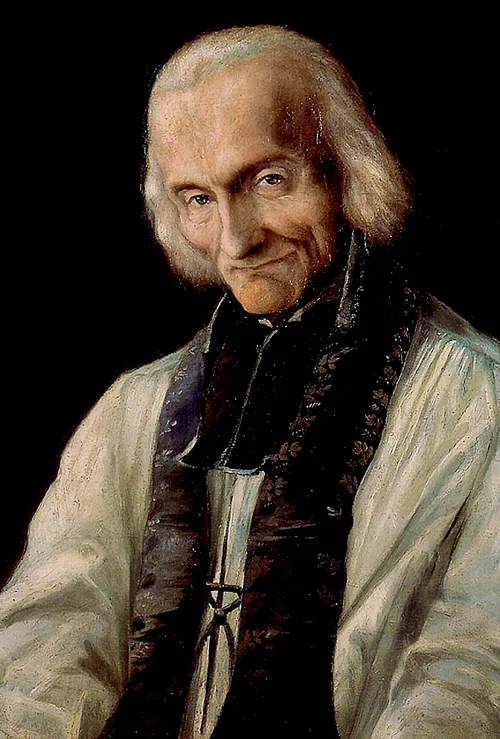
 Photo  St Jean Vianney (the Cure of Ares) by George Desvallieres  from Wikipedia, Wikimedia Commons 

We invite readers to consider writing articles for inclusion in this blog. Have you discovered something that could help others in their prayer, alone or in a group?
I have been reminded recently about Joyce Huggett. She gave many talks and wrote books such as ‘Listening to God’ and ‘Formed by the Desert’. How did she contribute to your life? Her family are inviting those who knew her to contribute to a memorial service in June.

Philip – Blog editor.

The Julian Meetings support in-person and online groups around the country. We make teaching on Contemplative Prayer and Meditation as easily and widely accessible as we can. Articles and reviews express the views only of their respective authors.  
Posted on

Musing on Lent and Easter music. 

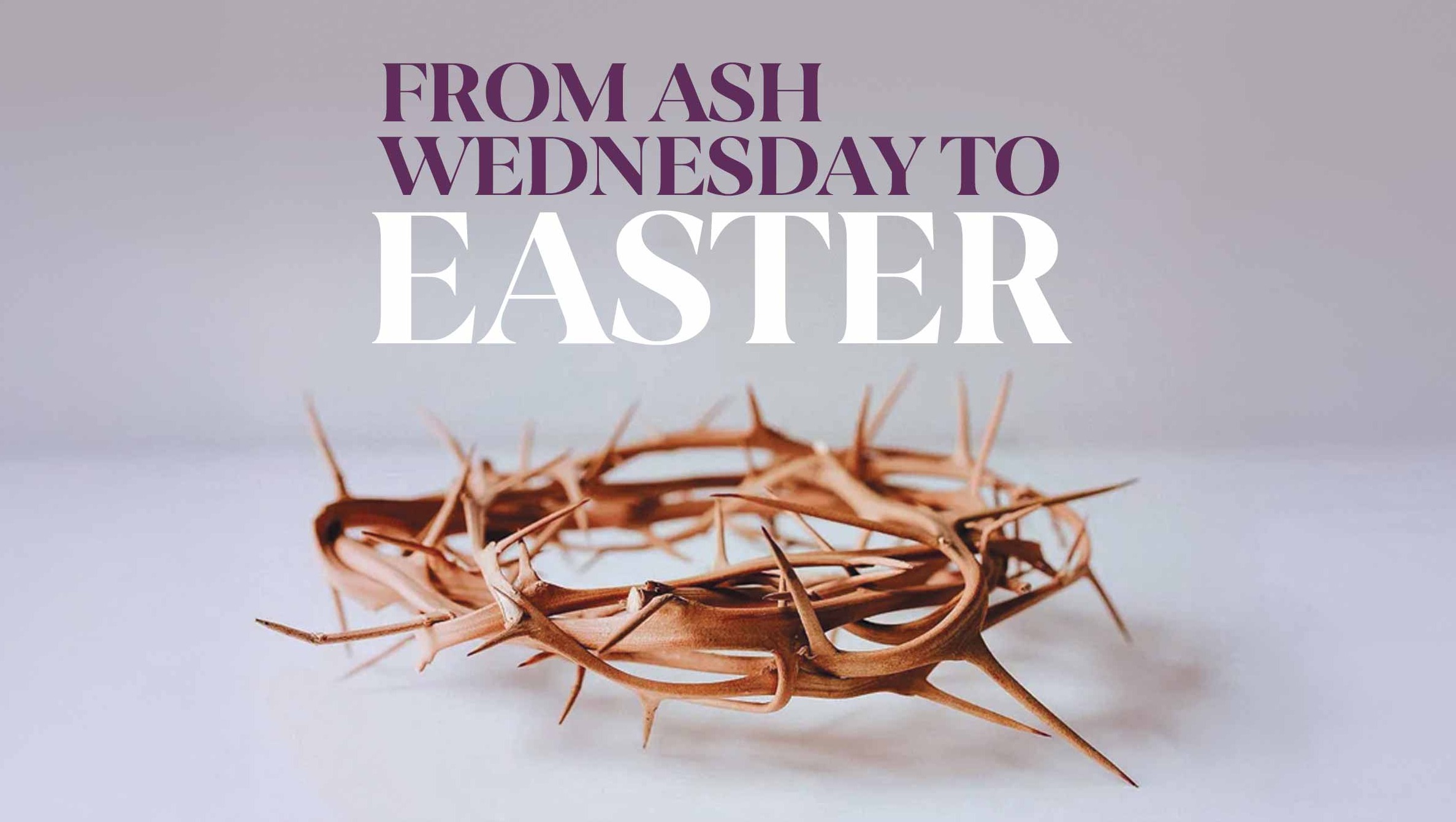
crown of thorns with title lent and easter © Blackburn Cathedral

During the installation of Abp. Sarah Mullally, lines were sung from the words of Julian of Norwich. The composer Joanna Marsh had compiled these words in her anthem All Shall Be Well in 2021. Lyrics and music © Joanna Marsh

Without love we may not live 

And in this love our life is everlasting.                                            

Love was without beginning, is and shall be without ending. 

All shall be well and all manner of thing shall be well. 

Ah! Good Lord, how might it all be well? 

For wickedness hath been suffered to rise  
contrary to the Goodness. 

 I it am, the Might and the Goodness of the Fatherhood; 

 I it am, the Wisdom of the Motherhood; 

 I it am, the Light and the Grace that is all blessed Love. 

The Blackburn Chamber Choir sang a programme of music for Lent and Easter. Various pieces gave different views of God and his work with us.  

One prayed that God “will not hide his face from us or cast us off in displeasure.” It pleaded with God to forgive all our sins. Another, by the same composer (Richard Farrant d. 1580), asked God to remember his tender mercy and loving kindness, instead of “the sins and offenses of our youth.”  

A twentieth century piece, “Solus ad Victinam”, by Kenneth Leighton (d.1988) used words by Peter Abelard who died in 1142. It reflected on Christ giving himself as a sacrifice for our sin. It asked that we will suffer Christ’s pain for the 3 days. By doing so, we aim to win his mercy. This allows us to share his glory and “the laughter of his Easter day”.

These concepts seem alien today. The idea of pleading for forgiveness seems foreign. The sense that God is displeased with us and would punish us is also unfamiliar. The yearning to suffer with Christ is even more so.  

Our Bishop said that Jesus had sought us. He saved us. Then, He sat down after completing His task (Hebrews 1:3). God is all loving kindness. We do not need to plead for what he has already given. 

Another more popular piece from the Romantic era (Mendlesson d. 1847), asked God to listen because the godless and wicked oppress the writer. It then yearned for ‘the wings of a dove: far away would I rove… In the wilderness build me a nest to remain there for ever at rest’. It felt like sheer escapism, more the self-indulgence of the composer than the spiritual resourcing of the listeners.  

Do we come to Julian meetings or meditate at home, to have time ‘at rest’? Or do we meditate because, as another piece (Ubi Caritas Ola Gujielo b. 1978) reminded us, “where love is, there is God,” who binds us together in unity? in Christ we are one with each other and with God. We come to experience that, not merely assert it .  

Richard Rohr and others expand that unity. In Christ, we are one with people of any ethnic background. We are one with those who speak any language. We are united with people of any religion. We are at one with both the poor and the rich. We are at one with God. Despite our current wars, we are at one with Ukrainian and Russian, American, Israeli, Palestinian and Iranian.  The is no duality between God and people, and no ‘us’ and ‘them’ between people groups.

The broad range of Christian prayers use many pictures of God and his action on us. In silence, we allow God simply to be himself. We open ourselves to a new, simple vision. We discover the tranquility underlying the discords and upsets of the world. We also drop the chaos of our minds. This is not to ‘remain forever at rest,’ but to face with confidence whatever comes next. 

Text © Philip Tyers.  

Image © Blackburn Cathedral, used with permission

 The Julian Meetings support in-person and online groups around the country. We make teaching on Contemplative Prayer and Meditation as easily and widely accessible as we can. Articles and reviews express the views only of their respective authors.

Posted on

Opening and Closing the Silence

Words used to open and close the silence at a Julian Prayer group.

OPENING PRAYER

We are your sheep,

and you are our Father and Mother.

You lead us towards peace and stillness

and are a balm for our souls.

No matter what trouble or strife we encounter

you are always there for us,

letting us know that

All Shall Be Well

and All Shall Be Well.

No matter what despair and anxieties we feel

you tell us that you are always with us

to the end of time,

and we will not be overcome.

You nourish us daily, in all circumstances,

and your balm overflows upon us,

as you enfold us in your everlasting Love.

OPENING PRAYER

Lord God, we come before you today,

in stillness and silence.

We thank you for breathing your Holy Spirit

into our lives and into our hearts.

Bless us Lord,

as we listen to your

still small voice of calm.

Amen.

The words in this following prayer came to me near the end of the 30-minute silence at my local Julian Prayer group:

OPENING PRAYER

Lord, calm our minds,

as you calmed the storm.

Let all our anxious thoughts and feelings

drift away

like ripples on a lake,

as you walk across the water

of our hearts

and take us by the hand

and say

Peace, Be Still.

OPENING PRAYER

You Lord are in this place,

your presence fills it.

I have come to rest in your presence,

taking time to just ‘Be’.

Fill me with your Holy Spirit,

Love and Peace.

Amen.

CLOSING PRAYER

Thank you for this time of stillness,

a time to share in the

Love, Peace, Joy and Hope

with everyone in this Julian group,

with angels and archangels

and with all the company of heaven.

Amen.

CLOSING PRAYER

We thank you, Lord

for this time of stillness.

For the time we have spent in your presence.

May we go forth each day

with faith, with hope, with love,

and may our souls be filled with your

eternal Light.

Amen.

Photo and text © Diane Meladio

Posted on

God of Wholeness

O God of wholeness, we rest in you.

You listen with us to the sound of running water.

You sit with us under the shade of the trees of our healing.

You walk once more with us in the garden in the cool of the day.

The oil of your anointing penetrates the cells of our being.

The warmth of your hands steadies us and gives us courage.

O God of wholeness, we rest in you.

From the April 2024 magazine

Posted on

To pray where prayer has been valid 

More than an order of words

If you came this way,  
Taking any route, starting from anywhere, 
At any time or at any season,  
It would always be the same: you would have to put off  
Sense and notion. You are not here to verify, 
Instruct yourself, or inform curiosity  
Or carry report. You are here to kneel  
Where prayer has been valid. And prayer is more  
Than an order of words, the conscious occupation 
Of the praying mind, or the sound of the voice praying.  
And what the dead had no speech for, when living,  
They can tell you, being dead: the communication 
Of the dead is tongued with fire beyond the language of the living.  
Here, the intersection of the timeless moment 
Is England and nowhere. Never and always. 

T.S. Eliot, Little Gidding 

Image attribution istolethetv, CC BY 2.0 https://creativecommons.org/licenses/by/2.0, via Wikimedia Commons

a person paying their respects at hong kong cemetary during qing ming festival, happy valley, hong kong.