Posted on

At the Point of Suffering

What is the point of suffering? The article is followed by a book review of a novel telling a story of people around a traumatised individual, which also uses the example of Julian of Norwich. This is followed by material to help prayer and the announcement of an on line meeting.

We probably all wish that we could ask God some questions and get the immediate clarity of response that Julian records during her Revelations of Divine Love. Many of us want to know the point of suffering. Why does it have to be this way? 

When she had her chance to ask him, it was one of the things uppermost in Julian’s mind. Why sin? Why suffering? Why pain? What’s it for? To paraphrase, she thinks, if I can’t ask this now, when can I? She does it for us as much as herself. 

God tells her that sin and pain are necessary, and that, as we have all read, “all shall be well.” He doesn’t explain explicitly why suffering is necessary, and maybe that is because it is beyond our comprehension. The sense I get is that he is asking Julian (and us) to trust, to wait, then see. But he does give her much reassurance.

All the terrible things in life seem to exist so that God can one day set them right. He won’t expand on some of his ‘privities’ or secrets, even though he seems to be bursting to tell his beloved daughter about them. Some things are being kept for us in heaven, like a wonderful surprise.

Julian speaks of God’s joy at picking us up after we fall, and of Christ’s affirmation to her that he would gladly have suffered more for our sakes if he could have. 

In Chapter 29 she asks, how can it all be made well, and God answers that if he, through Christ, can remedy the Fall of Adam, then he can certainly take care of all the lesser evils. 

Today I was praying for some people on the internet who had said they were broken. A single mother whose job had fallen through; a woman who’d lost hope and someone else who had just had two bereavements in the space of a fortnight. I was also praying for myself and my husband, who are in bits after the worst six months of our lives (and they have some competition).

“Lord,” I said, “we give all our broken pieces to you as prayer. The mess we have made of things, the mess others have made of us. Please mend us. Bless these shards of pottery and make us and our lives into new vessels. Please take these pigs’ ears and turn them into silk purses, in Jesus’ name, Amen.”

As I prayed, it struck me that that is the point of suffering, or one of them. That we fail or are failed (usually both) and we turn over all the pieces to God. This so that he can make or remake us, make our lives here and in eternity even better, according to His plans (remembering that better doesn’t always look the way we think it should), and build a loving, trusting relationship with us at the same time. 

I thought of Julian, her question and answer sessions with God. He takes our sinful, broken pieces; a fall, a broken beloved Son; those who hurt him; the worst that we can do; our violence, grief, sin, pain, innocent suffering; everything awful, and turns it into the most beautiful, loving reconciliation with him. 

It becomes a new life, a reforging, a rebirthing, the commencement of Heaven on Earth. All this done with and through his love. Surely this is the pattern of all pain? Given up to God, endured with faith, it can become, it will become, it shall become “well”. 

Text ©Keren Dibbens-Wyatt; a writer and artist with a passion for prayer, poetry, story, and colour. She is a Christian contemplative who writes to encourage and entertain readers of all ages. Keren is the author of All That Is Made (Herald Press, 2025) and Recital of Love (Paraclete Press, 2020). Her work also features regularly in literary journals and anthologies. She lives in southeast England with her husband and is housebound due to chronic illness.

BOOK REVIEW. A QUESTION OF PERSPECTIVE.

Gillian Poucher sent an advance reader copy of this deeply absorbing novel. It draws a parallel between the medieval mystic Julian of Norwich and a contemporary counsellor. Their stories are told in parallel. Poucher creates a credible, historically researched, living back story for Julian, related by those around her at that time. It starts with the loss of her husband and children during the Plague. Interspersed with this, today’s characters reflect on her writings. They key character is a counsellor, called Julia, who lives next door to the remaining arch of Walsingham Abbey. Recently arrived, she is developping new friendships by joining a book club. Together, the club discover for themselves an intuitive, even spiritual perspective on life as they read Julian of Norwich ‘Revelations of Divine Love’.

“She admitted she had skipped through some of the graphic portrayals of Christ’s suffering on the cross, but had appreciated some of what she described as the homely images, in particular the idea that the whole of creation was enclosed in a hazelnut, made, loved, and kept by God. Marie bent across the table eagerly, a carrot speared on her fork. ‘It’s amazing that we’re all enfolded in divine love like that, isn’t it? I think it means that whether we’re alive or dead, we’re all safe in God’s embrace. ”

They find love and acceptance. They support each other following a suicide. They help a traumatized person recover from an event that had increasingly damaged her life. They discover that the death and resurrection of Jesus is reflected in personal suffering and recovery. We are rapidly drawn into the story, carried along through painful swerves and finally relieved by the resolution. I expect to revisit this book periodically. It refreshes my awaress of the historical Julian, and of the interconnections between our past and our present. We are held by God and can accept those around. Fiction escorts information past the sceptical modern mindset, and a spring of water heals our heart. It is a thoroughly worthwhile exploration of Julian of Norwich and how her writings can affect us. I have not read the previous books in the trilogy. This one is an accessible introduction to Julian and to her relevance for us today. 

All thoughts and opinions expressed in this review are my own. The book is due to be published on 4th. September and can be ordered on Amazon. 

Text ©Blog Editor. Picture © Heald Poucher Publications

MATERIAL TO HELP US PRAY:

QUOTATION FROM ST CLARE OF ASSISI: 

Place your mind before the mirror of eternity 
Place your soul in the brilliance of glory
And transform your entire being  
into the image of the Godhead Itself through contemplation. 
He, Christ, is the splendor of eternal glory,  
the brightness of eternal light,  
and the mirror without cloud. 
Gaze upon Him, consider Him, contemplate Him,  
as you desire to imitate Him. 

(‘Franciscan Spirit’)

PUTTING THINGS IN PERSPECTIVE IN PRAYER

To demonstrate our position before God, I could open my arms as wide as possible to illustrate God, then narrow them a little to portray the Kingdom of God. A little narrower: the universe. Much narrower: the world. A 10 cm gap: the Church, or the Country. 1 cm.: us. Our worries are small by comparison with the whole. But that gap is about the size of Julian of Norwich’s hazel nut. To her, this represented everything that exists. It is simultaneously fragile and precious to God, who sustains it, holds it in existence, and cherishes it. If he does that with everything, so too does he hold us and our interests, be they personal, ecclesial, or national. 

Psalm 66: 12: “You tested us, we went through fire and water; but you brought us out into a place of liberty.”   
Overall, Psalm 66 praises God for saving people. In this context, testing is part of saving! God does a thorough job in our lives. There are no half measures for God.  

In our silence we patiently allow God to work. All things are in God’s hands. God knows our needs before we ask (Matt 6:8) and we participate as he heals/saves us and the world. We allow the Spirit to pray ‘in groans too deep for words’ Romans 8:26. 

Text © Blog Editor    

ONLINE MEETING – SAVE THE DATE – 10 OCTOBER

At present, there are about 120 active Julian Meetings across the country. The National Council are offering an opportunity for members of the groups to encourage one another. We propose to set up an open online meeting on Sat 10 Oct from 2-4pm.
How is your group running?
What encourages you?
We look forward to your replies, by responding to this email, and attending the on-line meeting – Zoom details will be given nearer the time.

The Julian Meetings support in-person and online groups around the country. We make teaching on Contemplative Prayer and Meditation as easily and widely accessible as we can. Articles and reviews express the views only of their respective authors.  https://thejulianmeetings.net/contact-for-blog/  
Posted on

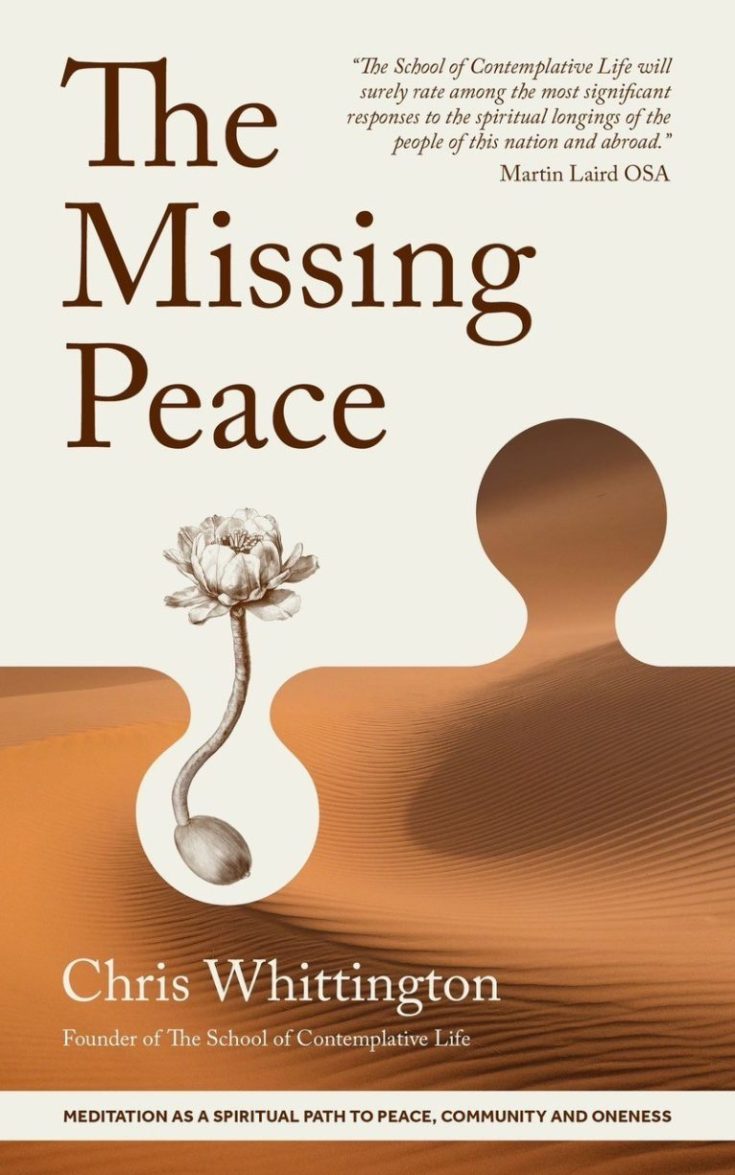
The Missing Peace: Book Review

Meditation as a spiritual path to peace, community and oneness.

Chris Whittington, the author of this book asserted  “To all intents and purposes, the teaching and practice of meditation, of silent prayer, has all but disappeared from institutional churches”(p.1). 

‘I was encountering (material) which was at the same time both utterly irresistible and profoundly disorientating… Alongside texts from the Christian contemplative tradition, I’d been studying texts from other traditions, particularly those of Zen and Tibetan Buddhism, Advaita Vedanta and Sufi Islam. I told the Abbot it seemed as if a single voice was shining through everything I was reading… he just smiled and quietly said, ‘Yes’. (p.2). 

The lack of tuition in silent prayer had concerned Hilary Wakeman when she initiated the Julian Meetings in 1973. She sought advice from church leaders, then from representatives of several contemplative prayer groups who had been running for 50 years or more. Chris had Prinknash Abbey on hand, and at the age of 18, spoke to the Abbot. 

Through his title, Chris is asserting that he has found the piece that will complete the jigsaw of our lives, and help us to discover the Peace that comes from God.

This book assembles the talks Chris has given to teach ‘meditation from the Christian wisdom tradition as a spiritual path to peace, community and oneness – as a way of clearing space to encounter the divine nature of life’. (p.128). 

Each chapter lasts between one and three pages. They are practical, showing how contemplative prayer heals our daily living. Each quotation is identified at the foot of the page. A quick flick through reveals the breadth of resources, ancient and contemporary, that he has used including Rowan Williams, Martin Laird OSA, the Cloud of Unknowing, Julian of Norwich, the Desert Fathers, and Wendy Beckett. The book is prefaced by commendations from a reliable range of writers. 

To Chris, everything follows from the simple practice taught to him by Fr. Alphege, OSB: ‘Let the prayer word and your breath flow together gently and rest there’ (p. 22). His book shows how this can benefit every aspect of our lives.  

I recommend this book as an accessible resource about the living Christian tradition of contemplative prayer and meditation.  

© Philip Tyers 

Member of The Julian Meetings 

The Missing Peace: Chris Whittington: Norwich, Canterbury Press, 2025. ISBN 978-1-78622-679-2, paperback, e-book and audiobook.  £12.99/£19.99 

We invite readers to suggest further books for review, and are looking for further member reviewers. For this or to offer a contribution for the blog, visit https://thejulianmeetings.net/contact-for-blog/  
The Julian Meetings support in-person and online groups around the country. We make teaching on Contemplative Prayer and Meditation as easily and widely accessible as we can. Articles and reviews express the views only of their respective authors. 

Posted on

Remembering Julian of Norwich near her Anniversary

Julian of Norwich – reflections over the years. 

Our meetings are named after Julian of Norwich, but she is not our primary focus. The churches remember her on the 8th of May, the anniversary of her stream of mystical experiences in 1373. Following the Revelations, Julian pondered them for twenty years, challenging God and gaining clarity. Julian’s final text was hidden for many years, through the Reformation persecutions in England and the French revolution. Finally, a Presbyterian woman, Grace Warrack, hunted out an old manuscript in the British Library and copied it by hand. Sheila Upjohn investigated the story, wrote a book about it, and alluded to it in her April 2018 article. 

Here are some excerpts from our treasure trove of magazines: 

She retained a positive outlook while remaining real.

She is a “happy mystic”, and her writings are full of ‘joyous calm’ in spite of the serious challenges she experienced and discussed with God 

 © Martin Israel August 2003. 

The book addresses contemporary concerns.

“Her book was ‘rediscovered’ by a woman scholar at just the right time, when women were beginning to have a voice and be listened to. It was immediately popular. Here was a book by an English woman, not a foreign mystic. One of us. And her message is one of hope and optimism, not doubt and despair. Julian’s book breathes an atmosphere of common sense, a balanced mind,a loving heart, a closeness to the ordinary, that we all need to hear.”  

     “She is conversant with the idea of God as Mother, most likely through her own experience of motherhood. Jesus feeds us and teaches us as a mother feeds and teaches her child; God wraps us in goodness as a mother wraps up her infant; Jesus is courteous and friendly in demeanour, not some judge who is easily offended”  

     “She would have seen the seamy side of life, had contact with tradesmen, prostitutes, rogues. Her mildness is noticeable in that she condemns no one, and sees God as non condemnatory too. A life of prayer and listening enabled her to see that sin is not always where we think it is, and indeed ‘all shall be well’ despite our faults and failings. 

     “in her cell Julian wrestles with the big questions of life: sin, the humanity of Christ, the place of suffering, what is love and how it is shown, our eternal destiny and God’s Providence”. 

     “If we want, Julian can be our friend and teacher, opening our eyes to new ways of seeing and understanding life, God and ourselves. She can teach us about the value of silence and prayer, of keeping going when there seems to be no feedback. And Julian is characterised by her wonderful sense of gratitude. God is good. The meaning of life is love. And in accepting one another prayerfully and non-judgementally we accept and love the whole of humanity. Truly ‘All shall be well.’ “

© Elizabeth Obbard, Julian of Norwich–woman of Faith and Prayer. August 2008.

During the Coronavirus lock-down in 2020, Julian’s example became particularly relevent:

“Perhaps we can follow Julian by filling time with thoughts of the love of God rather than being led off-track by the media circus. All that Julian experienced led her to write her wonderful Revelations of Divine Love, so full of insight and reflection. The God she shows us in the suffering and compassionate Jesus is the same God for us. ‘He did not say, ‘you shall not be tempest-tossed, you shall not be work – weary, you shall not be discomforted’. But he said ‘you shall not be overcome’.”  

(August 2020 © Gill Butterworth, citing Julian’s longer book, RDF Chapter 68). 

In December 2023, Margaret Coles compared Julian of Norwich with a gifted, tenacious journalist: 

Dangerous  

It was a dangerous and perforce secret mission. While the medieval church was preaching sin, punishment, purgatory and hellfire, Julian was writing about God’s unconditional love and merciful compassion. She wrote that God was never angry, that he looked upon his darling children ‘with pity, not with blame’, had forgiven us for all wrongdoing, past, present and future, and was for ever coming towards us with his mercy and love. Julian knew full well the risk she was taking. Had she been discovered she would have had to recant or be burnt at the stake.  

Persistent  

… She had the integrity to risk her life for the story, as do many modern-day journalists. Julian is a reliable witness, a diligent fact-checker who dared to say, at a press conference with God, ‘Sorry, I didn’t quite get that point. Would you mind clarifying it?’ Add to her extraordinary courage and integrity a thoroughness and rigorous attention to detail and pains-taking efforts to describe precisely what she was shown, a she understood that every detail counted.  

Not an easy task  

Julian confronted the toughest questions, getting to grips with the puzzling and sometimes disturbing knowledge entrusted to her – deep, mysterious themes that take some unravelling. What to make of ‘sin is behoovable’ – translatable as ‘appropriate’ or ‘necessary’ or ‘sin shall be a glory’ – when you support the church’s condemnation of sin? She wrote it all down faithfully, with no fudging. The answer, she discovered, is that the pain caused by sin can become a source of self-knowledge and humility and an acceptance of God’s forgiveness and love.  

An honest witness  

Julian’s best known saying is ‘All shall be well, and all manner of things shall be well’, but she is no Pollyanna. She lived through war, plague, famine and social unrest. She viewed the world through the little window of her anchor-hold, to which people brought their cares, seeking kindness and understanding. Trust is hard to win and easy to lose. Julian’s honest voice is a witness who helps us, in a world of pain and uncertainty, find the courage to dare to trust that we have the certainty of God’s love. © Margaret Coles 

All the editions of the magazine are easily available on the web site. There is inspiration, challenge, history, and the testimony of many who have found again a living encounter with God. While we recall Julian of Norwich and read her words, in silence, alone or in a meeting, we meet her God afresh in our own age. 

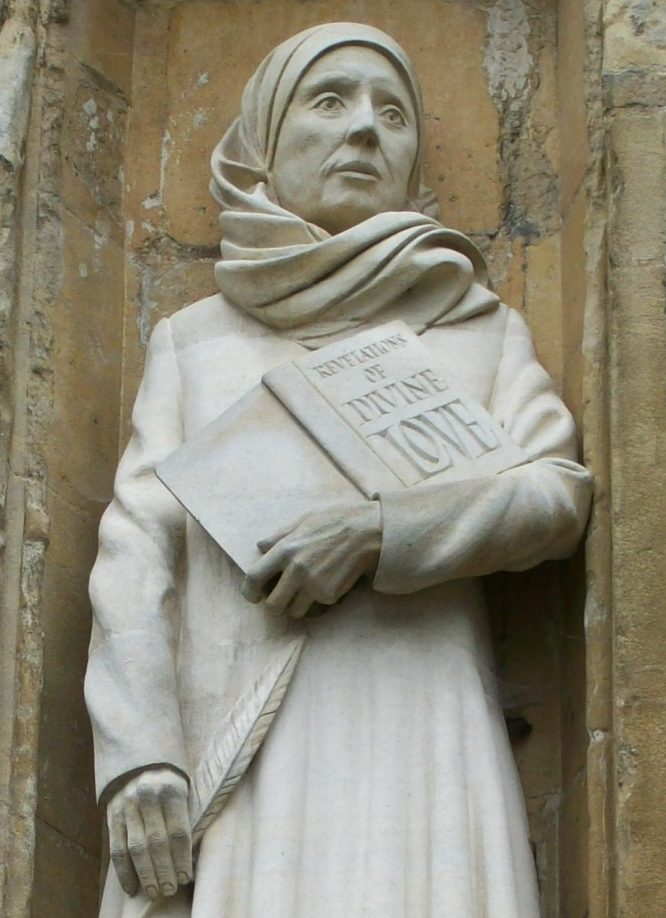
Text ©Philip Tyers, blog editor. Image from Wiki Commons, photograph of statue outside Norwich Cathedral by David Holgate, 2000. 

We welcome contributions to the blog. Please go to our contact page:

https://thejulianmeetings.net/contact-for-blog/  

We invite readers to suggest further books for review, and are looking for further member reviewers. Contact us on https://thejulianmeetings.net/contact-for-book-reviews/

 The Julian Meetings support in-person and online groups around the country. We make teaching on Contemplative Prayer and Meditation as easily and widely accessible as we can. Articles and reviews express the views only of their respective authors.  

Posted on

All That Is Made-The Comfort of Contemplative Prayer by Keren Dibbens-Wyatt

Keren Dibbens-Wyatt reflects on Julian of Norwich’s writings in ‘Revelations of Divine Love’.  Keren writes:

“I’ve been fascinated by the book and the wisdom it contains ever since I was given a copy by my husband Rowan on our first wedding anniversary. I had just begun my journey into contemplative prayer and was struck by how God had tucked me away from the world through chronic illness, so that I felt a kinship with Julian in her seclusion. 

 As I have contemplated Mother Julian’s vision of the small thing “the size of a hazelnut,” over the years, I’ve felt that it gives us a true sense of eternal perspective. One much needed in the world! God inspired me to write about it and my own smallness. The seed of a book began to germinate. 

I wrote about how it feels to be small, fragile and dependent, just like that small, round thing. I considered how that can lead us to trusting and knowing God as the one who made, keeps and loves us. I found that just this one revelation alone is enough to contemplate on for the longest time and that it can teach us a great deal about true humility and genuine faith. 

 This book is now out in the world and I’d love to share with you all the insights God has gifted about how this one “shewing” can bring us the ultimate comfort of knowing God and his love through contemplative prayer. 

Keren” 

Text and photo ©Keren Dibbens-Wyatt  

Publisher Herald Press USA

 Amazon link for UK