Posted on

Quality Time is Key in Spiritual Practices

the source of the key quotation, 'the Cure d'Ars'.

I looks at him, and he looks at me 

It is one of the signs of increasing age that one finds modern phrases or sayings annoying – ways of talking that were not around when one was young, but are now in common usage.  Of course, it is when one starts talking to the television and telling characters in dramas and news commentators how to speak that one knows that old fogy-ism has really set in with a vengeance. 

‘We are going to spend some quality time together.’  There is one that sets my teeth on edge.  Time itself has neither good nor bad quality.  It is a neutral space, which can be filled with anything.  It is the way that it is used which gives it its quality.  If someone is burgling a house, the time is not bad, the burglar is.  If someone is helping to raise money for a charity, it is the action which is good, not the time spent in the activity.  Time is neutral – we make it good or bad. 

In the New Testament account (Matthew 14.22-33), Jesus goes up into the mountains to pray.  He has just fed the crowds, he has been in the thick of it, and he is tired out and needs some respite.  It is such a great comfort to know that Jesus needed space in his life, space to pray, space to be alone, space to re-affirm his contact with his Father.  He needed time – he needed time away for the crowds, time to be with God.  It leads us to understand our own needs to give time to prayer.  It makes us realise that getting frazzled by life, getting up-tight, getting exhausted or fed up or out of sorts is not some deep fault in ourselves.  It is simply what happens.  The fault is to neglect to find time, to give time, to that contact with God which is available to all.  The fault is to neglect to give time to prayer. 

St Paul wrote that none of us know how to pray as we ought (Romans 8:26)– also a very comforting passage in the Bible, because don’t we just know how true that is.  Some prayer time seems productive, some seems remarkably sterile.  We cannot guarantee to have quality time when we pray, because the time itself is neutral, and our experience of prayer varies.  What we can do is give time, sacrifice time, set time aside.  Going in to prayer time with the expectation that we will get a lot out of it – that we will have a quality experience – is a great mistake.  All we have to do in prayer is give the time.  Of course, there are different ways of praying; intercession, praise, thanksgiving, and the rest; but that is a different matter.  There is no type of praying that does not require the sacrifice of time, even if only for a moment in the middle of a busy day. 

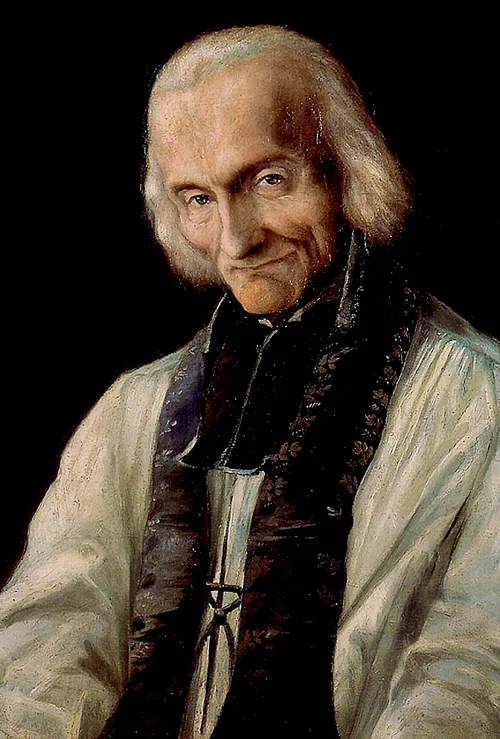
The Curé d’Ars (Jean Vianney, 8 May 1786 – 4 August 1859) told a story about prayer.  He used to go into his church and find a peasant sitting there looking at the crucifix on the altar.  He used to think to himself that the man was sitting there because he did not know what to do, and did not know how to pray – what could such a poor, ignorant man know about prayer?  So he went to the man to speak to him, and to offer him help in his prayer life.  He went up to him and asked what he was doing.  “I’m sitting here,” he said, and he indicated towards the figure of Christ, “and I looks at him and he looks at me.”  That is a perfect description of contemplative prayer.  And the Curé d’Ars realised that he had nothing to teach the man.  The man, above all, was giving time to prayer, and giving his whole attention in the time that he sat there.  There was nothing for the Curé to add. 

Text © Jonathan Smith Shoreham-by-Sea Julian Meeting 

 Photo  St Jean Vianney (the Cure of Ares) by George Desvallieres  from Wikipedia, Wikimedia Commons 

We invite readers to consider writing articles for inclusion in this blog. Have you discovered something that could help others in their prayer, alone or in a group?
I have been reminded recently about Joyce Huggett. She gave many talks and wrote books such as ‘Listening to God’ and ‘Formed by the Desert’. How did she contribute to your life? Her family are inviting those who knew her to contribute to a memorial service in June.

Philip – Blog editor.

The Julian Meetings support in-person and online groups around the country. We make teaching on Contemplative Prayer and Meditation as easily and widely accessible as we can. Articles and reviews express the views only of their respective authors.  
Posted on

Overcoming Distraction in Contemplative Prayer

The practice of contemplative prayer in the face of distraction


So here in the midst of the world
With all its present pain and madness
You are not the sponge soaking up carbon emissions
Rather you are the channel of God‟s peace
Let that peace arise within you
Deeper than the sea of your own need or desire
Let that peace be a purity
A swept room
A tidied house
A simple order
An inner spaciousness
A forgiven, merciful place
Released from clawing need
Let go of the castles you have dug for yourself in the churned sand
Be washed flat by the beauty of the incoming waves
Let God‟s goodness in
Like a sparkling incoming tide
Smoothing the sand
And leaving a sheen of silver
Now you have cleared your near distance of the debris of your mind

See the expanse
Where heaven and earth meet
And all, all from east to west
From north to south
Is filled with light


Richard Carter
From ‘The City is my Monastery’
published by Canterbury Press ISBN: 9781786222138
© Used with permission. August 2024 Magazine.

Posted on

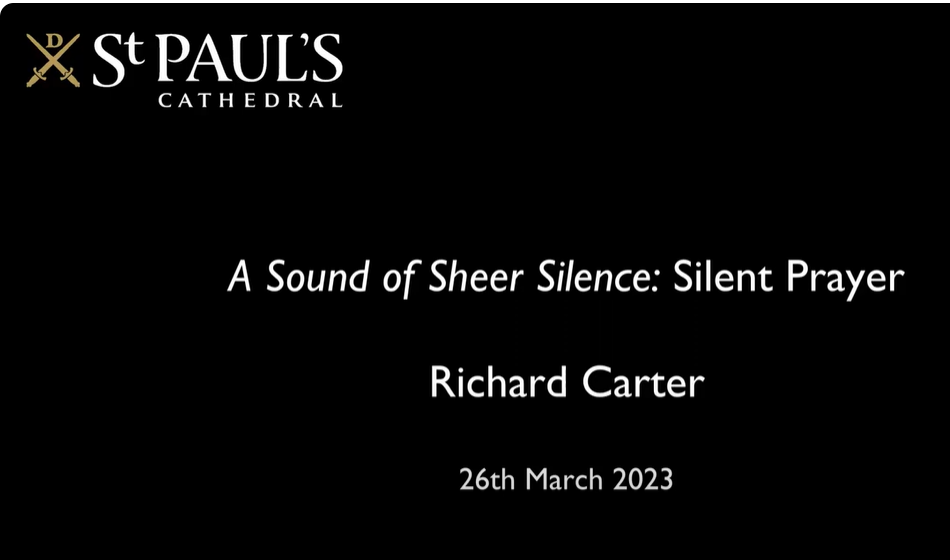
A Sound of Sheer Silence

From the earliest years of Christianity to the present day, the practice of silent prayer is where many have sought, and found, the presence of God. But it is not always as simple as it sounds. In this video The Revd Richard Carter offers a ‘beginner’s guide’ to silence, reflecting on its nature, practice, joys and pitfalls, and how we can find it in our noisy city and busy lives. Richard was for many years a member of the Melanesian Brotherhood in the Solomon Islands where silence was a daily part of the spiritual life of the community. In London he is the founder and leader of the Nazareth Community where contemplative prayer is the basis for their contemporary rule of life. He is Associate Vicar for Mission at St Martin-in-the-Fields in central London, and the author of ‘The City is my Monastery: A contemporary rule of life’.