

What is the point of suffering? The article is followed by a book review of a novel telling a story of people around a traumatised individual, which also uses the example of Julian of Norwich. This is followed by material to help prayer and the announcement of an on line meeting.
We probably all wish that we could ask God some questions and get the immediate clarity of response that Julian records during her Revelations of Divine Love. Many of us want to know the point of suffering. Why does it have to be this way?
When she had her chance to ask him, it was one of the things uppermost in Julian’s mind. Why sin? Why suffering? Why pain? What’s it for? To paraphrase, she thinks, if I can’t ask this now, when can I? She does it for us as much as herself.
God tells her that sin and pain are necessary, and that, as we have all read, “all shall be well.” He doesn’t explain explicitly why suffering is necessary, and maybe that is because it is beyond our comprehension. The sense I get is that he is asking Julian (and us) to trust, to wait, then see. But he does give her much reassurance.
All the terrible things in life seem to exist so that God can one day set them right. He won’t expand on some of his ‘privities’ or secrets, even though he seems to be bursting to tell his beloved daughter about them. Some things are being kept for us in heaven, like a wonderful surprise.
Julian speaks of God’s joy at picking us up after we fall, and of Christ’s affirmation to her that he would gladly have suffered more for our sakes if he could have.
In Chapter 29 she asks, how can it all be made well, and God answers that if he, through Christ, can remedy the Fall of Adam, then he can certainly take care of all the lesser evils.
Today I was praying for some people on the internet who had said they were broken. A single mother whose job had fallen through; a woman who’d lost hope and someone else who had just had two bereavements in the space of a fortnight. I was also praying for myself and my husband, who are in bits after the worst six months of our lives (and they have some competition).
“Lord,” I said, “we give all our broken pieces to you as prayer. The mess we have made of things, the mess others have made of us. Please mend us. Bless these shards of pottery and make us and our lives into new vessels. Please take these pigs’ ears and turn them into silk purses, in Jesus’ name, Amen.”
As I prayed, it struck me that that is the point of suffering, or one of them. That we fail or are failed (usually both) and we turn over all the pieces to God. This so that he can make or remake us, make our lives here and in eternity even better, according to His plans (remembering that better doesn’t always look the way we think it should), and build a loving, trusting relationship with us at the same time.
I thought of Julian, her question and answer sessions with God. He takes our sinful, broken pieces; a fall, a broken beloved Son; those who hurt him; the worst that we can do; our violence, grief, sin, pain, innocent suffering; everything awful, and turns it into the most beautiful, loving reconciliation with him.
It becomes a new life, a reforging, a rebirthing, the commencement of Heaven on Earth. All this done with and through his love. Surely this is the pattern of all pain? Given up to God, endured with faith, it can become, it will become, it shall become “well”.
Text ©Keren Dibbens-Wyatt; a writer and artist with a passion for prayer, poetry, story, and colour. She is a Christian contemplative who writes to encourage and entertain readers of all ages. Keren is the author of All That Is Made (Herald Press, 2025) and Recital of Love (Paraclete Press, 2020). Her work also features regularly in literary journals and anthologies. She lives in southeast England with her husband and is housebound due to chronic illness.
BOOK REVIEW. A QUESTION OF PERSPECTIVE.
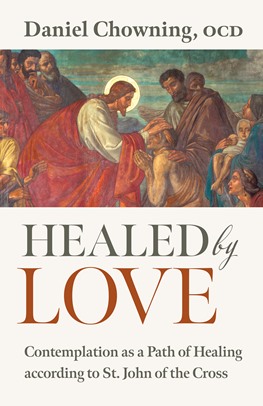
Gillian Poucher sent an advance reader copy of this deeply absorbing novel. It draws a parallel between the medieval mystic Julian of Norwich and a contemporary counsellor. Their stories are told in parallel. Poucher creates a credible, historically researched, living back story for Julian, related by those around her at that time. It starts with the loss of her husband and children during the Plague. Interspersed with this, today’s characters reflect on her writings. They key character is a counsellor, called Julia, who lives next door to the remaining arch of Walsingham Abbey. Recently arrived, she is developping new friendships by joining a book club. Together, the club discover for themselves an intuitive, even spiritual perspective on life as they read Julian of Norwich ‘Revelations of Divine Love’.
“She admitted she had skipped through some of the graphic portrayals of Christ’s suffering on the cross, but had appreciated some of what she described as the homely images, in particular the idea that the whole of creation was enclosed in a hazelnut, made, loved, and kept by God. Marie bent across the table eagerly, a carrot speared on her fork. ‘It’s amazing that we’re all enfolded in divine love like that, isn’t it? I think it means that whether we’re alive or dead, we’re all safe in God’s embrace. ”
They find love and acceptance. They support each other following a suicide. They help a traumatized person recover from an event that had increasingly damaged her life. They discover that the death and resurrection of Jesus is reflected in personal suffering and recovery. We are rapidly drawn into the story, carried along through painful swerves and finally relieved by the resolution. I expect to revisit this book periodically. It refreshes my awaress of the historical Julian, and of the interconnections between our past and our present. We are held by God and can accept those around. Fiction escorts information past the sceptical modern mindset, and a spring of water heals our heart. It is a thoroughly worthwhile exploration of Julian of Norwich and how her writings can affect us. I have not read the previous books in the trilogy. This one is an accessible introduction to Julian and to her relevance for us today.
All thoughts and opinions expressed in this review are my own. The book is due to be published on 4th. September and can be ordered on Amazon.
Text ©Blog Editor. Picture © Heald Poucher Publications
MATERIAL TO HELP US PRAY:
QUOTATION FROM ST CLARE OF ASSISI:
Place your mind before the mirror of eternity
Place your soul in the brilliance of glory
And transform your entire being
into the image of the Godhead Itself through contemplation.
He, Christ, is the splendor of eternal glory,
the brightness of eternal light,
and the mirror without cloud.
Gaze upon Him, consider Him, contemplate Him,
as you desire to imitate Him.
(‘Franciscan Spirit’)
PUTTING THINGS IN PERSPECTIVE IN PRAYER
To demonstrate our position before God, I could open my arms as wide as possible to illustrate God, then narrow them a little to portray the Kingdom of God. A little narrower: the universe. Much narrower: the world. A 10 cm gap: the Church, or the Country. 1 cm.: us. Our worries are small by comparison with the whole. But that gap is about the size of Julian of Norwich’s hazel nut. To her, this represented everything that exists. It is simultaneously fragile and precious to God, who sustains it, holds it in existence, and cherishes it. If he does that with everything, so too does he hold us and our interests, be they personal, ecclesial, or national.
Psalm 66: 12: “You tested us, we went through fire and water; but you brought us out into a place of liberty.”
Overall, Psalm 66 praises God for saving people. In this context, testing is part of saving! God does a thorough job in our lives. There are no half measures for God.
In our silence we patiently allow God to work. All things are in God’s hands. God knows our needs before we ask (Matt 6:8) and we participate as he heals/saves us and the world. We allow the Spirit to pray ‘in groans too deep for words’ Romans 8:26.
Text © Blog Editor
ONLINE MEETING – SAVE THE DATE – 10 OCTOBER
At present, there are about 120 active Julian Meetings across the country. The National Council are offering an opportunity for members of the groups to encourage one another. We propose to set up an open online meeting on Sat 10 Oct from 2-4pm.
How is your group running?
What encourages you?
We look forward to your replies, by responding to this email, and attending the on-line meeting – Zoom details will be given nearer the time.
The Julian Meetings support in-person and online groups around the country. We make teaching on Contemplative Prayer and Meditation as easily and widely accessible as we can. Articles and reviews express the views only of their respective authors. https://thejulianmeetings.net/contact-for-blog/


You must be logged in to post a comment.