
The Jesus Prayer
We start with excerpts from various articles, before moving to a paper by Jonathan Smith.
While The Jesus Prayer has various forms, many other similar phrases or even words have a similar method and effect. Some communities use the prayer in public, either saying it together or having one member of the group say it aloud while the rest pray in the heart.
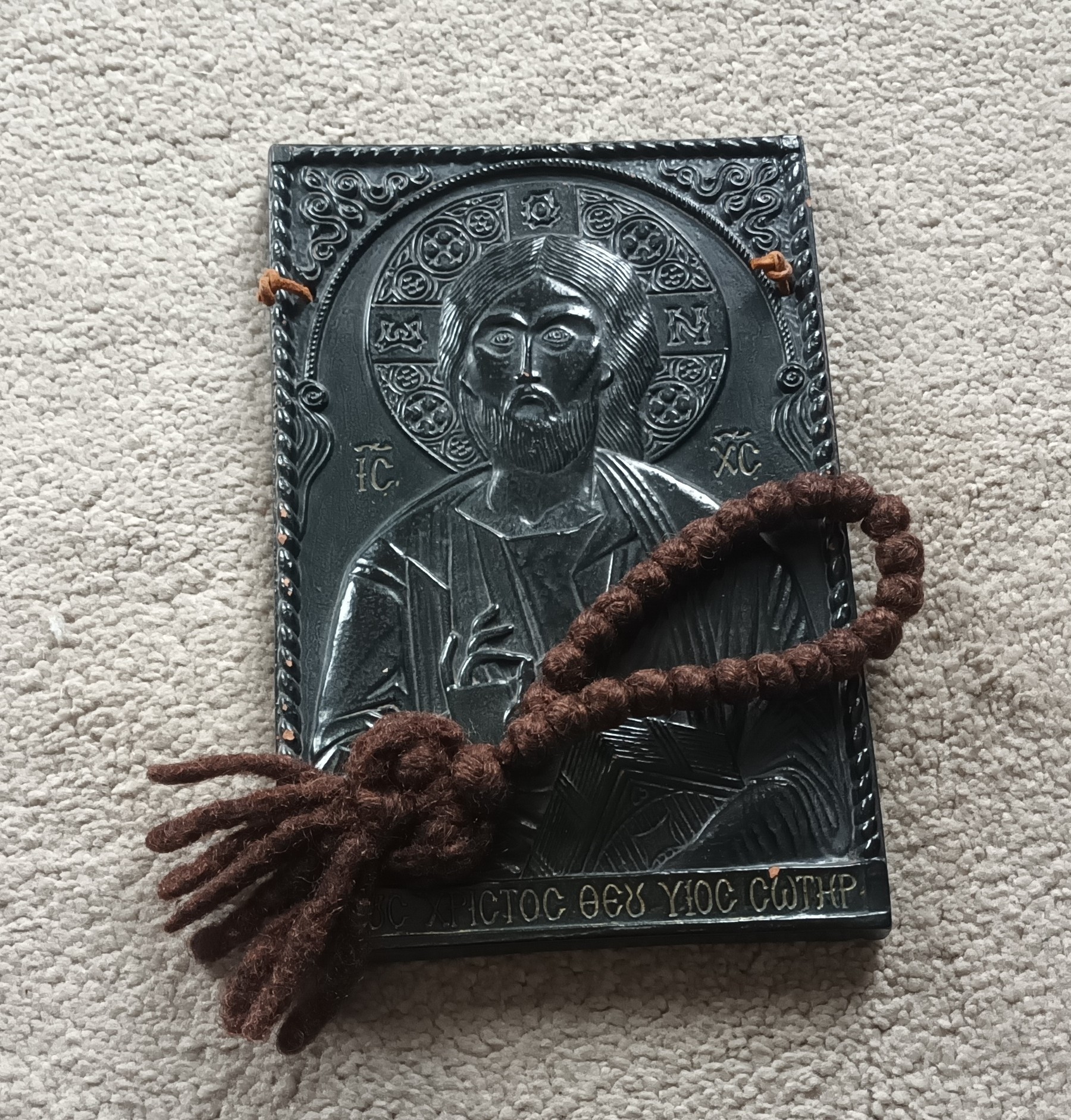
The prayer is often said looking at an icon and using a prayer rope – see the accompanying photo. ©Philip Tyers
Anne Stamper – The Jesus Prayer – December 2006
I have been aware of the Jesus Prayer for many years, but my interest in its use was further stimulated by reading ‘The way of a Pilgrim’ and then a short time afterwards being asked to review for the JM Magazine Jonathan Smith’s book ‘The power of the Jesus Prayer – a reflection and guide.’ I started to use the prayer (and attended) a guided retreat on the Jesus Prayer being led by Bishop Simon Barrington-Ward.
(where I noted) ‘the phrases that spoke to me. ‘
Prayer is stepping into a river that is already flowing
Praying with the mind in the heart
Practicing the presence of God in Christ we can only pray in the power of the spirit.
Prayer is not fulfilling a duty but coming up for air.
The Jesus Prayer keeps one suspended between time and timelessness.
Know you are welcome in the presence of God.’
Text ©Anne Stamper
Barrington-Ward is also quoted by Ann Moran in her review of his book on the Jesus Prayer: “It is a practice of the presence of God, and it is being in that presence, relaxed and alert”. © Ann Moran
“Find a quiet place to sit alone and in silence; bow your head and shut your eyes. Breathe softly, look with your mind into your heart; recollect your mind—that is, all its thoughts—and bring them down from your mind into your heart. As you breathe, repeat: “Lord Jesus Christ, have mercy on me,” either quietly with your lips, or only in your mind. Make an effort to banish all thoughts; be calm and patient, and repeat this exercise frequently”
― Gleb Pokrovsky, The Way of a Pilgrim: The Jesus Prayer Journey—Annotated & Explained
‘To use the Jesus prayer is to dive into a stream which is already flowing in the direction in which you wanted to go, and then being simply borne by the current’ Selected by Anne Stamper in her review of Barrington – Ward’s ‘The Great Exchange’.
Francis Ballinger: book review; Letters of Direction / Streams of Grace JM December 2006
“Letters of Direction”:
“Therefore leave your soul too, to pray as suits it best, in its own way, without strain. Allow it most of the time to remain quite still. Pray along the lines which show you the needs of the world and which interest you. Nothing could be better. In a word, follow your bent; your need of quiet or of doing nothing according to what seems most natural to you at the time.” © Francis Ballinger.
The Jesus Prayer – Jonathan Smith.
The Jesus Prayer is very old, and its use dates back to solitary monks in the Egyptian desert in the fifth century AD. Because of this, it has gained the reputation of being the preserve of people like monks or other ‘especially spiritual’ people, and not something for ordinary Christians. But the Jesus Prayer and its practice is very simple, and the only thing that is really needed is the desire to draw closer to God in prayer.
The Words of the Prayer
There are a number of versions of the prayer, and none is more right or wrong than any other.
The oldest form is: Lord Jesus Christ, Son of God, have mercy on me.
Also common, is a longer form: Lord Jesus Christ, Son of God, have mercy on me, a sinner.
Shorter forms are also used: Lord Jesus Christ, have mercy on me,
or just: Jesus, have mercy.
Using the Prayer
Sit comfortably and let your breathing be natural. A good way of preparing to use the prayer is to focus on your inward and outward breath for a few minutes, which may get a little deeper.
If you are praying alone, say the prayer quietly out loud for a few minutes. If you are in a group were this would disturb others, you can simply say the words with your lips.
Let the prayer enter into your mind, and when you are ready, focus on that mental repetition. Don’t worry if the prayer goes away; just repeat it again out loud or with your lips. It will eventually lodge in your consciousness.
As you focus on the prayer, and with a little bit of practice, you may find that the prayer moves downwards to your chest or to your heart. Another name for the Jesus prayer is ‘The Prayer of the Heart’.
This may last a little time, or for the rest of the prayer period, and sometimes you may feel that the prayer fills your whole body. But whatever happens, it is only focusing on the prayer that is important
Worries and Distractions
There is no right way and no wrong way of saying the prayer. Everyone has to return to vocal or mental prayer when distractions occur, and trying to work out whether one is doing the prayer ‘right’ is one common distraction.
Other thoughts and concerns will lead the mind away from the prayer, and everyone experiences very well-trodden paths of thought which head off in their own directions.
The task when this happens is simply to recognize that one has been led away from the prayer, and without any self-criticism at all, to gently redirect the mind to its words.
Various experiences can occur during the time of prayer, from feelings of love, to feelings of regret about past actions. Some of these feelings may be quite intense. But such things are not the purpose of the prayer, and one should not hope for, or pursue, any particular experience. The only task is to say the prayer with as much attention as one can muster.
The real results of saying the Jesus Prayer faithfully are not found in any experience during prayer time, but at other times. We take whatever God’s grace grants us during our prayer into the rest of our lives, to share with those we meet, with a new awareness of Jesus’ presence with us and in the world.
An Everyday Prayer
The Jesus prayer can be used as a regular part of prayer life. It can be used for five or ten minutes at the start or end of prayers of intercession.
It can be used as an extended form of contemplative prayer for 15 or 30 minutes, once or twice a day. If our work and family life allow, a regular time can be set aside for it in the evening or morning. It can be used during the washing up, while we clean the house, while we walk down the street, while we sit on a train or a bus. All that is required is an honest turning towards God, and the prayer can be used at any time, in any situation.
Prayer time can be long or short, from a half hour set aside to focus on it, to less than a minute, as we take a moment between activities.
It is the prayer, praying in us, that does the work; that, and the grace of God, who always comes to meet us as we turn back to him. He will guide us in its use and show us how it fits into our lives.
Lord Jesus Christ, Son of God, have mercy on me.
Text copyright © Jonathan Smith, member of the Shoreham on Sea meeting. Written for his church, after the publication of his book, The Power of The Jesus Prayer in 2005.
Further Reading:
The Jesus Prayer, Simon Barrington-Ward, Oxford, Bible Reading Fellowship 1996
Praying The Jesus Prayer Together by SSF Ramon, Brother (Author), Simon Barrington-Ward (Author), & 1 more reviewed
The way of a Pilgrim – Various editions and translations of this book are available.
You must be logged in to post a comment.