Subscribe to continue reading
Subscribe to get access to the rest of this post and other subscriber-only content.
The Jesus Prayer
We start with excerpts from various articles, before moving to a paper by Jonathan Smith.
While The Jesus Prayer has various forms, many other similar phrases or even words have a similar method and effect. Some communities use the prayer in public, either saying it together or having one member of the group say it aloud while the rest pray in the heart.
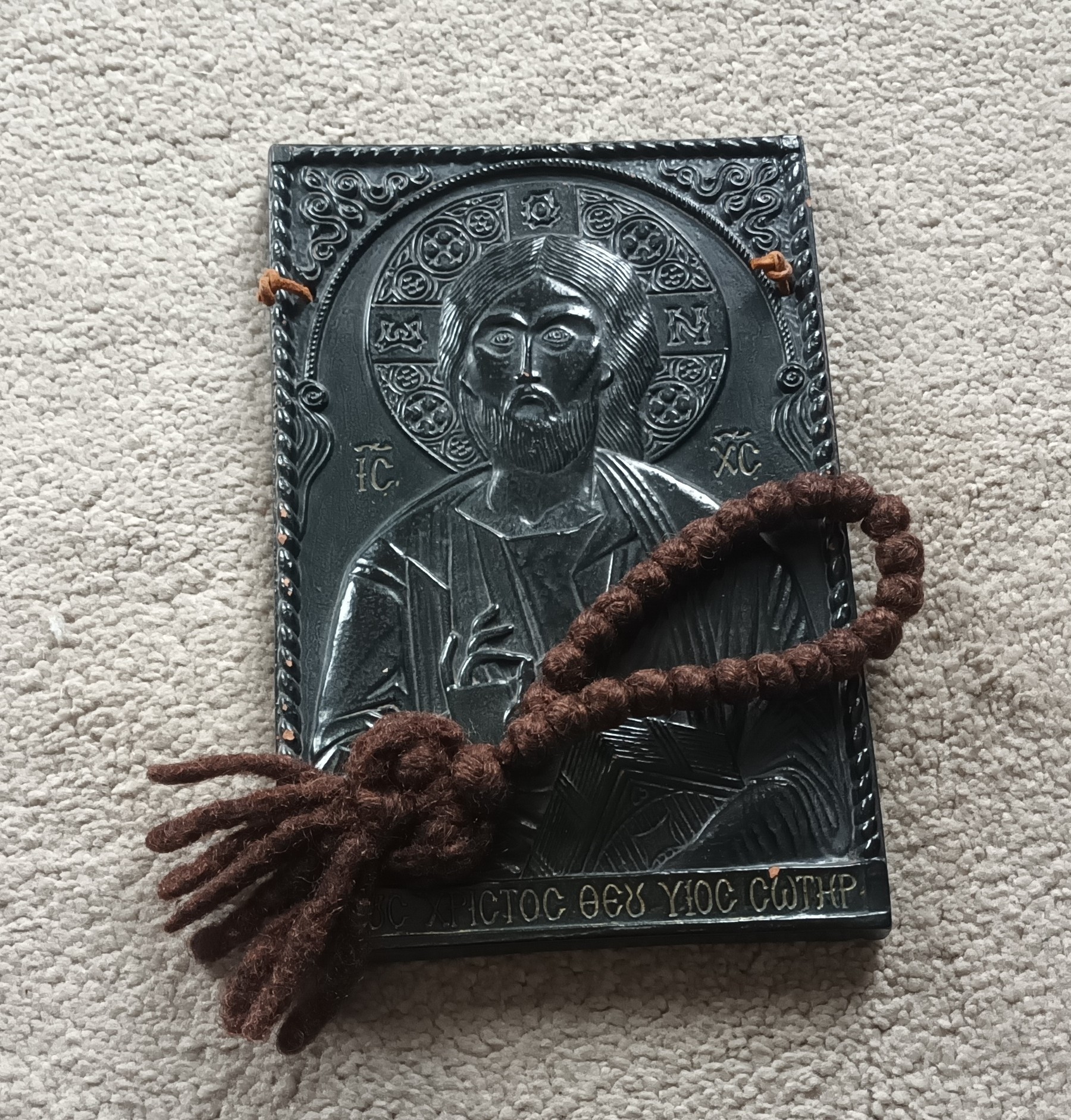
The prayer is often said looking at an icon and using a prayer rope – see the accompanying photo. ©Philip Tyers
Anne Stamper – The Jesus Prayer – December 2006
I have been aware of the Jesus Prayer for many years, but my interest in its use was further stimulated by reading ‘The way of a Pilgrim’ and then a short time afterwards being asked to review for the JM Magazine Jonathan Smith’s book ‘The power of the Jesus Prayer – a reflection and guide.’ I started to use the prayer (and attended) a guided retreat on the Jesus Prayer being led by Bishop Simon Barrington-Ward.
(where I noted) ‘the phrases that spoke to me. ‘
Prayer is stepping into a river that is already flowing
Praying with the mind in the heart
Practicing the presence of God in Christ we can only pray in the power of the spirit.
Prayer is not fulfilling a duty but coming up for air.
The Jesus Prayer keeps one suspended between time and timelessness.
Know you are welcome in the presence of God.’
Text ©Anne Stamper
Barrington-Ward is also quoted by Ann Moran in her review of his book on the Jesus Prayer: “It is a practice of the presence of God, and it is being in that presence, relaxed and alert”. © Ann Moran
“Find a quiet place to sit alone and in silence; bow your head and shut your eyes. Breathe softly, look with your mind into your heart; recollect your mind—that is, all its thoughts—and bring them down from your mind into your heart. As you breathe, repeat: “Lord Jesus Christ, have mercy on me,” either quietly with your lips, or only in your mind. Make an effort to banish all thoughts; be calm and patient, and repeat this exercise frequently”
― Gleb Pokrovsky, The Way of a Pilgrim: The Jesus Prayer Journey—Annotated & Explained
‘To use the Jesus prayer is to dive into a stream which is already flowing in the direction in which you wanted to go, and then being simply borne by the current’ Selected by Anne Stamper in her review of Barrington – Ward’s ‘The Great Exchange’.
Francis Ballinger: book review; Letters of Direction / Streams of Grace JM December 2006
“Letters of Direction”:
“Therefore leave your soul too, to pray as suits it best, in its own way, without strain. Allow it most of the time to remain quite still. Pray along the lines which show you the needs of the world and which interest you. Nothing could be better. In a word, follow your bent; your need of quiet or of doing nothing according to what seems most natural to you at the time.” © Francis Ballinger.
The Jesus Prayer – Jonathan Smith.
The Jesus Prayer is very old, and its use dates back to solitary monks in the Egyptian desert in the fifth century AD. Because of this, it has gained the reputation of being the preserve of people like monks or other ‘especially spiritual’ people, and not something for ordinary Christians. But the Jesus Prayer and its practice is very simple, and the only thing that is really needed is the desire to draw closer to God in prayer.
The Words of the Prayer
There are a number of versions of the prayer, and none is more right or wrong than any other.
The oldest form is: Lord Jesus Christ, Son of God, have mercy on me.
Also common, is a longer form: Lord Jesus Christ, Son of God, have mercy on me, a sinner.
Shorter forms are also used: Lord Jesus Christ, have mercy on me,
or just: Jesus, have mercy.
Using the Prayer
Sit comfortably and let your breathing be natural. A good way of preparing to use the prayer is to focus on your inward and outward breath for a few minutes, which may get a little deeper.
If you are praying alone, say the prayer quietly out loud for a few minutes. If you are in a group were this would disturb others, you can simply say the words with your lips.
Let the prayer enter into your mind, and when you are ready, focus on that mental repetition. Don’t worry if the prayer goes away; just repeat it again out loud or with your lips. It will eventually lodge in your consciousness.
As you focus on the prayer, and with a little bit of practice, you may find that the prayer moves downwards to your chest or to your heart. Another name for the Jesus prayer is ‘The Prayer of the Heart’.
This may last a little time, or for the rest of the prayer period, and sometimes you may feel that the prayer fills your whole body. But whatever happens, it is only focusing on the prayer that is important
Worries and Distractions
There is no right way and no wrong way of saying the prayer. Everyone has to return to vocal or mental prayer when distractions occur, and trying to work out whether one is doing the prayer ‘right’ is one common distraction.
Other thoughts and concerns will lead the mind away from the prayer, and everyone experiences very well-trodden paths of thought which head off in their own directions.
The task when this happens is simply to recognize that one has been led away from the prayer, and without any self-criticism at all, to gently redirect the mind to its words.
Various experiences can occur during the time of prayer, from feelings of love, to feelings of regret about past actions. Some of these feelings may be quite intense. But such things are not the purpose of the prayer, and one should not hope for, or pursue, any particular experience. The only task is to say the prayer with as much attention as one can muster.
The real results of saying the Jesus Prayer faithfully are not found in any experience during prayer time, but at other times. We take whatever God’s grace grants us during our prayer into the rest of our lives, to share with those we meet, with a new awareness of Jesus’ presence with us and in the world.
An Everyday Prayer
The Jesus prayer can be used as a regular part of prayer life. It can be used for five or ten minutes at the start or end of prayers of intercession.
It can be used as an extended form of contemplative prayer for 15 or 30 minutes, once or twice a day. If our work and family life allow, a regular time can be set aside for it in the evening or morning. It can be used during the washing up, while we clean the house, while we walk down the street, while we sit on a train or a bus. All that is required is an honest turning towards God, and the prayer can be used at any time, in any situation.
Prayer time can be long or short, from a half hour set aside to focus on it, to less than a minute, as we take a moment between activities.
It is the prayer, praying in us, that does the work; that, and the grace of God, who always comes to meet us as we turn back to him. He will guide us in its use and show us how it fits into our lives.
Lord Jesus Christ, Son of God, have mercy on me.
Text copyright © Jonathan Smith, member of the Shoreham on Sea meeting. Written for his church, after the publication of his book, The Power of The Jesus Prayer in 2005.
Further Reading:
The Jesus Prayer, Simon Barrington-Ward, Oxford, Bible Reading Fellowship 1996
Praying The Jesus Prayer Together by SSF Ramon, Brother (Author), Simon Barrington-Ward (Author), & 1 more reviewed
The way of a Pilgrim – Various editions and translations of this book are available.
This book review gives a handy list of inspirations for expanding our prayer lives. After the review there are a series of other items to assist our prayer, 3 book notifications and an invitation to our general meeting on 10 October.
Significantly starting with “Listening to God in silence and stillness”, Growing in Prayer presents 15 short chapters, each exploring different ways of praying – of growing in prayer. This is a very practical and accessible book. Each short chapter includes a Bible quotation and a two- or three-page introduction to the way of praying with simple steps to follow and closing with a few recommended books and websites. Each chapter ends with blank pages for the reader to make notes of their experience for further reflection. The clear print and layout make it easy to use as course material.
This book is based on a a prayer course originally developed in the Diocese of Rochester and could easily be used as a course either individually or in a group. If we are in a time of change, this could be a valuable part of that journey.
Chapters included are:
Listening to God in silence and stillness
Lectio Divina
Praying with your imagination
Intercessory prayer
Centering prayer
Praying in nature
Praying with images and symbols.
Praying with your creativity
Praying with poetry
Praying with the five senses
Praying with icons
Praying with a labyrinth
Praying with music
Journaling
The Examen
Your notes
© Gail Ballinger
Growing in Prayer: exploring 15 different ways to pray for individuals and groups ; edited by Susanne Carlsson
BRF 2026 £9.99 e-book only, ISBN 978 80039 506 0
SUCH MATERIAL IN THE CONTEXT OF A JULIAN MEETING.
“Group meetings are willing to experiment with form, while keeping the meeting simple and single pointed.”
The first group I attended, for example, had an introduction including a scripture reading. After a quarter of an hour, the scripture was repeated, and again at the end.
In 1989 Robert Llwewlyn wrote The Fountain Within: Praying St John’s Gospel. Each chapter contained passages to be used in meditation. Short sections were to be read with a set response, then a few minutes of silence before reading the next. This would imply that a meeting would be broken into many sections.
My present group has an introduction followed by half an hour of silence. Then the leader for that session closes appropriately.
I am looking forward to hearing how your different groups are run, both normally and for a periodic different input. Could a group, for example, decide to experiment with a series of sessions using each of the chapters of this book, or would that be done seperately, before or after the regular meditation?
Our magazines contain many articles on prayer – see the LIbrary section of our website, particularly the Various Ways of Praying selection.
©Blog Editor, JM
Sister Wendy Becket: ‘I hope that once people read my book (on prayer) they will think, “ What a fool I’ve been. I didnt realise that I didn’t need a book on prayer.” You just need to have the courage and the faith to sit quietly and let God love you. Even if it is only for ten minutes a day.’ Peter Stanford: What we talk about when we talk about faith. Hodder, 2019.
Welcome to The Julian Meetings Open Council Meeting, October 2026.
At present, there are about 120 active Julian Meetings across the country. The National Council are offering an opportunity for members of the groups to encourage one another. We propose to set up an open online meeting on Sat 10 Oct from 2-4pm.
How is your group running?
What encourages you?
We look forward to your replies, by responding to this email, and attending the on-line meeting – Zoom details will be given nearer the time.
IMAGINING THE WORLD– BOOK NOTIFICATION
John Mann presents a short passage of biblical scripture alongside a contemplative reflection for each of the 34 days from 1 September to 4 October. These are inspired by the unique landscapes of the British and Irish countrysides. They also draw on the mystical and philosophical writings of Teilhard de Chardin, Simone Weil and Søren Kierkegaard. Each day’s reflection ends with a suggested prayer. John Mann writes: ‘The threats that exist of climate change, pollution, and environmental degradation through human activity, the uncontrolled greed for the Earth’s finite resources, the extraction and burning of fossil fuels, are well known…. While wars rage and humans continue to inflict horrendous suffering on other humans … the long term concern of the effects of human activity is laid bare”. He continues through the Island Spirituality Network to lead quiet days and retreats. Imagining the World – Daily Reflections for the Creation Season. Darton, Longman and Todd / Herne Books Paperback (178x110mm), 144pp, 9781917362221, £9.99, July 2026 Compiled using material provided by DLT. ©Blog Editor, JM
LIVING FOR JESUS AND JUSTICE BY SIMON JONES – BOOK NOTIFICATION.
This comprises of
1. a new presentation of the Beatitudes in today’s language;
2. a Daily Liturgy (with prayers for morning, midday and evening on a seven-day cycle);
3. Waymakers and Waymarkers, a 366-day calendar of people and events that bent the arc of British history towards justice; and
4. bespoke Occasional Prayers for justice-related events.
‘It’s so easy for the passion for justice to be channeled into activism whilst neglecting to nurture an inner life that fuels it. Mission spirituality is surely the rhythm of both. This new articulation of longings for a better world in prayers and liturgies along with the offering of memories of those who have gone before to light the road is a wonderful gift in that regard. It’s a great resource for individuals and communities seeking to join in God’s healing of all things, to breathe in before acting out.’ Jonny Baker, CMS
Living for Jesus and Justice; Daily Prayers for Radical Christians; Simon Jones and Red Letter Christians UK 978 1 917362 13 9 Compiled using material provided by DLT. ©Blog Editor, JM
Treasures in Straw: The griefs and gifts of the Christmas story– BOOK NOTIFICATION
Christmas can be a magical time, but also a uniquely painful one. Inspired by
the difference she sees between Christmas as we mark it today and the original
story of the nativity, Tanya Marlow writes for everyone who struggles with
Christmas. ‘Nowadays Christmas feels like either grief or gift,’ she says, ‘but the nativity is both grief
and gift together… My invitation to you this season is to look afresh at the original Christmas story,
with the freedom to be honest in lament, exuberant in praise, or both together. Whether you love
Christmas or dread it, this is a chance to treasure those forgotten spiritual blessings that do not perish
or fade, and rediscover genuine delight in Jesus, our greatest gift.’
The Julian Meetings support in-person and online groups around the country. We make teaching on Contemplative Prayer and Meditation as easily and widely accessible as we can. Articles and reviews express the views only of their respective authors.
Please send your comments or contributions for publication on the blog to https://thejulianmeetings.net/contact-for-blog/
The Gospel discovered by the Seventeenth Century poet, George Herbert, was that Jesus eases us. He had suffered ‘a great affliction’ that broke him. He found that Jesus eased him, and described the discovery in his delightful poem, ‘Jesu’. In silent prayer, we too find that Jesus eases us. We trust that his easing can be experienced, not only by us, but by all.
Centuries before, Abraham too had experienced a crisis. He had been promised children, but expected to die childless. God repeated his promise. “Abram believed the LORD, and he credited it to him as righteousness” Genesis 15:6. The accompanying picture is ‘Abraham’ by Ronald Rae. It shows an almost cartoon face, peeking shyly at the sky, as if pondering the stars that symbolised the number of descendants he would have. The fragility of the facial expression contrasts with the solidity and size of the rock into which it is carved. Beside it is a fingerpost implying ‘walk’, and a bench implying ‘rest’. There is a right time for each.
Here is George Herbert’s poem. In his day, the letter ‘J’ had only recently been differentiated from the letter ‘I’.
Jesu is in my heart, his sacred name
Is deeply carved there: but th’other week
A great affliction broke the little frame,
Ev’n all to pieces: which I went to seek:
And first I found the corner, where was J,
After, where ES, and next where U was graved,
When I had got these parcels, instantly
I sat me down to spell them, and perceived
That to my broken heart he was I ease you,
And to the whole is J E S U.
George Herbert , from his collection “The Temple”, 1633.
Behind the silence which is the key part of a Julian meeting, there may be consideration of Scripture. Here Marian Sale of the Isle of Man Julian meeting, shares an article she wrote for the group. She takes key lines from a section of the bible and reflects on them using other verses and her own experience. This invites the reader to take time to ponder and let each verse sink in, rather than just flash past.
ECCLESIASTES CHAPTER 3.
There is a time for everything:
1) A time to be born and a time to die.
In John 3:4 Jesus tells us that “no one comes to see the kingdom of God unless he be born again.” Some people call themselves “born again Christians”. This can happen at any age and it does not have to be once only, like St Paul on the road to Damascus (Acts 9). Perhaps some might not experience this until they are on their death beds. The spiritual writers tell us we are likely to experience “little deaths” throughout our lives. The seed has to die to become a plant (Jn.2:24). We have to die from childhood in order to become adult. We die a bit every day. I do not intend to enter the thorny questions of euthanasia, suicide or abortion.
2) A time to plant and a time to uproot.
When talking of the Pharisees, Jesus says “Every plant that my heavenly Father has not planted will be pulled up by the roots (Matt: 15:13). Also “every tree that does not bear good fruit is cut down and thrown into the fire.” (Matt:7:19). When Dutch Elm disease arrived on the Island, the Forestry Commission had a policy of cutting down and burning all diseased trees in order to preserve the rest.
3) A time to kill and a time to heal.
Although it says “thou shalt not murder” in the Ten Commandments, if a terrorist runs into a school or pop concert, brandishing a gun, it might be sensible to kill him before he commit mass murder
4) A time to tear down and a time to build.
Jesus tore down the tables of the money lenders in the Temple. At the moment of Jesus’ death “the curtain of the Temple was torn in two” (Matt 27:51). There is a saying:- “Ask your worst enemy to prune your roses” because the harder they are cut down the stronger the gr th for the following year. The Victorian slums were torn down in order to build more healthy and affordable housing. We still have the heritage of the magnificent mediaeval Cathedrals.
5) A time to weep and a time to laugh. A time to mourn and a time to dance.
“Blessed are you who weep now, for you shall laugh” (Luke 6:11). As Jesus was being led away to be crucified, He told his disciples “Do not weep for me, weep for yourselves and for your children”(Lk.23:28). “Weeping may remain for a night, but rejoicing comes in the morning.” (Psalm 30:5). “Those who sow in tears will reap with songs of joy”(Ps. 126:5). Jesus wept at the death of His friend Lazarus (Jn.11:35). It is only natural to weep at the death of our relatives and loved ones, but they would not want us to wear black for years like Queen Victoria. God turns our mourning into dancing (Ps.30:11) and the prodigal son was welcomed home with dancing (Lk. 15:25).
6) A time to be silent and a time to speak.
Jesus remained silent to his accusers in front of Pontius Pilate (Matt 27:14) because He knew His final destination. This was foretold by Isaiah (53:7-8) “He was oppressed and afflicted, yet he did not open his mouth, he was led like a lamb to the slaughter, and as a sheep before his shearers is silent, he did not open his mouth.”
Although Ecclesiastes was written at the time of King Solomon it is equally relevant for today. Time has nothing to do with minutes, hours and years. Sometimes time flies, sometimes it seems to drag.
© Marian Sale
Diane Watkins writes:
I was a member of Beverley Julian meeting. When I was a young person, I wrote a poem which expressed my thoughts and feelings about the mystery of suffering which I include below. I have never shown it to anyone until now.
Who cares? Who cares? Who cares?
Yes, who will care
When all the blood and sweat have flowed and dried
When furrowed face is quenched with tears run cold
And anguished heart with anguish is o’er whelmed
For I care, God, thou knowest how I care,
And how my caring is to nothing brought
By others knowing much and caring naught.
But caring’s not enough- no, we must DO ,
And doing must engage the ravening foe,
Yet caring not how little we can do,
And knowing just how little we can know.
© Diane Watkins
A sequence of verses for meditation, celebrating our union with Christ:
I live, no longer I, but Christ who lives in me (Gal 2:20)
In whom all things hold together (Col 1:17)
And God is all in all. (1 Cor. 15:28)
The Julian Meetings magazine contained a variety of materials; articles, poems, verses, and book reviews. This edition of the Blog partly revives that tradition. Please contact us with your response: https://thejulianmeetings.net/contact-for-blog/
Photograph © Philip Tyers. ‘Abraham’, by Ronald Rae b. 1946, in the grounds of the Royal Edinburgh Hospital, for mental care.
The Julian Meetings support in-person and online groups around the country. We make teaching on Contemplative Prayer and Meditation as easily and widely accessible as we can. Articles and reviews express the views only of their respective authors.
Please send your contributions for publication on the blog using the online form at https://thejulianmeetings.net/contact-for-blog/
Julian of Norwich – reflections over the years.
Our meetings are named after Julian of Norwich, but she is not our primary focus. The churches remember her on the 8th of May, the anniversary of her stream of mystical experiences in 1373. Following the Revelations, Julian pondered them for twenty years, challenging God and gaining clarity. Julian’s final text was hidden for many years, through the Reformation persecutions in England and the French revolution. Finally, a Presbyterian woman, Grace Warrack, hunted out an old manuscript in the British Library and copied it by hand. Sheila Upjohn investigated the story, wrote a book about it, and alluded to it in her April 2018 article.
Here are some excerpts from our treasure trove of magazines:
She retained a positive outlook while remaining real.
She is a “happy mystic”, and her writings are full of ‘joyous calm’ in spite of the serious challenges she experienced and discussed with God
© Martin Israel August 2003.
The book addresses contemporary concerns.
“Her book was ‘rediscovered’ by a woman scholar at just the right time, when women were beginning to have a voice and be listened to. It was immediately popular. Here was a book by an English woman, not a foreign mystic. One of us. And her message is one of hope and optimism, not doubt and despair. Julian’s book breathes an atmosphere of common sense, a balanced mind,a loving heart, a closeness to the ordinary, that we all need to hear.”
“She is conversant with the idea of God as Mother, most likely through her own experience of motherhood. Jesus feeds us and teaches us as a mother feeds and teaches her child; God wraps us in goodness as a mother wraps up her infant; Jesus is courteous and friendly in demeanour, not some judge who is easily offended”
“She would have seen the seamy side of life, had contact with tradesmen, prostitutes, rogues. Her mildness is noticeable in that she condemns no one, and sees God as non condemnatory too. A life of prayer and listening enabled her to see that sin is not always where we think it is, and indeed ‘all shall be well’ despite our faults and failings.
“in her cell Julian wrestles with the big questions of life: sin, the humanity of Christ, the place of suffering, what is love and how it is shown, our eternal destiny and God’s Providence”.
“If we want, Julian can be our friend and teacher, opening our eyes to new ways of seeing and understanding life, God and ourselves. She can teach us about the value of silence and prayer, of keeping going when there seems to be no feedback. And Julian is characterised by her wonderful sense of gratitude. God is good. The meaning of life is love. And in accepting one another prayerfully and non-judgementally we accept and love the whole of humanity. Truly ‘All shall be well.’ “
© Elizabeth Obbard, Julian of Norwich–woman of Faith and Prayer. August 2008.
During the Coronavirus lock-down in 2020, Julian’s example became particularly relevent:
“Perhaps we can follow Julian by filling time with thoughts of the love of God rather than being led off-track by the media circus. All that Julian experienced led her to write her wonderful Revelations of Divine Love, so full of insight and reflection. The God she shows us in the suffering and compassionate Jesus is the same God for us. ‘He did not say, ‘you shall not be tempest-tossed, you shall not be work – weary, you shall not be discomforted’. But he said ‘you shall not be overcome’.”
(August 2020 © Gill Butterworth, citing Julian’s longer book, RDF Chapter 68).
In December 2023, Margaret Coles compared Julian of Norwich with a gifted, tenacious journalist:
Dangerous
It was a dangerous and perforce secret mission. While the medieval church was preaching sin, punishment, purgatory and hellfire, Julian was writing about God’s unconditional love and merciful compassion. She wrote that God was never angry, that he looked upon his darling children ‘with pity, not with blame’, had forgiven us for all wrongdoing, past, present and future, and was for ever coming towards us with his mercy and love. Julian knew full well the risk she was taking. Had she been discovered she would have had to recant or be burnt at the stake.
Persistent
… She had the integrity to risk her life for the story, as do many modern-day journalists. Julian is a reliable witness, a diligent fact-checker who dared to say, at a press conference with God, ‘Sorry, I didn’t quite get that point. Would you mind clarifying it?’ Add to her extraordinary courage and integrity a thoroughness and rigorous attention to detail and pains-taking efforts to describe precisely what she was shown, a she understood that every detail counted.
Not an easy task
Julian confronted the toughest questions, getting to grips with the puzzling and sometimes disturbing knowledge entrusted to her – deep, mysterious themes that take some unravelling. What to make of ‘sin is behoovable’ – translatable as ‘appropriate’ or ‘necessary’ or ‘sin shall be a glory’ – when you support the church’s condemnation of sin? She wrote it all down faithfully, with no fudging. The answer, she discovered, is that the pain caused by sin can become a source of self-knowledge and humility and an acceptance of God’s forgiveness and love.
An honest witness
Julian’s best known saying is ‘All shall be well, and all manner of things shall be well’, but she is no Pollyanna. She lived through war, plague, famine and social unrest. She viewed the world through the little window of her anchor-hold, to which people brought their cares, seeking kindness and understanding. Trust is hard to win and easy to lose. Julian’s honest voice is a witness who helps us, in a world of pain and uncertainty, find the courage to dare to trust that we have the certainty of God’s love. © Margaret Coles
All the editions of the magazine are easily available on the web site. There is inspiration, challenge, history, and the testimony of many who have found again a living encounter with God. While we recall Julian of Norwich and read her words, in silence, alone or in a meeting, we meet her God afresh in our own age.
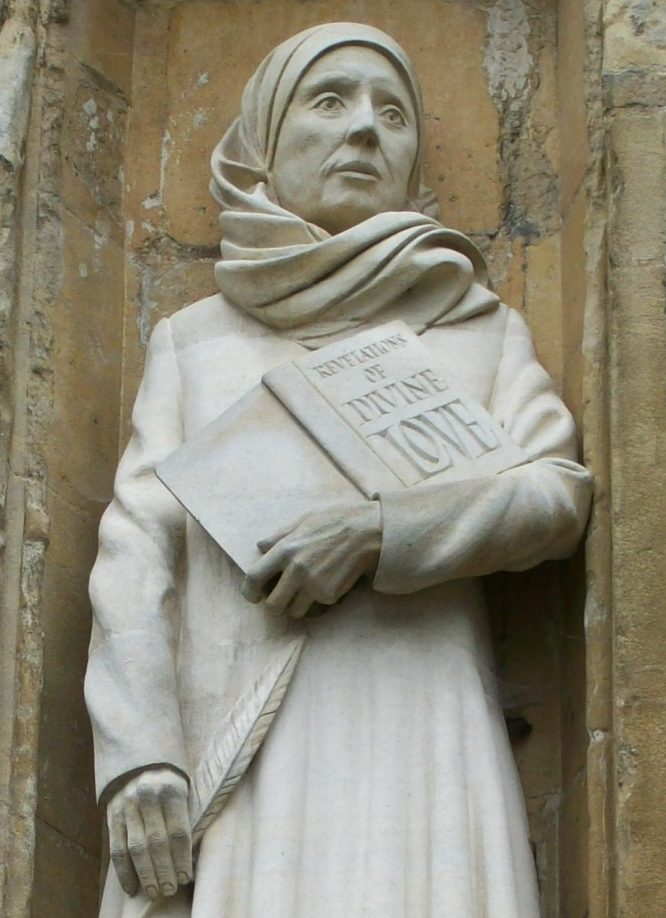
Text ©Philip Tyers, blog editor. Image from Wiki Commons, photograph of statue outside Norwich Cathedral by David Holgate, 2000.
We welcome contributions to the blog. Please go to our contact page:
https://thejulianmeetings.net/contact-for-blog/
We invite readers to suggest further books for review, and are looking for further member reviewers. Contact us on https://thejulianmeetings.net/contact-for-book-reviews/
The Julian Meetings support in-person and online groups around the country. We make teaching on Contemplative Prayer and Meditation as easily and widely accessible as we can. Articles and reviews express the views only of their respective authors.
Our August magazine is now available and the printed copy is with our Meetings and individual members. It is our last printed magazine. Details of how we plan to replace it are all in the magazine. You can read it online here together with our April magazine which also contains information about our plans for the future. We do need help to make that future happen. Details are all in the magazine pages 17 & 20.
If you subscribe to this blog to receive new posts as they are published but have not joined our membership please consider becoming a member to to receive news and updates and contribute to the discussions on the future of JM. This is free.

The video offers an experience of a typical Julian Meeting. Use for your personal prayer or in a meeting. Julian Meetings are a network of Christian ecumenical contemplative prayer groups across the UK, open to people of all faiths and none. Find out more details about a group near you at http://www.thejulianmeetings.net The website also has guidance for those not quite sure how to use the half hour silence for contemplative prayer and meditation.
In the 1980’s and into the 2000’s JM were very active in South Africa. There were several meetings. Canon John Rowlands was a key figure in promoting JM in South Africa. He gave a series of talks on Christian Meditation and Contemplative Prayer for the JM groups and these were recorded on tape. In 2022 we were approached by John Goodall who had acquired the tapes and a transcript of the talks. He wanted to make them more widely available. He gave us permission to format them in a modern and accessible manner. The content is still relevant today, although the language, style and delivery is of its time. We have improved the quality of the recordings but do not expect modern standards. Each talk is split into two or three sections. This was done to make it easier for the JM groups to use in meetings. A text transcript is still in preparation and will be added as available.
John Goodall writes: “Regarding Canon John Rowlands, he has indeed died. This was some years ago. He exercised remarkable pastoral care in his life. I understand that he worked in Cape Town’s District Six during the torrid Apartheid days, and I notice he received something of an honourable mention in Richard Reeves’s classic South African work, Buckingham Palace, District Six. He spent years promoting Julian Meetings from the early 1980s in South Africa. Also he was very kind, together with his sister, to my mother, a penurious missionary widow who lived in Cape Town. (As too was Bishop Tutu, who always supported clergy widows.)”
All the entries in bold blue are links to parts of each talk. Eg – Talk 1 is the introductory talk. Prepare for silence and Lead Into Silence are extracts. It is all as given to us. We have not done any editing apart from improving the sound quality. So just go with the flow.


At our 50th Anniversary National Gathering our founder, Hilary Wakeman gave the keynote address. She pre-recorded the address for us in case she was unable to attend. Here is the video.
You must be logged in to post a comment.