
Treasures from past and present.
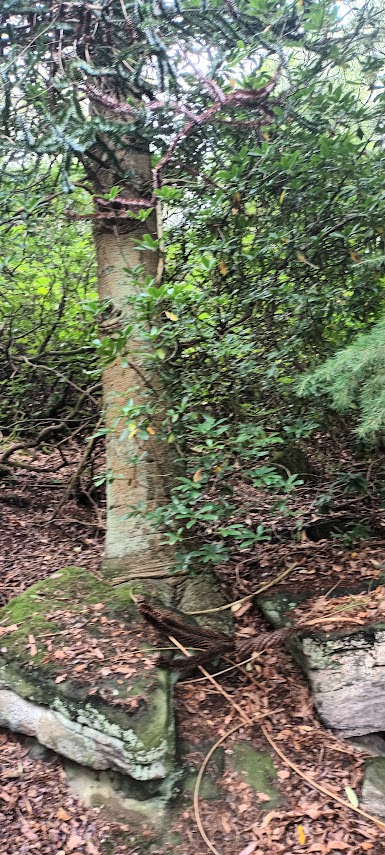
The accompanying photograph shows a tree that has over the course of a century pushed the surrounding boulders apart.
This blog is like the scribe instructed in the Kingdom, who brings treasures both old and new from his stores Matthew 13:12.
Over its history, Christians have learned many things. For example, before he died in 257AD, Cyprian wrote
“When we pray it is not for one person, but for the entire people; because we the whole people, are one. God, who is the Teacher of prayer and peace, taught us peace. He wished each one to pray for all, just as he, himself, has borne all together in one”
Commentary on the Lord’s Prayer, Ch. 8. Extract from Saints on Earth: A biographical companion to Common Worship by John H Darch and Stuart K Burns.
‘We the whole people, are one’ is like a draught of fresh water to our thirsty separated world. What is slaking your thirst these days?
On 10th. October, the Admin group are holding an open meeting on Zoom. We want to learn from you how things are going in your groups. We hope to encourage one another.
In April 2003, meetings were preparing for the 30th. Anniversary. In the Julian Meeting Magazine Hilary Wakeman described how they started. She had visited many places and met people interested in contemplative prayer.
“In each place …We talked about contemplative prayer, and how so few people – including clergy of all denominations – seemed to know about it, which was very hard on those who felt drawn to it. We agreed that what we all wanted was some sort of network of practitioners, with regular meetings where we could pray together in this way.”
Today in 2026 we are still meeting, still working to help people know about contemplative prayer.
The same edition held an article by Di Cooke explaining the difference between contemplative prayer, meditation , and silent prayer. I find I slip between the three during any prayer session, but find that continuing the struggle to remain in contemplative mode especially fruitful. (see also Deidre Morris’ 2010 article).
The April 2017 magazine has Giles Fraser writing about praying alone in church.
“Of course you can do it elsewhere, but these are places set aside for it. Here the silence creeps into me, a bit like the cold. Not the silence of empty nothingness but the silence of sitting comfortably with a friend. And in to that silence I bring all that is not OK with me.
“The chemistry of prayer is the meeting of these two elements: that little surd of hidden desperation that some (most, all?) of us carry around with us, often without owning up to it, and that vast expanse of purposeful silence, the shorthand for which is God. In my experience, these two elements are drawn to each other. And the slow reaction between them is worth breaking into any church to find.
“There are various accelerants to this chemical reaction – the repetition of liturgical formulas, even lighting candles. Like all organised religion, this is easy enough to sneer at. But key to the reaction is silence and time. Both eat away at our excuses, our false hopes, our lack of reality. Self-serving bull-shit doesn‘t easily survive the rigours of time and silence. And in this fantasy-busting environment I am lent the courage to open the most defended bits of me to the infinite love of God. “
April 2016 found Ian Cowley wondering
“what a contemplative life looks like in 21st century Britain. Part of me would like to move to a small house in West Wales or the Scottish borders, and try to live a life of quiet contemplation. But that is not a realistic option for me, or indeed for most of us. So we are faced with the challenge of working out a contemplative way of living which will be constantly at odds with the culture that surrounds us. We who feel this call to a contemplative way of life seem like missionaries living in a world which increasingly does not understand us and speaks a strange and different language. … At the heart of the contemplative life is learning to let go: learning to live in the present moment. … As we grow into the practice of daily contemplative prayer, we will find ourselves being drawn, more and more, to this letting go, this radical detachment and trusting entirely in God. We live in an age of anxiety, preoccupied with control, significance and security. Jesus says to his followers ‘let not your hearts be troubled, neither let them be afraid.’ (John 14:27) He calls us to live gladly in the grace of the present moment, knowing that ‘sufficient unto the day is the evil thereof.’ (Matthew 6:34) … Our culture continually tells us what will give us security and happiness, power and control. If we long for God’s way of doing things, for lasting joy and the peace which passes understanding, we will choose to set our hearts on a different way of living and being. We then have to work out each day what this means. This is the contemplative way of living. This is the way of life in which we depend utterly, each and every day, on the grace and goodness of our Lord Jesus Christ.”
Our Julian library of magazine articles is a treasury. Many articles and poems withstand the test of time. We also need a constant input of fresh writing to set alongside it. Please send in fresh articles.
The programme by Dr. Janina Ramirez about how Julian of Norwich’s manuscript was found is still available on BBC iplayer.
Photograph and text © Blog Editor. Individual quotations copyright by their respective authors.
The Julian Meetings support in-person and online groups around the country. We make teaching on Contemplative Prayer and Meditation as easily and widely accessible as we can. Articles and reviews express the views only of their respective authors.
We invite readers to contribute articles or to suggest further books for review, and are looking for further member reviewers.
You must be logged in to post a comment.