Posted on

Christmas PRESENT

Last Advent the first passage I read was the start of John’s gospel. As I lay in bed next morning, I ‘heard’ it in my head, but in the present tense. It had a huge impact, making everything NOW rather than then. Perhaps it will for you too:  

“In the beginning is the Word, and the Word is with God, and the Word is God. He is with God in the beginning. Through him all things are being made; without him nothing is being created. In him is life, and that life is the light of men. The light is shining in the darkness and the darkness does not understand it.  

“Here is a man sent from God whose name is John. He comes as a witness to testify concerning that light, so that through him all men may believe. He himself is not the light; he comes only as a witness to the light. The true light that gives light to every man is coming into the world. He is in the world, and though the world is ever being made through him, the world does not recognise him. He comes to that which is his own, yet his own do not receive him. Yet to all who do receive him, to those who believe in his name, he gives the right to become children of God… 

The Word is becoming flesh and is making his dwelling among us. We see his Glory, the glory of the one and only, who comes from the Father, full of grace and truth.” 

By a JM member from the December 2010 magazine. Search our library for more articles, reflections and poems on the themes of Advent and Christmas.

Photo by Porapak Apichodilok: https://www.pexels.com/photo/brown-gift-box-360624/

Posted on

A Reflection for Advent

Lead-in at a Julian Meeting in Australia in December 2013 

An Advent message in the Book of Lamentations? Unlikely as it seems, some verses seem to hold a messianic significance.  

In Lamentations the first four chapters are written in acrostic form: each verse – or in chapter 3, each triplet of verses – starts in order with a letter of the Hebrew alphabet. The book, attributed to Jeremiah, comes just after his prophecies. The poetic form of lament is common in the Old Testament, and there are more laments than praises in the Psalms.  

Jeremiah and Lamentations is a tale of judgment on God’s chosen people because of their sin and rebellion. However there are promises that some will be saved, that God has not utterly abandoned them and they will be restored. Their very existence was testimony to God keeping his promises. While the people agreed that they deserved punishment, they were impatient for the good bits of the prophecy to take place.  

Chapter 3: 22-26: Because of the LORD’s great love we are not consumed, for his compassions never fail. they are new every morning: great is your faithfulness. I say to myself, The LORD is my portion; therefore I will wait for him.The LORD is good to those whose hope is in him, to the one who seeks him; it is good to wait quietly for the salvation of the LORD.  

Jeremiah is expressing his hope in God. Prophecies can have multiple fulfilments and so the prophecy fulfilled in Jeremiah’s time has its ultimate fulfilment in the birth of Jesus Christ.  

Advent is a season of preparation and waiting. We wait for the One who brings salvation to the world. An angel tells Joseph, Mary’s betrothed, in a dream you are to name him Jesus, because he will save his people from their sins. (Matthew 1:21)  

It is good to wait quietly for the salvation of the LORD.  

Two things come together to make Christmas necessary. The first is our need to be saved – not a popular idea today. We are self-made men and women who can chart our own course and settle our own destiny. We believe the hollow promise that ‘anyone can change the world.’ But it just isn’t true. We don’t all have the opportunity, the ability, or the desire to do that. Our desire is the problem – not only do we desire the wrong things, but we do not desire the One who made us, do not desire to know Him or honour Him. We cannot escape our web of guilt, decay and death. We cannot change ourselves, let alone the world. And we need someone to save us.  

Yet that alone would not explain Christmas. We could have been left to take the consequences of our own decisions. But Christmas is necessary because God won’t give up on us. He is true to Himself, and won’t abandon us. His determination to rescue his people, to eventually gather them round His throne and shower them with his blessings, is the great explanation of why Mary fell pregnant and Christ was born.  

So let us focus on God’s gracious gift of love and salvation that came to us in Jesus Christ, our Lord and Saviour.  

I conclude with the beautiful words from Isaiah 9:6,7. Notice how often the word “will” appears in this passage. These are the Lord’s precious promises to us, to encourage us in a confused and turbulent world.  

For unto us a child is born,  

to us a son is given,  

and the government will be on his shoulders.  

And he will be called  

Wonderful Counsellor, Mighty God,  

Everlasting Father, Prince of Peace.  

Of the increase of his government and peace  

there will be no end.  

He will reign on David’s throne  

and over his kingdom,  

establishing and upholding it  

with justice and righteousness  

from that time on and forever.  

The zeal of the LORD Almighty  

will accomplish this.  

©John Ryall 

Photo https://www.pexels.com/@nubikini/

Posted on

Pondering the Julian Meetings

But when the Lord comes, will he find faith on earth? Luke 18:8

I was sitting in my allotment, pondering what I should be doing. I noticed that there was a slight slope and the earth at the top kept on wandering down to the bottom, where the shed is. The soil had enveloped the bottom of the shed and it was rotting. So I loaded the wheelbarrow up with the excess soil and took it to the beds higher up. It sounded like a command. Prevent soil erosion!. I made sides for the beds to keep the soil still.

I also heard it as a call to the next stage of my life. What acts as a barrier to prevent the continuing erosion of the soil of faith? Prayer. Maintaining the continual link with God. I could be like marram grass, anchoring the shifting sands of faith, giving my neighbours something to cling to. That is one reason I asked the Dean whether I could start a contemplative prayer group in Blackburn Cathedral. He put the Canon Missioner onto me, and we agreed a monthly time, and started up. 

Recently, the Archbishop, Stephen Cotterill, conducted a series called ‘faith in the North’, where he visits each diocese with instruction on the Lord’s Prayer. It is one of the few bits of the Bible many people have memorised. He said that it is a guide not only for prayer, but also for Christian living. The first word is ‘Our’. A Christian lives in the presence of other people, and FOR other people. And God if father of all people. His kingdom invites all to benefit, ‘on earth as in heaven’. 

Matthew precedes it with Jesus’ instructions on private prayer. There seems an implicit with those who make a show of prayer within a religious culture. Today in England we have a predominantly non religious culture. There are sizable pockets of Muslims and other where things are different, but the main flavour of our society excludes religion. That does not mean that we should therefore change Jesus’ teachings. The cathedral itself is a private space, where one can be hidden. The staff and congregation do all they can to ensure open public access and run events that encourage all sorts of people to come in. 

In the contemplative prayer group we come together and sit down. Each of us goes into our private space inside, and closes the door. We focus on God, knowing that around us others are doing the same. Instead of being closed off, we come together into the shared space, but each is in their own heart, where we always meet not only our Lord and ourselves, but The World. By going in, we reach out. And when we go out, we reach in. It is by paying serious attention to what is going on around us, seeing how it is all held in God, that we meet God as He is. We find he is in our individual hearts and in everyone else too.The Creator is always at work. By tuning in to the One, we find the All.

So what is the future of Julian meetings? Our founder pondered this in her Fiftieth Anniversary address, She recalled how in the early days, she had contacted the other groups exploring and teaching Contemplative Prayer. She found they were elderly and dwindling. She asked us whether we felt we should continue, and gave us silence to invite the Spirit to guide us.

The future will start where we are. My impression is that we are a group of individuals, continuing silent prayer, and some of us are lucky enough to belong to a group. The improving material on our web page is our gift to the Church, especially to those exploring silent prayer.

I’m not sure about the future concrete fulfilment of the coming of the Lord. I have always felt he is here and now, in a different mode to Judah AD 30, but as real. I expect this to continue. But to answer the hypothetical question, “if he came, would he find faith on earth?”, Julian meetings do their bit to ensure the answer ‘yes’. We do not impose faith. We open ourselves to the One in whom faith may be had. We discover, in the silence, what he has to offer. We give ourselves to the waiting, turning back again and again as our attention drifts, to the source of life itself. We are like Marram grass, anchoring the sand dune of faith against erosion.

Text and image ©Philip Tyers

Blackburn Cathedral Contemplative Prayer Meeting

November 2025

NB Philip Tyers is a JM member. The Blackburn Cathedral Contemplative Prayer Group is not a registered Julian Meeting but is organised on similar principles as appropriate for the Cathedral.

Posted on

All Saints and All Souls, Reflecting on Loss and Grief.

Nothing is Lost

When my friend was in the final stages of dementia and both speech and cognition were lost, I wondered what it must be like to lose control of one’s mind. Was it like a deep state of meditation where one is beyond thought? Where do all the memories go, all the relationships and experiences of a lifetime? I found these deeply comforting and appropriate words in a book by John O’ Donohue, where he wrote this blessing following a chapter on the subject of absence in all its forms:

May you know that absence is alive with hidden presence, that nothing is ever lost or forgotten.                                                          

May the absences in your life grow full of eternal echo.                  

May you sense around you the secret Elsewhere where the presences that have left you dwell.                                                      

May you be generous in your embrace of loss.                                  

May the sore well of grief turn into a seamless flow of presence.                                       

May you be embraced by God in whom dawn and twilight are one.

May your longing inhabit its dreams within the Great Belonging.

As I meditate on these words it reminds me that when I come to God in stillness and silence, all my experiences of life, love and loss are always present in the vast, eternal Presence which holds all of creation, beyond time and space, in peaceful and loving embrace. Nothing is ever lost, I am never alone, and there is nothing to fear.

From:         ‘Walking in wonder’ John O’Donohue

photo and text © K Marsh

All Saints’ Day, also known as All Hallows’ Day, the Feast of All Saints, the Feast of All Hallows, is observed by Christians from the eve 31st October and November 1st in honour of all the saints of the Church.

All Souls’ Day, also called The Commemoration of All the Faithful Departed, is a day of prayer and remembrance for all the faithful departed. Observed by Christians on 2 November.

Allhallowtide includes the three days from October 31st to November 3rd inclusive,

NB Dates can vary depending on the tradition of the particular Church. This is in accordance with the Western Christian tradition.

Posted on

New Magazine Index: Easily Find Articles & Topics

We have launched an index to our magazine library 2001-2024.  The magazines have been available to read for a while.  Recently we added 2001-2010.  But it was difficult to identify or find an author, contributor, topic or article.  Not everyone wants to read a random whole magazine .

Thanks to the valiant efforts of one of our members we now have an complete index to the entire content of our archive, plus selections highlighting various categories.

See our new Library page.  Here you will find links to the various selections plus the entire index comprising over 1,500 entries. It is easy to find, and access the original texts and articles online.

The selections are:

Contemplative Prayer, Julian of Norwich, The Spiritual Journey, Modern Contemplatives, JM Online and Outside the UK, Various Ways of Praying,  Arts and Crafts, The Human Condition, Poems, Devotional Resources, Quotations

 We are in the process of creating links to take you directly to the text or to the original magazine in our archive. This is a manual process so is taking time. But all the information is there for you to easily find and read any entry. You can find the original magazine in our magazine archive.

Image generated with AI

Posted on

All That Is Made-The Comfort of Contemplative Prayer by Keren Dibbens-Wyatt

Keren Dibbens-Wyatt reflects on Julian of Norwich’s writings in ‘Revelations of Divine Love’.  Keren writes:

“I’ve been fascinated by the book and the wisdom it contains ever since I was given a copy by my husband Rowan on our first wedding anniversary. I had just begun my journey into contemplative prayer and was struck by how God had tucked me away from the world through chronic illness, so that I felt a kinship with Julian in her seclusion. 

 As I have contemplated Mother Julian’s vision of the small thing “the size of a hazelnut,” over the years, I’ve felt that it gives us a true sense of eternal perspective. One much needed in the world! God inspired me to write about it and my own smallness. The seed of a book began to germinate. 

I wrote about how it feels to be small, fragile and dependent, just like that small, round thing. I considered how that can lead us to trusting and knowing God as the one who made, keeps and loves us. I found that just this one revelation alone is enough to contemplate on for the longest time and that it can teach us a great deal about true humility and genuine faith. 

 This book is now out in the world and I’d love to share with you all the insights God has gifted about how this one “shewing” can bring us the ultimate comfort of knowing God and his love through contemplative prayer. 

Keren” 

Text and photo ©Keren Dibbens-Wyatt  

Publisher Herald Press USA

 Amazon link for UK

Posted on

Laughing with God a poem by Hafiz

Two Giant Fat People (by Hafiz a 14thC Persian poet and mystic see links at the end for details)

God and I have become
Like two giant fat people
Living in a tiny boat.

We keep
Bumping into each other
And laughing.

Image generated by AI

From Read the Spirit A review of Daniel Ladinsky’s A Year with Hafiz: Daily Contemplations.

“‘In the 19th Century, (Ralph Waldo) Emerson wrote that one of Hafiz’s greatest gifts was “his intellectual liberty, which is a certificate of profound thought. We accept the religions and politics into which we fall; and it is only a few delicate spirits who are sufficient to see that the whole web of convention is the imbecility of those whom it entangles—that the mind suffers no religion and no empire but its own. It indicates this respect to absolute truth by the use it makes of the symbols that are most stable and revered, and therefore is always provoking the accusation of irreligion.”

Below a blog post reflecting on the poem. Well worth reading.

Posted on

Opening and Closing the Silence

Words used to open and close the silence at a Julian Prayer group.

OPENING PRAYER

We are your sheep,

and you are our Father and Mother.

You lead us towards peace and stillness

and are a balm for our souls.

No matter what trouble or strife we encounter

you are always there for us,

letting us know that

All Shall Be Well

and All Shall Be Well.

No matter what despair and anxieties we feel

you tell us that you are always with us

to the end of time,

and we will not be overcome.

You nourish us daily, in all circumstances,

and your balm overflows upon us,

as you enfold us in your everlasting Love.

OPENING PRAYER

Lord God, we come before you today,

in stillness and silence.

We thank you for breathing your Holy Spirit

into our lives and into our hearts.

Bless us Lord,

as we listen to your

still small voice of calm.

Amen.

The words in this following prayer came to me near the end of the 30-minute silence at my local Julian Prayer group:

OPENING PRAYER

Lord, calm our minds,

as you calmed the storm.

Let all our anxious thoughts and feelings

drift away

like ripples on a lake,

as you walk across the water

of our hearts

and take us by the hand

and say

Peace, Be Still.

OPENING PRAYER

You Lord are in this place,

your presence fills it.

I have come to rest in your presence,

taking time to just ‘Be’.

Fill me with your Holy Spirit,

Love and Peace.

Amen.

CLOSING PRAYER

Thank you for this time of stillness,

a time to share in the

Love, Peace, Joy and Hope

with everyone in this Julian group,

with angels and archangels

and with all the company of heaven.

Amen.

CLOSING PRAYER

We thank you, Lord

for this time of stillness.

For the time we have spent in your presence.

May we go forth each day

with faith, with hope, with love,

and may our souls be filled with your

eternal Light.

Amen.

Photo and text © Diane Meladio

Posted on

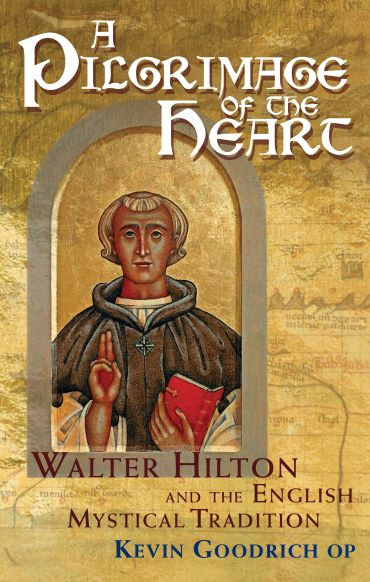
Review of A Pilgrimage of the heart: Walter Hilton and the English Mystical Tradition

Book cover.

Kevin Goodrich: A Pilgrimage of the heart: Walter Hilton and the English Mystical Tradition.

Darton, Longman an Todd. ISBN978-1-915412-13-3 published 2024 Available in Kindle and Hardcover

Review by Janet Robinson

This is an engaging and attractively produced book. It tells of the life and story of Walter Hilton of Thurgarton entwined with other mystics of the fourteenth century: Richard Rolle, the author of the Cloud of Unknowing, Julian of Norwich and Margery Kempe. The author has provided a useful background of the turbulent history of the times. He suggests that the book can be used as a virtual pilgrimage, making one’s way towards a deeper understanding of the spiritual road. Besides the narrative the author includes kindly but searching, practical questions and exercises for the reader. He laces the text with interesting narrative of his visits to the places where the mystics lived and adds helpful illustrations.

This makes altogether a very useful adjunct to one’s time of stillness. I have read the book through in order to review it but I believe that when I read it again, trying to answer some of the questions and exercises, it will deepen my contemplative prayer and expand my knowledge of the men and women whose stories he tells. I found it helpful where there is a discussion of the contemplative, the active and the “mixed” life of the spirit – something that Walter Hilton clarifies. Indeed I have just been to our local secondhand bookshop and found a copy of The Ladder of Perfection by Hilton!

Two small quibbles: I cannot feel entirely sure that Margery Kempe was a true contemplative. Certainly a pilgrim, a character larger than life, extremely active and noisy. The author himself calls her the “weeping mystic.” However, the story of her life and spiritual endeavour is appealing. My other quibble is a slight lack of proof reading. For example: St Catherine’s monastery, where John Climacus may have written The Ladder of Divine Ascent is in Sinai not Greece. But I digress. Do consider A Pilgrimage of the Heart as a valuable aide for your contemplative life.