Posted on

All That Is Made-The Comfort of Contemplative Prayer by Keren Dibbens-Wyatt

Keren Dibbens-Wyatt reflects on Julian of Norwich’s writings in ‘Revelations of Divine Love’.  Keren writes:

“I’ve been fascinated by the book and the wisdom it contains ever since I was given a copy by my husband Rowan on our first wedding anniversary. I had just begun my journey into contemplative prayer and was struck by how God had tucked me away from the world through chronic illness, so that I felt a kinship with Julian in her seclusion. 

 As I have contemplated Mother Julian’s vision of the small thing “the size of a hazelnut,” over the years, I’ve felt that it gives us a true sense of eternal perspective. One much needed in the world! God inspired me to write about it and my own smallness. The seed of a book began to germinate. 

I wrote about how it feels to be small, fragile and dependent, just like that small, round thing. I considered how that can lead us to trusting and knowing God as the one who made, keeps and loves us. I found that just this one revelation alone is enough to contemplate on for the longest time and that it can teach us a great deal about true humility and genuine faith. 

 This book is now out in the world and I’d love to share with you all the insights God has gifted about how this one “shewing” can bring us the ultimate comfort of knowing God and his love through contemplative prayer. 

Keren” 

Text and photo ©Keren Dibbens-Wyatt  

Publisher Herald Press USA

 Amazon link for UK

Posted on

Laughing with God a poem by Hafiz

Two Giant Fat People (by Hafiz a 14thC Persian poet and mystic see links at the end for details)

God and I have become
Like two giant fat people
Living in a tiny boat.

We keep
Bumping into each other
And laughing.

Image generated by AI

From Read the Spirit A review of Daniel Ladinsky’s A Year with Hafiz: Daily Contemplations.

“‘In the 19th Century, (Ralph Waldo) Emerson wrote that one of Hafiz’s greatest gifts was “his intellectual liberty, which is a certificate of profound thought. We accept the religions and politics into which we fall; and it is only a few delicate spirits who are sufficient to see that the whole web of convention is the imbecility of those whom it entangles—that the mind suffers no religion and no empire but its own. It indicates this respect to absolute truth by the use it makes of the symbols that are most stable and revered, and therefore is always provoking the accusation of irreligion.”

Below a blog post reflecting on the poem. Well worth reading.

Posted on

Opening and Closing the Silence

Words used to open and close the silence at a Julian Prayer group.

OPENING PRAYER

We are your sheep,

and you are our Father and Mother.

You lead us towards peace and stillness

and are a balm for our souls.

No matter what trouble or strife we encounter

you are always there for us,

letting us know that

All Shall Be Well

and All Shall Be Well.

No matter what despair and anxieties we feel

you tell us that you are always with us

to the end of time,

and we will not be overcome.

You nourish us daily, in all circumstances,

and your balm overflows upon us,

as you enfold us in your everlasting Love.

OPENING PRAYER

Lord God, we come before you today,

in stillness and silence.

We thank you for breathing your Holy Spirit

into our lives and into our hearts.

Bless us Lord,

as we listen to your

still small voice of calm.

Amen.

The words in this following prayer came to me near the end of the 30-minute silence at my local Julian Prayer group:

OPENING PRAYER

Lord, calm our minds,

as you calmed the storm.

Let all our anxious thoughts and feelings

drift away

like ripples on a lake,

as you walk across the water

of our hearts

and take us by the hand

and say

Peace, Be Still.

OPENING PRAYER

You Lord are in this place,

your presence fills it.

I have come to rest in your presence,

taking time to just ‘Be’.

Fill me with your Holy Spirit,

Love and Peace.

Amen.

CLOSING PRAYER

Thank you for this time of stillness,

a time to share in the

Love, Peace, Joy and Hope

with everyone in this Julian group,

with angels and archangels

and with all the company of heaven.

Amen.

CLOSING PRAYER

We thank you, Lord

for this time of stillness.

For the time we have spent in your presence.

May we go forth each day

with faith, with hope, with love,

and may our souls be filled with your

eternal Light.

Amen.

Photo and text © Diane Meladio

Posted on

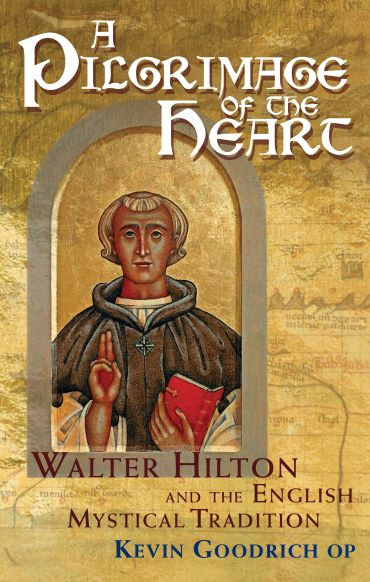
Review of A Pilgrimage of the heart: Walter Hilton and the English Mystical Tradition

Book cover.

Kevin Goodrich: A Pilgrimage of the heart: Walter Hilton and the English Mystical Tradition.

Darton, Longman an Todd. ISBN978-1-915412-13-3 published 2024 Available in Kindle and Hardcover

Review by Janet Robinson

This is an engaging and attractively produced book. It tells of the life and story of Walter Hilton of Thurgarton entwined with other mystics of the fourteenth century: Richard Rolle, the author of the Cloud of Unknowing, Julian of Norwich and Margery Kempe. The author has provided a useful background of the turbulent history of the times. He suggests that the book can be used as a virtual pilgrimage, making one’s way towards a deeper understanding of the spiritual road. Besides the narrative the author includes kindly but searching, practical questions and exercises for the reader. He laces the text with interesting narrative of his visits to the places where the mystics lived and adds helpful illustrations.

This makes altogether a very useful adjunct to one’s time of stillness. I have read the book through in order to review it but I believe that when I read it again, trying to answer some of the questions and exercises, it will deepen my contemplative prayer and expand my knowledge of the men and women whose stories he tells. I found it helpful where there is a discussion of the contemplative, the active and the “mixed” life of the spirit – something that Walter Hilton clarifies. Indeed I have just been to our local secondhand bookshop and found a copy of The Ladder of Perfection by Hilton!

Two small quibbles: I cannot feel entirely sure that Margery Kempe was a true contemplative. Certainly a pilgrim, a character larger than life, extremely active and noisy. The author himself calls her the “weeping mystic.” However, the story of her life and spiritual endeavour is appealing. My other quibble is a slight lack of proof reading. For example: St Catherine’s monastery, where John Climacus may have written The Ladder of Divine Ascent is in Sinai not Greece. But I digress. Do consider A Pilgrimage of the Heart as a valuable aide for your contemplative life.

Posted on

Overcoming Distraction in Contemplative Prayer

The practice of contemplative prayer in the face of distraction


So here in the midst of the world
With all its present pain and madness
You are not the sponge soaking up carbon emissions
Rather you are the channel of God‟s peace
Let that peace arise within you
Deeper than the sea of your own need or desire
Let that peace be a purity
A swept room
A tidied house
A simple order
An inner spaciousness
A forgiven, merciful place
Released from clawing need
Let go of the castles you have dug for yourself in the churned sand
Be washed flat by the beauty of the incoming waves
Let God‟s goodness in
Like a sparkling incoming tide
Smoothing the sand
And leaving a sheen of silver
Now you have cleared your near distance of the debris of your mind

See the expanse
Where heaven and earth meet
And all, all from east to west
From north to south
Is filled with light


Richard Carter
From ‘The City is my Monastery’
published by Canterbury Press ISBN: 9781786222138
© Used with permission. August 2024 Magazine.

Posted on

Exploring the Spiritual Labyrinth Experience

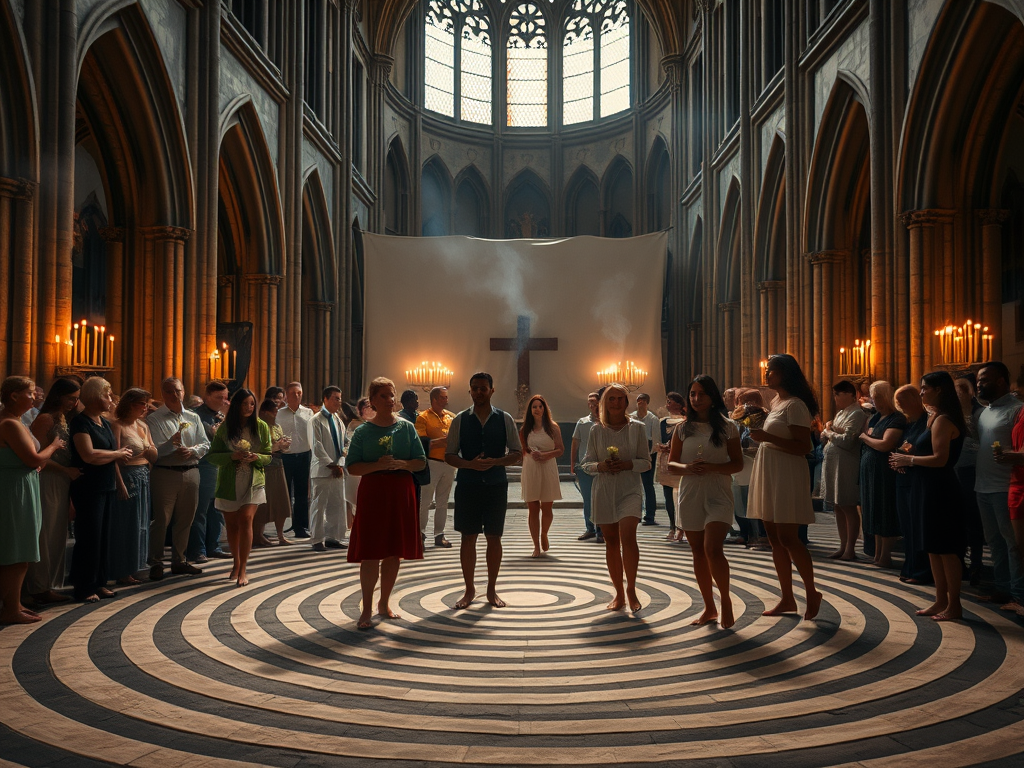
Saturday 4 August 7.30pm. The cathedral nave is clear of chairs, the lighting is subdued. Two dozen of us gather in a circle in the north transept. At the centre of our chairs is a bunch of carnations, and a ball of twine with its free end curling in a spiral away from the flowers. A flautist quietly plays variations on Taize chants.

Judith, the Cathedral chaplain, welcomes us and explains the history of labyrinths and mazes as spiritual aids. Following the path occupies your mind, while walking occupies your body, and your spirit is free to be with God. For some there is great significance in working towards the centre – of yourself, of God, of… – and then working outwards again back to your everyday world.

The labyrinth we are to walk is laid out in the centre of the nave. It is a 36-feet diameter canvas on which is a copy of the labyrinth at Chartres Cathedral. Because it is on canvas we are asked to remove our shoes before we enter it. While Judith is explaining to us, a verger is walking the labyrinth, censing it as he goes.

We are each given a flower, to be a symbol of whatever we choose and to do with as we choose. Judith explains that we are free to use all the cathedral, the cloisters, the cloister garden and the crypt as we choose, and to join in with others as much or as little as we wish. She then picks up the end of the twine and sets off slowly out of the transept and down the north aisle. Each of us in turn picks up and holds on to the twine so that eventually we are spread out along it like beads on a string. It gives me an unusual experience of connectedness.

Judith leads us down to the back of the nave, across to the west doors and then up the centre of the cathedral towards the labyrinth. In the subdued lighting the labyrinth looks very mystical, surrounded as it is with nightlight candles and wreathed in the smoke of incense.

There is a limit to how many people can physically walk the maze at any one time, and I am a long way down the line, so I leave the string and walk quietly out to the cloisters and the garden. In the evening light the stones glow, while the pool at the centre is darkly reflective.

When I return to the nave I remove both my shoes and my socks. It seems right to walk the labyrinth barefoot. It is a tightly interlocking pattern. At first I head towards the centre, and then the path turns away from it, and continues on a complicated twisting route. I need to concentrate, or I wobble or nearly miss the path. I try looking up and out across the labyrinth, but this confuses my eyes as there are so many lines. So, unless I am very near the edge of the maze, I keep my gaze within quite close limits. I am short­sighted: I wonder how it feels to someone with long sight?

As I walk I keep passing some people regularly, others I never encounter, and yet more are near at intervals and then at a distance. I often have to turn sideways, or dip aside so that someone on an adjacent path and I can pass without knocking each other off our route. One lady is dancing her way around the labyrinth, swaying along to the music she can obviously hear in her head.

It takes a surprisingly long time to reach the centre – it is quite a long walk. Most people seem to stop there for a while, sitting or standing in the small space to pray, or reflect. I feel quite claustrophobic at the centre of the labyrinth, perhaps because of the number of people in a small space.

I would like to walk it alone, or with one or two others only, to see how different an experience it might be.

Some people have placed their flowers round the edge of the labyrinth. Many leave them at the centre, but mine is still in my hand as I start on my return walk. I have realised what it signifies for me, and therefore where I wish to leave it. There are fewer people on the labyrinth as I walk back. At times I go quite a distance without meeting anyone, and I am aware of the pattern stretching away from me, and then the shadowy spaces of the cathedral beyond. I feel a sense of relief when I reach the end, almost as though I am escaping…

Perhaps I am escaping to something. Still barefoot, I walk across the cold stone floor, and up the steps into part of the cathedral that is unlit. But I know where I am going, and there is enough light shining through the arches and tracery to find my way. I take my flower and place it quietly, gently, in my chosen place, and open my heart to God, and make a promise. This is why I came. This is why I am here.

After a while I return to the nave and reclaim my shoes and socks. I walk towards the west door and sit in one of the stone seats built into the west wall. The building is transformed by the dim light, the wafts of incense: the lack of chairs or furnishing. A lady is dancing quietly, caught up in the atmosphere of this magical, mystical space. One person is walking the labyrinth alone, moving within the circle of lights and flowers.

We all move towards the maze, and gather round it. We can just reach to hold hands and encircle it. There is chance for people to speak, to pray, to share. Then we bless each other in the words of the Grace, eyes meeting eyes across the maze, the candle flames flickering on our hands, on our faces. We know we have been blessed indeed.


©Deidre Morris August 2001 magazine

Image generated with AI

Posted on

Poems by Angelus Silesius OFM,  1624 – 1677

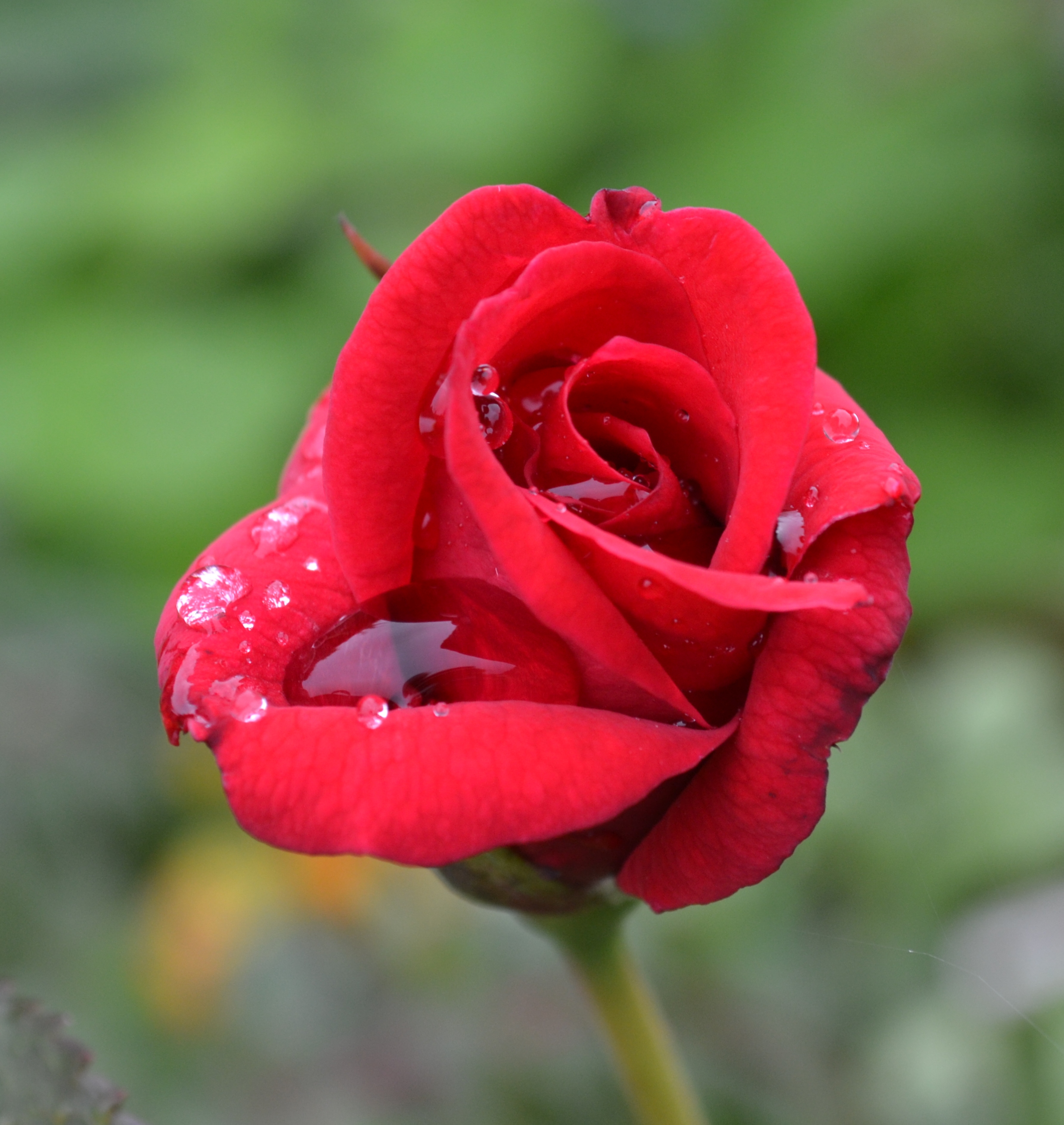
Red Rose with raindrops by K Marsh

These are two lovely, contemplative poems by Angelus Silesius, a 17th century Franciscan whose theology has similarities with that of Meister Eckhart, the 14th century Dominican mystic who said:  ‘God is God and has no why. God has no why but yet he is the why of everything.’

The rose:

The rose is without why, it blooms because it blooms. It does not pay attention to itself, asks not whether it is seen.

The heart:

Thy heart receives thy God and all that with Him goes when it expands towards Him as does an opening rose.

K Marsh    

Text & Photo ©K Marsh

Posted on

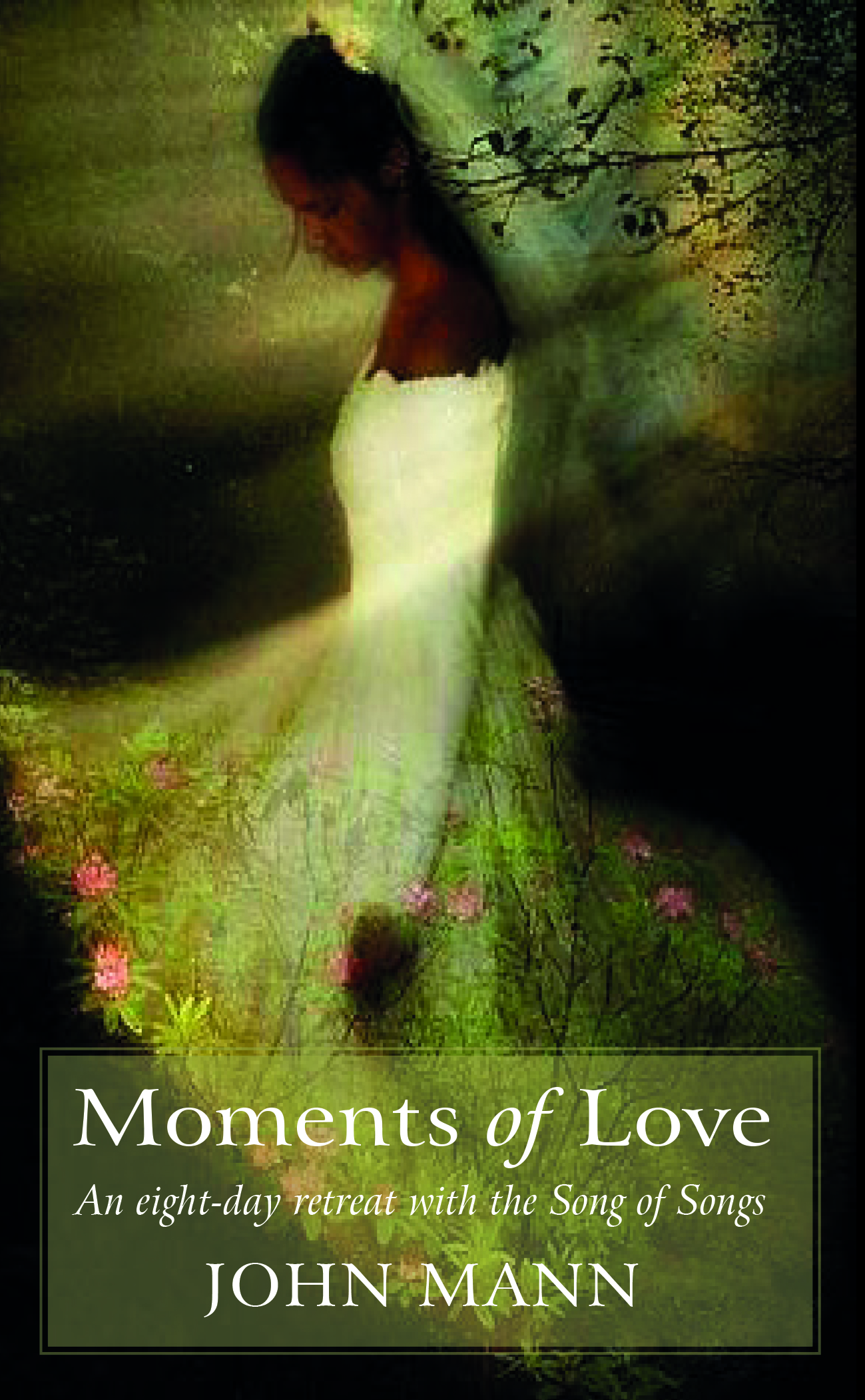
Moments of Love by John Mann

Book cover Moments of Love by John Mann

An Eight-Day Retreat with the Song of Songs 

Information from the publisher:

This attractive little book offers an eight-day retreat through the Bible’s poetic allegory of divine love, the Song of Songs. Four times a day for eight days, for Morning, Midday, Evening and Night, the book presents a short passage from the Song of Songs (NRSV) and a 300-500 word reflection. Each reflection is designed according to the time of day. Readers should put aside 20-30 minutes four times a day for the duration of this eight-day period – for the purpose of creating a focused and rewarding meditation upon personal prayer in loving fellowship with God. With a Foreword by Michael Burrows, the Bishop of Limerick (Church of Ireland). 

John Mann has served as a full-time stipendiary Anglican priest for almost all his working life, much of it in Belfast. He was Dean of Belfast Cathedral from 2011 to 2017, having spent many years in parish life and as examining chaplain to the Bishop of Connor.  He has written four other books. 

https://www.dltbooks.com/titles/2408-9781917362009-moments-of-love

If you would like to review this book please contact our Book Review Editor

Posted on

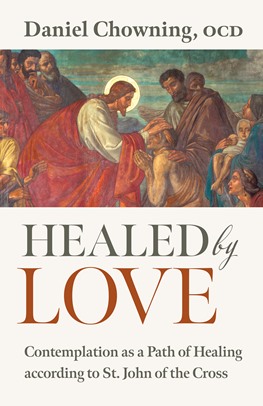
Healed by Love Daniel Chowning OCD. Review

Daniel Chowning: Healed by Love: Contemplation as a path of healing according to St John of the Cross

Liturgical press 2025

Blackwells £18.99. Amazon Kindle £16                                   ISBN: 9798400800122, 0012244
            eISBN: 9798400800139, E00139

The title of this book engaged my interest since, while a beginner in accessing the work of St John of the Cross, I have found the foothills of his work inspiring.

Written by a fellow Carmelite who has immersed himself in St John’s life and writings it offers a deep reflection on the healing power of contemplation to be found in his work. My review only touches the surface of the work as I will need so much more time and prayer to absorb and benefit from its teaching.

Initially I was attracted by the account of the saint’s life. Born into a very poor family and as a teenager employed as a nurse’s aide and alms seeker for the sick poor of a charitable hospital, he learned compassion and tenderness at first hand. He cared for the physically and the spiritually ill to the end of his life. Encouraged to study he was drawn to the Carmelite order and made his profession in 1564. His religious life and thought was much bound with the thinking and inspiration of Teresa of Avila and though of very different personalities they supported each other through difficult times. There being much opposition within the Church to the reforms which Teresa instigated, John was “kidnapped” and imprisoned for nine months in extreme deprivation. He escaped and lived for ten years in Andalusia where he was confessor and spiritual director to both religious and laity and there wrote all his major works. Later he became prior of a monastery in Segovia.

To the end of his life he was hounded by traditionalists who tried to destroy his reputation. He died in 1591 at the age of 49. As the author says: “He responded in love to every circumstance in life, good or bad, joyful or painful” His abiding words were

“Where there is no love, put love, and you will draw out love.”

So far, I have described only the first chapter of this remarkable book. The remaining ten chapters are a serious investigation of John’s understanding of the spiritual and psychological ills of we humans and how, despite the fact that he lived more than 400 years ago, he can still offer guidance and help for healing and forgiveness. As Sr.Elizabeth Obbard writes in her review (and I cannot do better):

“In this beautiful and very readable book, Fr. Daniel Chowning has distilled the teaching of St. John of the Cross for a new generation, linking it with his own personal, pastoral, and psychological insights. Under St. John’s guidance all are encouraged to surrender to the process of healing and transformation in Christ. It is a contemplative journey that leads to freedom and the integration of the whole person. Chowning’s writing is the fruit of many years of studying and teaching the Carmelite saints, and I was hooked from page one. Be enthused, inspired, and challenged to make the journey of contemplative love a way of life ‘costing not less than everything.’ It’s never too late to set out.”

(© 2025 by Daniel Chowning, OCD. Published by Liturgical Press, Collegeville, Minnesota. Used with permission.)

Janet Robinson