Posted on

Quality Time is Key in Spiritual Practices

the source of the key quotation, 'the Cure d'Ars'.

I looks at him, and he looks at me 

It is one of the signs of increasing age that one finds modern phrases or sayings annoying – ways of talking that were not around when one was young, but are now in common usage.  Of course, it is when one starts talking to the television and telling characters in dramas and news commentators how to speak that one knows that old fogy-ism has really set in with a vengeance. 

‘We are going to spend some quality time together.’  There is one that sets my teeth on edge.  Time itself has neither good nor bad quality.  It is a neutral space, which can be filled with anything.  It is the way that it is used which gives it its quality.  If someone is burgling a house, the time is not bad, the burglar is.  If someone is helping to raise money for a charity, it is the action which is good, not the time spent in the activity.  Time is neutral – we make it good or bad. 

In the New Testament account (Matthew 14.22-33), Jesus goes up into the mountains to pray.  He has just fed the crowds, he has been in the thick of it, and he is tired out and needs some respite.  It is such a great comfort to know that Jesus needed space in his life, space to pray, space to be alone, space to re-affirm his contact with his Father.  He needed time – he needed time away for the crowds, time to be with God.  It leads us to understand our own needs to give time to prayer.  It makes us realise that getting frazzled by life, getting up-tight, getting exhausted or fed up or out of sorts is not some deep fault in ourselves.  It is simply what happens.  The fault is to neglect to find time, to give time, to that contact with God which is available to all.  The fault is to neglect to give time to prayer. 

St Paul wrote that none of us know how to pray as we ought (Romans 8:26)– also a very comforting passage in the Bible, because don’t we just know how true that is.  Some prayer time seems productive, some seems remarkably sterile.  We cannot guarantee to have quality time when we pray, because the time itself is neutral, and our experience of prayer varies.  What we can do is give time, sacrifice time, set time aside.  Going in to prayer time with the expectation that we will get a lot out of it – that we will have a quality experience – is a great mistake.  All we have to do in prayer is give the time.  Of course, there are different ways of praying; intercession, praise, thanksgiving, and the rest; but that is a different matter.  There is no type of praying that does not require the sacrifice of time, even if only for a moment in the middle of a busy day. 

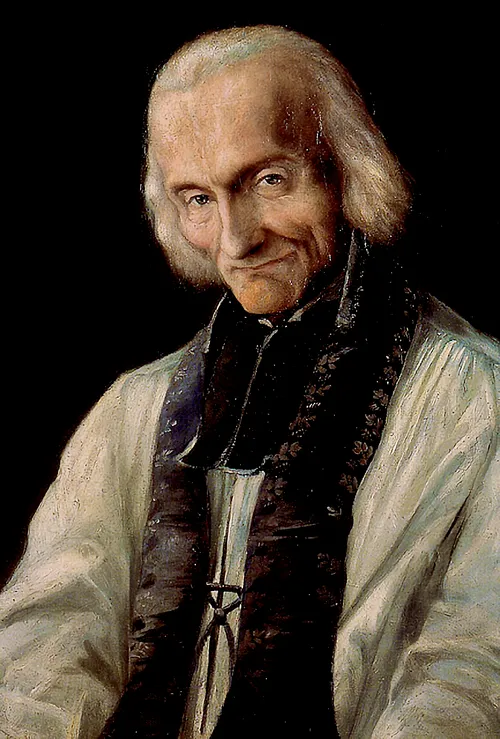
The Curé d’Ars (Jean Vianney, 8 May 1786 – 4 August 1859) told a story about prayer.  He used to go into his church and find a peasant sitting there looking at the crucifix on the altar.  He used to think to himself that the man was sitting there because he did not know what to do, and did not know how to pray – what could such a poor, ignorant man know about prayer?  So he went to the man to speak to him, and to offer him help in his prayer life.  He went up to him and asked what he was doing.  “I’m sitting here,” he said, and he indicated towards the figure of Christ, “and I looks at him and he looks at me.”  That is a perfect description of contemplative prayer.  And the Curé d’Ars realised that he had nothing to teach the man.  The man, above all, was giving time to prayer, and giving his whole attention in the time that he sat there.  There was nothing for the Curé to add. 

Text © Jonathan Smith Shoreham-by-Sea Julian Meeting 

 Photo  St Jean Vianney (the Cure of Ares) by George Desvallieres  from Wikipedia, Wikimedia Commons 

We invite readers to consider writing articles for inclusion in this blog. Have you discovered something that could help others in their prayer, alone or in a group?
I have been reminded recently about Joyce Huggett. She gave many talks and wrote books such as ‘Listening to God’ and ‘Formed by the Desert’. How did she contribute to your life? Her family are inviting those who knew her to contribute to a memorial service in June.

Philip – Blog editor.

The Julian Meetings support in-person and online groups around the country. We make teaching on Contemplative Prayer and Meditation as easily and widely accessible as we can. Articles and reviews express the views only of their respective authors.  

Posted on

Silence Is

Often, silence is approached via activity –  

the seeking of something in tandem with the resistance of other thing(s).  

Yet, silence is not the pursuit of a state but indeed  

a cessation of activity that reveals the innate ground of being. 

 Later, our mind attempts to describe That with words such as  

stillness, peace, truth, love, beauty  

or indeed silence. 

Silence isn’t audio-centric here. 

 It is a word chosen to poetically articulate  

That within which all of It’s modulations arise.  

When the soul ceases the reification of itself  

and surrenders into That which it borrows its presence from; Silence Is. 

When we die to ourselves  

and let the weather patterns of creation come and go, 

 there is only Itself.  

When we are reborn as/in experience,  

we describe That whence we came from as Silence. 

 Yet, unlike experience, Silence never truly comes or goes –  

it is the ever-present canvas upon which all experiences arise.  

Thus, we needn’t turn away from experience  

but simply recognise its substance;  

revealing that there is only, 

has only,  

can only,  

will only (Be)  

Silence and its modulations. 

Surrender is to Silence as fire is to wood. 

©Jamie Robson https://jamierobson.com

Posted on

All Saints and All Souls, Reflecting on Loss and Grief.

Nothing is Lost

When my friend was in the final stages of dementia and both speech and cognition were lost, I wondered what it must be like to lose control of one’s mind. Was it like a deep state of meditation where one is beyond thought? Where do all the memories go, all the relationships and experiences of a lifetime? I found these deeply comforting and appropriate words in a book by John O’ Donohue, where he wrote this blessing following a chapter on the subject of absence in all its forms:

May you know that absence is alive with hidden presence, that nothing is ever lost or forgotten.                                                          

May the absences in your life grow full of eternal echo.                  

May you sense around you the secret Elsewhere where the presences that have left you dwell.                                                      

May you be generous in your embrace of loss.                                  

May the sore well of grief turn into a seamless flow of presence.                                       

May you be embraced by God in whom dawn and twilight are one.

May your longing inhabit its dreams within the Great Belonging.

As I meditate on these words it reminds me that when I come to God in stillness and silence, all my experiences of life, love and loss are always present in the vast, eternal Presence which holds all of creation, beyond time and space, in peaceful and loving embrace. Nothing is ever lost, I am never alone, and there is nothing to fear.

From:         ‘Walking in wonder’ John O’Donohue

photo and text © K Marsh

All Saints’ Day, also known as All Hallows’ Day, the Feast of All Saints, the Feast of All Hallows, is observed by Christians from the eve 31st October and November 1st in honour of all the saints of the Church.

All Souls’ Day, also called The Commemoration of All the Faithful Departed, is a day of prayer and remembrance for all the faithful departed. Observed by Christians on 2 November.

Allhallowtide includes the three days from October 31st to November 3rd inclusive,

NB Dates can vary depending on the tradition of the particular Church. This is in accordance with the Western Christian tradition.

Posted on

Opening and Closing the Silence

Words used to open and close the silence at a Julian Prayer group.

OPENING PRAYER

We are your sheep,

and you are our Father and Mother.

You lead us towards peace and stillness

and are a balm for our souls.

No matter what trouble or strife we encounter

you are always there for us,

letting us know that

All Shall Be Well

and All Shall Be Well.

No matter what despair and anxieties we feel

you tell us that you are always with us

to the end of time,

and we will not be overcome.

You nourish us daily, in all circumstances,

and your balm overflows upon us,

as you enfold us in your everlasting Love.

OPENING PRAYER

Lord God, we come before you today,

in stillness and silence.

We thank you for breathing your Holy Spirit

into our lives and into our hearts.

Bless us Lord,

as we listen to your

still small voice of calm.

Amen.

The words in this following prayer came to me near the end of the 30-minute silence at my local Julian Prayer group:

OPENING PRAYER

Lord, calm our minds,

as you calmed the storm.

Let all our anxious thoughts and feelings

drift away

like ripples on a lake,

as you walk across the water

of our hearts

and take us by the hand

and say

Peace, Be Still.

OPENING PRAYER

You Lord are in this place,

your presence fills it.

I have come to rest in your presence,

taking time to just ‘Be’.

Fill me with your Holy Spirit,

Love and Peace.

Amen.

CLOSING PRAYER

Thank you for this time of stillness,

a time to share in the

Love, Peace, Joy and Hope

with everyone in this Julian group,

with angels and archangels

and with all the company of heaven.

Amen.

CLOSING PRAYER

We thank you, Lord

for this time of stillness.

For the time we have spent in your presence.

May we go forth each day

with faith, with hope, with love,

and may our souls be filled with your

eternal Light.

Amen.

Photo and text © Diane Meladio