Posted on — Leave a comment

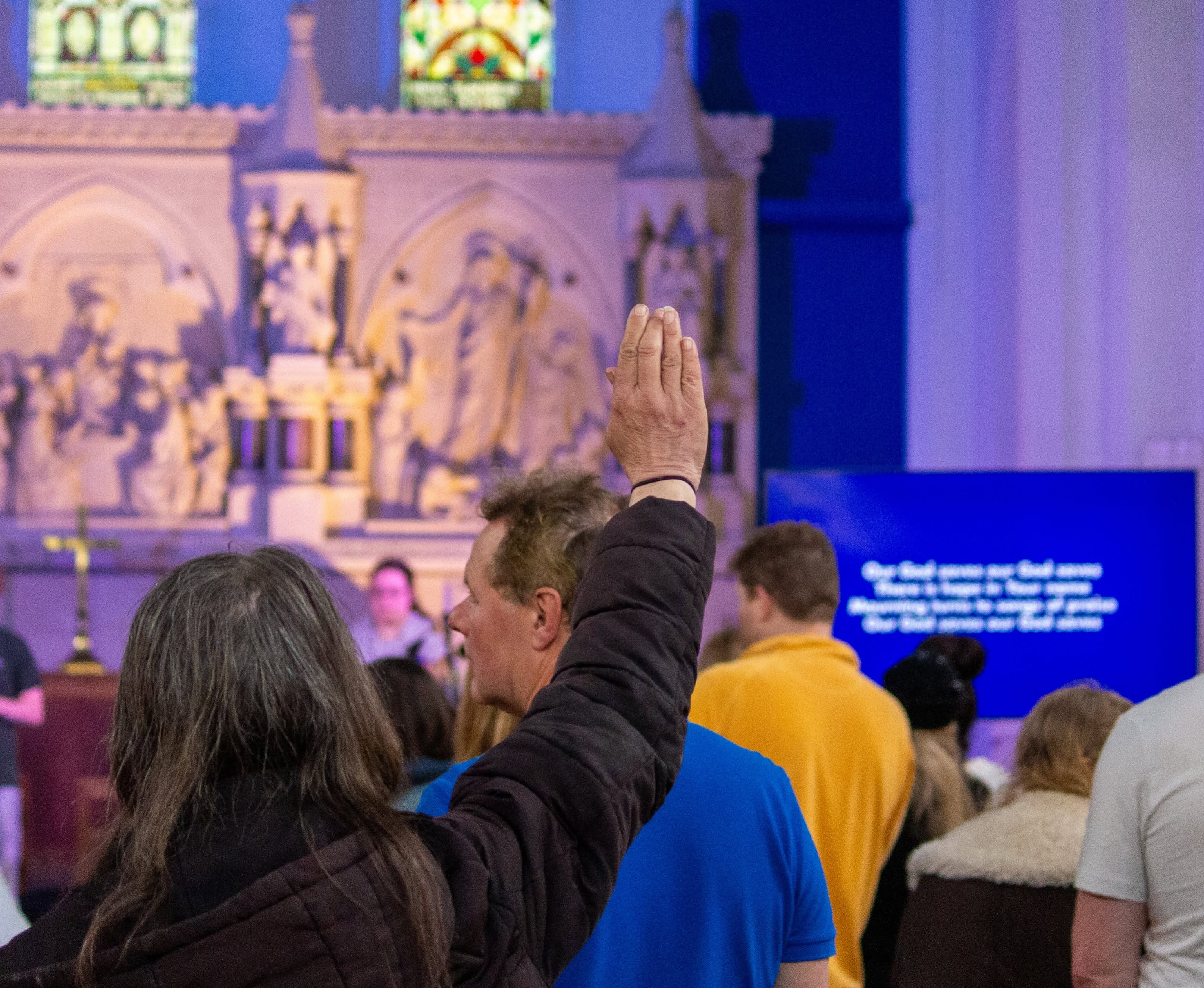
Contemplative Prayer and Charismatic Worship

The Julian Meetings started in the 1970s. People were traveling to the East to learn about meditation. Christians had neglected their own methods. We were part of the movement to restore Meditation and Contemplation for the ordinary Christian.

In the same era, the Charismatic movement arose. During corporate adoration, silence would fall.

A Welsh Baptist minister called Raymond Lloyd was transfixed by that silence and wanted more. This started his journey to becoming the hermit, Brother Ramon SSF. The journey took decades, but it started in Charismatic worship.

Similarly Joyce Huggett linked Evangelical-Charismatic experience in her congregation with exploration of the Christian mystics. She worked with the Jesuit priest and teacher, Gerard Hughes. Both contributed generous forewords to each others books.

Charismatic churches are still growing across the country. As folk journey through singing into mystical experience, The Julian Meetings can provide experience and resources.

I attended a half night of prayer recently and was blown away by the worship. It was in the ‘night club’ style adopted by the Resource Churches sponsored by Holy Trinity Brompton. A phrase appeared on the screens around the congregation. A singer led. It was simple enough and repeated enough for everyone to join in. There was a band accompanying, in an atmospheric way. It was not the soft rock of the eighties and nineties. It has progressed, but the melodies are still easy to catch, easy to repeat. It was sung meditation. The leader took us to heaven and held us there. The songs continued almost seamlessly for twenty minutes, then silence. There were places all around the building with different ways of praying for the evening’s topic. People moved from one to the next, or found a place they liked and stayed there. After half an hour or so, we returned to the centre, where the musicians held us in heaven again, and a leader gave a talk before sending us back into solitude and silence.

The song that gripped me was Worthy of It All by David Brymer and Onething ‧ 2012

The song joins the singers with the elders who cast their crowns in the worship in Heaven, Revelation 4:10. It quotes ‘From you are all things and to you are all things’. This comes from Romans 11:36. He refers to the incense rising in Revelation 8:3. As one sings, one feels caught up into Heaven. The song is not doctrine centred. It does not refer to the history of Jesus, or the experience of the singer. It focusses on God. It builds on a few verses and holds one there.

The line ‘From you are all things, and to you are all things’ turns the singer to embrace the whole of creation. God is not just its creator, but its destination. Therefore, as one walks around the world, doing one’s daily tasks, one re-perceives what life is all about. Each object, each person, each thought, ultimately, is from and for God. We can find a viewpoint in landscape or the street from which to contemplate this. As always, God is here and now, wherever and whenever here and now may be. This is what one discovers through meditation and contemplation. This is what folk can also discover in Charismatic worship.

Brother Ramon SSF (1936-2000) Hermit and Author.

In preparation for Baptist ministry, Ramon wrote  ‘Unless our concept of God relates experientially to modern man, then our preaching and faith will not communicate’. He grew up in Swansea, ministered as a Baptist in Cardiff, toured as a Franciscan Friar, evangelising, preaching, leading retreats, and writing many books on the spiritual life. He ended his days in a hermitage outside Glasshampton Monastery. See ‘A Franciscan Way of LIfe’ by Arthur Howells.

Joyce Huggett (1937-2017): Modern pioneer of contemplative spirituality

“She was a pioneer in evangelical circles of the contemplative tradition, helping people to value the disciplines of stillness, silence and solitude. She opened up for them a whole new world of spirituality through her writing, and for some, by her gentle yet persistent mentoring. She introduced the idea of retreat, the practice of listening prayer and the benefits of spiritual direction at a time when such practices were neither fashionable nor always welcomed”. See Tony Horsfall‘s article on the Premier Christianity website.

Gerard J. Hughes SJ 1924 – 2021 Jesuit priest and ecumenical teacher of prayer.

Gerard was a Philosopher and spiritual director. He ran the Jesuit study centre St. Bueno’s centre in Wales for a while. This brought the Spiritual Exercises of St. Ignatius de Loyola alive for Christians of all denominations. These teach a way of using scripture in meeting God relevantly. He wrote many books, notably ‘God where are you’ (DLT) in which he writes:

‘God’, I said at the age of three to see what would happen;

‘God?’ I am still saying seventy years later, and still waiting to see what will happen’.

He worked on healing the split between Christian spirituality and everyday life. He showed how in stillness, we allow God to pray in us, and in life, to work through us. See Francis Dodd in Independent Catholic News.

Stephen Parsons suggests we need to be aware of the coercive power of Charismatic worship. After describing his experience of the worship I mention, followed by its move into forgiveness and healing, he writes ‘the point I felt most in tune with the spirituality of the service was in the moment where the leaders seemed to move the mood of the service from control to a time of spontaneity and into what felt like real freedom and tangible spiritual content.’ He ends with a wistful ‘Is there somewhere in Britain that understands what this kind of worship in Spirit and in Truth looks like? I think I might recognise it when I see it.’

Julian Meetings were there for the Charismatic movement of the 1970s. We are still ready for the contemplative journey of the current generation. The Spirit speaks in the Charismatic space and walks them into the desert to hear the silent voice, in stillness and solitude.

Text© blog editor. Image ©St Luke’s Blackburn.

The Julian Meetings support in-person and online groups around the country. We make teaching on Contemplative Prayer and Meditation as easily and widely accessible as we can. Articles and reviews express the views only of their respective authors.

Please send your contributions; poems, articles, reviews – for publication on the blog to https://thejulianmeetings.net/contact-for-blog/

I usually publish what you send in, but this time the in-box has run dry.

Posted on

Spiritual Vision

Book Review: The Spiritual Vision of Wendy Becket – living in the heaven of God’s presence’ by Michelle Jones

Sister Wendy Beckett was a Catholic nun who became famous for her BBC TV documentaries on the history of art during the 1990s. In this spiritually nourishing book, Australian theologian Michelle Jones explores Sister Wendy’s rich theology and spirituality.

Jones draws on a wide range of writings by Sister Wendy and others (including unpublished correspondence) and interviews. This extensive research is brought together in six comprehensive chapters which follow an introductory biography. The third chapter bears the subtitle of the book: ‘Living in the heaven of God’s presence’. This is a key takeaway: Sister Wendy was deeply conscious of God pervading her whole life from an early age. She recorded later how she was just four years old when, sitting under the table at home after Mass one Sunday, ‘suddenly, I became overwhelmed by the reality of God – the greatness and the power and the love and my own infinite smallness. And I knew that I was held in that greatness and protected and I would never ever have to feel anxious.’

Jones reverts to this remarkable experience frequently throughout the book. It proved a seminal moment which profoundly informed Sister Wendy’s spiritual insight, especially that all of life, including suffering and pain, is encompassed by God. This is strongly reminiscent of Julian of Norwich, and it’s no surprise to discover she was an important influence on Sister Wendy.

I enjoyed the wide-ranging sources used to illuminate Sister Wendy’s thinking. There is much to treasure, and I found many passages to return to after a first reading: I generally eschew turning over page corners, but did so many times for ease of future reference. I wholeheartedly recommend ‘The Spiritual Vision of Wendy Becket’ as a rich spiritual resource which shines light on an extraordinary recent mystic.

Book review text © Gillian Poucher, author of The Julia Butler Series and ‘Vision of Light’. Picture © SPCK

Elizabeth Mills, a regular contributor to these pages, sent in the following. Please send in your contributions too.

Come Quietly

Come quietly
to the door

Knock gently
and wait

Leave behind
your worries

Lay them
gently down

The door opens
and you are welcomed

Come inside
and rest awhile

Feel the Peace
within

and let it fill
your heart

This day and every day
Amen

© Elizabeth Mills 4th November 2026

The Magazine of December 2012, without explanation, but in a high visibility box, said:

Silent is an Anagram of Listen.

Please explore our web site https://thejulianmeetings.net/ for even more inspiration.

At the recent zoom discussion, we recognised that there are on line meetings, in person groups, and groups that use both methods simultaneously. There was also mention that some groups send an email, text or letter to those who cannot attend in person. This contains the material for the meeting which can then be used at the regular meeting time or at any time the individual finds suitable. Between us, we could probably post blogs providing such material for wider use. Please boldly send your contributions. They might be helpful to someone, somewhere.

The Julian Meetings support in-person and online groups around the country. We make teaching on Contemplative Prayer and Meditation as easily and widely accessible as we can. Articles and reviews express the views only of their respective authors.

Please send your comments or contributions for publication on the blog to https://thejulianmeetings.net/contact-for-blog/

Posted on

An Abiding Tree.

A book review on The Abiding Tree, by Michael Weissman is followed by notes from our recent On Line Open Council meeting. It seemed to me that the Julian Meetings are like ‘An Abiding Tree’, providing shade and sustenance to those who attend meetings, follow us on line, or use our web site and social media accounts. They keep us abiding in Christ.

BOOK REVIEW: The Abiding Tree: a Parable for the Weary.

A tree was planted in good soil. It put its roots down, and grew, producing leaves and fruit. People came, sat in its shade and took its fruit. Over the years, it kept giving but ended up tired and battered. The rains seemed to fall less. The ground grew hard and dry. It felt like giving up. Then came the gardener, who looked at it, paid attention, and sent rain to the distant hills. Over the days, the rain seeped down to the tree. It stretched its roots down and took up the fresh water. Slowly it revived. One day the gardener returned and saw that it was healthy again. He sat, rejoicing, in the tree’s shadow, enjoying its leaves and fruit again.

Michael explained: “I wrote The Abiding Tree initially for one friend. He’d given everything to everyone until there was nothing left for himself. He was drained by life. I wanted to help him, but I didn’t know what to say. So I did the one thing I knew to do: I turned to the Bible. … The problem wasn’t that my friend gave too much. It was that he gave from an exhaustible source. He didn’t need to try harder. He didn’t need to become stronger, more disciplined, or better at enduring. He simply needed to stop trying to produce life from himself. He needed to abide in Christ” (John 15:5)

Every page of this heart-warming parable is carefully illustrated using AI. Each offers a different bible verse about God restoring us.

One could open the book each day, or at the beginning of a Julian Meeting, to allow God to refresh us, not just for today, not just through a dry patch, but for secure long term abiding. This encouraging book takes us to the living waters on which we all depend.

ISBN-13 979-8952350007 Publisher : ‎ Fresh Perspectives. Amazon UK: Kindle at £5.90, print from £13.99. Local bookshops can order direct from the publisher. There is a ‘print on order’ service. Picture ©Fresh Perspectives Publishing. Text: ©Blog Editor.

Local Groups written contributions to OUR RECENT ZOOM MEETING

Some groups sent written replies to our questions before the meeting. I removed Names and locations so that the groups cannot be identified, but they illustrate the variety of meetings.

We have a Monthly online meeting, with folks from very far outwith our region! It has kept us accessible for all, and we can share images and music to accompany our stillness, if we wish. It is a very welcoming and all-encompassing group.

We are a regular group of 6-9 men and women from CofE, RC and ex  URC backgrounds. Ages range from 50s to 80s. We share 30 mins of contemplative prayer usually starting with The Lord’s Prayer and ending with the Grace. After praying we enjoy a cup of tea and fellowship. We are encouraged by the friendship of others, their love of Jesus, and the opportunity for silent prayer. However, many are reluctant to lead.

Our in – person meeting, has a kind and gentle lead who ensures welcome and inclusion.  It is ‘low key’, small, unpretentious, and accepting.  The lead starts off with word of any absentees and of those we need to hold in prayer.  A verbal reading is followed by music to enter silence. Different members contribute to the workings of each meeting.  Further music brings us out, followed by the Grace.  We seldom have any discussion of the reading. We enjoy more local conversation and chat over tea.

Our online group starts with a member who runs through a short ‘stilling’ exercise.  We then have a ‘visual’ or illustration with the text of the initial reading that someone else speaks, and which then stays on screen throughout the silence.  The text is re-read to come out of silence and forms the basis for ensuing discussion.  We only say the Grace together when signing out of zoom.  A piece of music often accompanies the visual at beginning and end. It takes the form more of meditation than of contemplation but has established something strong that works remotely.

A monthly meeting helps to strengthen my imperfect practice of daily stilling and contemplation, and introduces me to new sources that I’d not have found otherwise.  For most of our interactions with others there is an obligation to engage in talk.  People with whom one can share silence are special and it heartens me to find them, however few and far between.

Our meetings are an introduction to the simple practice of meditation in the Christian tradition. They are designed to introduce people to the practice and to encourage and sustain people as they get started with a regular daily silent practice. They start with a talk on a Christian theme or aspect of modern living and set out intent. After a period of silence, we have some fellowship time to discuss what arises during practice and to encourage each other. I am boosted by belonging to (another group with more frequent on-line meditations). I am also encouraged by reading, and I attend retreats when I can, including a recent joint Christian and Zen retreat.

Our group has been running weekly now for around 5 months. There are 12 people who have attended and most weeks we get between 6 to 8 – but not always the same 6-8! worst attendance was 4 best was 9. I think it is appreciated by regulars, and it covers mainly Christians I know from church but 4 people from the village who are not church goers. I have only just started to advertise it beyond our little congregation and through the Julian Groups, so hopefully we may attract a few more people

I think that is about 25 years since our group started but we still meet on the last Friday of every month at month. There are only two left from the original group but now we usually have at least three or four people from the seven on the list, at each meeting. We take it in turns to provide a lead in and these vary enormously, sometimes just a short piece of poetry and sometimes a longer piece, – or short extracts from a book. A candle is lit when everyone is settled and the lead-in is read aloud before we go into half an hour of silence. I bring us out of the silence with a short prayer and then when everyone is settled with coffee and biscuits, the lead-in is read again before we share our thoughts. The thing that I value most is the shared silence, and sometimes there are quite long spells of silence while we absorb some new understanding.

We meet on the fourth Monday of each month in a church room. After lighting a candle to form a sacred space, we have a short reading followed by a piece of music, before moving into the Silence for half an hour. Then we have a second piece of music followed by a prayer or another short reading to come back out of the Silence. Then we put the kettle on for tea or coffee and biscuits and a chat about our experience and plans resulting from it. During the Silence we listen for the Holy Spirit and receive thoughts or feelings in return. We are encouraged by the insights that we gather, the sharing of experiences, the calm of sitting with the Holy Spirit, the company of likeminded friends.  We have 6-8 people attending each month out of an interest group of fifteen to twenty. Members are from four local churches; Anglican, Methodist, Presbyterian and Catholic. In addition one member is agnostic.

We had to stop meeting in the chapel two years ago.  It was very difficult to bring people to join us, or to give silence a try. People are welcome to join myself and husband at our house for a shared silence, and one person tries to do so. I send an e-mail or letter with a lead-in and lead-out to all.  I would really miss the shared, in-person silence, … but everyone else seems happy with the current arrangements. We put JM into God’s hands when we had the Gathering in London, and I am happy that it is still bringing people to silence and contemplation in ways that suit the changing times. I continue to pray for the Spirit to guide those who are now tasked with caring for its future.

Our group is small, informal and welcoming. We are encouraged by sharing with others a period of silent reflection, and by taking turns to select a reading and briefly introduce it. Sitting in silence for a sustained period of time is a discipline which always repays. We have no more than 6/7 members at any one time.    We share the organisational tasks and run quite smoothly.  We would like to see a few more members but would not like to lose the intimacy of the smaller group.    The loss of one or two key members might see it close down.  It has a certain fragility.

The Julian Meetings support in-person and online groups around the country. We make teaching on Contemplative Prayer and Meditation as easily and widely accessible as we can. Articles and reviews express the views only of their respective authors.

We invite readers to contribute articles or to suggest books for review, and are looking for further member reviewers.