Posted on 1 Comment

The Work of Oneing, Together

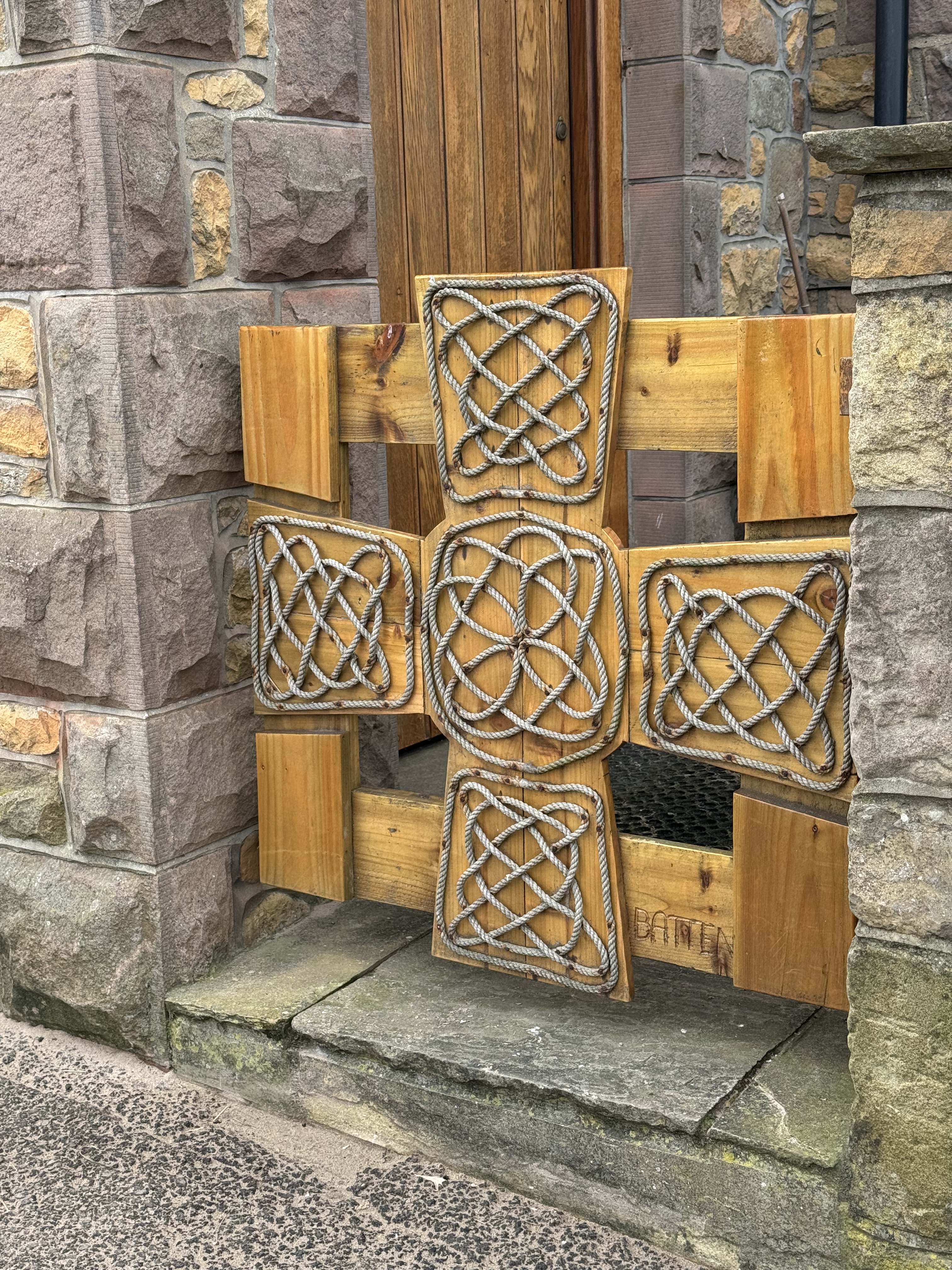
knotted rope cross signifies our uniting in Christ.

We usually intersperse blogs with book reviews. In view of the death of the solitary, Maggie Ross, last month, we hear today from Ruth Mills, who uses terms based on ‘eremos’: the Desert, where Jesus went to be alone with God. Ruth is currently studying with the Community of the Resurrection in Mirfield, Yorkshire.

Solitude in Community

The first time I arrived at a Julian Meeting I was drawn to the paradox of following Mother Julian’s example of sitting in eremitic silence, whilst sitting with others to do so: coming together – to be alone with God.   

Yet in the juxtaposition there is something that is, without doubt, the nature of the Oneing of the soul to God which Julian writes of in her Revelation of Divine Love.   

“The soul is preciously knitted to Him in its making by a knot so subtle and so mighty that it is Oned into God” Julian writes.   And it is because every individual is “oned” to God that. Julian reasons, all of humanity is inextricably linked to one another.  True spiritual togetherness means recognising that human separation is an illusion, and that humanity is inherently fused to the Divine from the moment of creation, expressed through the vivid imagery of a tightly bound knot.  

Those gifted in the craft of knotwork have a fine art-form of working a cord through, around and within itself in a work which bonds, and if done well, with exquisit beauty.  The work of the oneing of one’s soul with God is labour and beauty also, possibly the most wonderful and transformative undertaking of a human life.   

As a vowed celibate to the Single Consecrated Life, my life is, personally, set apart from the secular world for the Glory and the Kingdom of God, and yet the purpose of my consecration is to free me to enter more fully back into the world so that I may enter more fully into the love of Creation and humanity which follows closely in the footsteps of the Lord Jesus.   

But contemplation isn’t a work only reserved for Religious or the Church, it’s a divine work for all humanity, together.  If the Kingdom of God is encounter, communion, and coming together, then the real challenge is this: how do we come near when human constructs set us apart?   

Julian writes “prayer ones the soul to God”.   

In following Julian into silence, we are not merely withdrawing from the outside world in pursuit of stillness. Rather, we are entering into prayer that reaches beyond the confinements of the secular world towards the Creator God who is present in all places. Yes, we turn from distractions, but we do not reject the world. Instead, we turn forward, reaching more deeply into the ever-present Kingdom of God, which has already arrived and encompasses us in every place and time. 

Julian’s eremitic life was situated within the movement of the church and the people around her, setting her apart in radical solitude for prayer for the world yet gifting connection with those who sought her counsel through her cell window.  It was a position of hermitic ‘being’ pointing all souls towards the Glory of God: a work of sewing together the souls and Creator in the work of salvific oneing, not only through divine ecstatic intimacy, but in divine disruptive participation. 

From Julian’s Anchorhold to our meeting room.   

Like all skillful craft forms, we need a mentor and guide to sit alongside us, to work beside us, teaching and steadying our hands as we learn to fine-tune our spiritual practice. Here, Julian serves as our master weaver, guiding us in the art of being “oned.” 

This paradox reveals itself for the Glory of God. In our sitting together eremitically, we are silent in the shared work of Oneing – of weaving that binding knot of union with the Divine. 

A worthy work indeed. 

Text and Photograph ©Ruth Mills 

Photograph: knotted Celtic gate at the fishing village of Beadnell Bay, Northumbria. “This is my own photo- I’ve been walking the St Aidan’s way with Newcastle diocese and was in one of the villages we passed through in May- I was really stunned by it”.   

Martha Reeves (born 1941) died peacefully on June 11, 2026 in Oxford. She was a vowed Anglican solitary (or anchorite) and author of books on spirituality, for example ‘Silence, a user’s guide’. Her pen name was Maggie Ross. She In an interview with Church Times she wrote “communities are only as healthy as the solitudes that make them up; and that a life that is prayer is about being, not doing”. Her gravestone reads: ‘Sr Martha Emilie ReevesIn Silence Beholding ‘, a part quotation from her book ‘Writing the icon of the heart‘. She had written her own blog since 2006. She opened her 2020 article on “Silent Knowing” by quoting Graham Ward: “all theology must emerge from silence and result in silence”. 

“As far as my study of scripture goes, I have found that to love Christ above all things will involve three things: warmth and song and sweetness. And these three, as far as I know from personal experience cannot exist for long without there being great quiet.” Richard Rolle, The Fire of Love, C15, cited by Janet Rolinson

“Many children seek not to just learn about and think about God, but to experience God as the ground of their being. Meditation is one way of experiencing the presence of Jesus within. Meditation provides children with an opportunity to undertake a journey of silence and stillness as one way of helping them cope with the pressures of life”.© Gail Ballinger – August 2005 JM magazine p. 5.

The Julian Meetings support in-person and online groups around the country. We make teaching on Contemplative Prayer and Meditation as easily and widely accessible as we can. Articles and reviews express the views only of their respective authors. 

Please send your comments or contributions for publication on the blog to  https://thejulianmeetings.net/contact-for-blog/  
Posted on

Stillness Is Deeper Than Silence 

Stillness among noise

The Julian meetings practice Christian meditation/contemplative prayer, and this web site consists of a treasury of material supporting that practice. Here one of our members contributes from his rich experience of stillness even amid demanding, even life threatening, situations.

We often speak about silence as though it is something we must achieve. We sit down, close our eyes, and then discover that the mind has not received the instruction. Thoughts arrive. Sounds continue. Memories, worries, ideas, feelings, and distractions move around us. 

That can lead people to think they are failing at silent prayer. 

But perhaps stillness is deeper than silence. 

The silence of a Julian Meeting is not, I think, a demand that we somehow empty the mind by force. Very few people can do that. Perhaps nobody can do it completely. The mind moves. It produces thoughts in the same way the body breathes and the ears hear. The problem is not that thoughts arise. The question is what we do with them. 

Do we chase them? Do we argue with them? Do we try to push them away? Or can we simply allow them to be present, without making them the centre of our attention? 

This is where contemplative prayer becomes both gentle and demanding. It asks very little from us in one sense: just sit, be present, and wait upon God. But in another sense it asks a great deal, because it asks us not to control the experience. 

Meister Eckhart and other Christian contemplative writers often point us towards this kind of detachment: not coldness, not indifference, but freedom from the need to grasp everything that passes through the mind. In that spirit, stillness is not the absence of thought. It is the grace of not being ruled by every thought. 

Another word for this may be equanimity: a balanced presence, neither grasping nor resisting. In Christian terms, I do not mean a self-made calm, achieved by effort alone. I mean something received and practised: a grace that helps us remain present before God amid whatever moves around us and within us. 

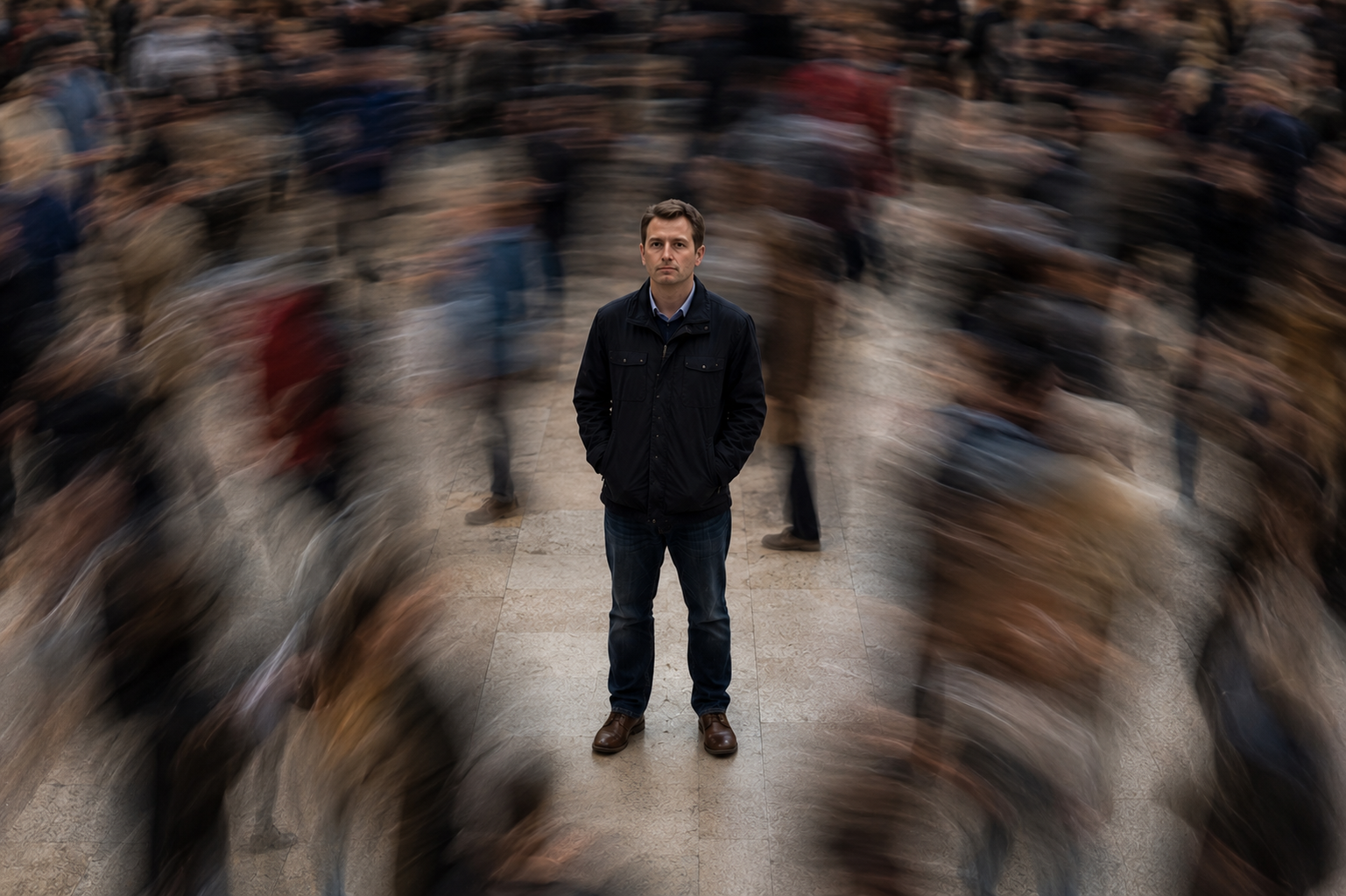
This is why I find the image of the still person in the long-exposure photograph so helpful. Around them, the world rushes past. People move, lights blur, the street is full of activity. Yet the person remains still. The movement has not disappeared. The stillness is not created by removing the movement. The stillness is found within it. 

That is often what our inner life is like. 

We may come to silent prayer with a mind full of movement. We may be tired, distracted, anxious, or restless. We may be very aware of the sounds in the room, the noises outside, or the unfinished business of the day. Yet none of that prevents stillness. It only gives us the place where stillness may be practised. 

I have found this to be true beyond the meeting room as well. There have been moments in my own life, in difficult and noisy circumstances, where I have discovered that stillness was possible even when quiet was not. I do not always manage it. Far from it. There are many times when I have followed the wrong thought, fed the wrong feeling, or made the noise louder by engaging with it. That, perhaps, is a reflection for another time. 

For now, the point is simpler. 

If thoughts arise in prayer, we need not punish ourselves. If we suddenly realise we have been carried away by them, we can gently return. No drama is needed. No failure has occurred. We return to stillness as often as necessary. 

Perhaps this is one way of understanding grace. Not as a dramatic feeling, nor as a special experience we must seek, but as the quiet strength to remain present before God amid everything that moves around us and within us. 

So the challenge may be this: not only to sit in silence during a Julian Meeting, but to carry something of that stillness into life. 

Into the street. Into the workplace. Into family life. Into uncertainty. Into noise. 

Stillness is not the absence of noise. 

Stillness is deeper than silence. 

“Be still, and know that I am God.” 
Psalm 46:10 

Text ©️ Ian Beers. Image created using Artificial Intelligence from prompts by Ian Beers 

The following recent quotations might inspire and deepen our contemplative prayer both alone and together:

Quaker Peace Testimony

Quakers find our faith moves us to love rather than war, even when that is risky. In 1928, British Quakers described their experience of the spirit of Christ in worship:

“In silence, without rite or symbol, we have known the Spirit of Christ so convincingly present in our quiet meetings that his grace dispels our faithlessness, our unwillingness, our fears, and sets our hearts aflame with the joy of adoration. We have thus felt the power of the spirit renewing and recreating our love and friendship for all our fellows.”

Facebook entry 25th June 2026 ©️ Quakers in Britain.

Sue Derbyshire and Gail Ballinger of Winchester Julian Meeting recommended the following: 

Meditation practice can turn me into a sponge. The true nature of a sponge is that it gathers water and it releases water.   It does not hold onto, own, or create water.  In meditation I am filled with the grace of God, the flowing waters of life.  

Hence, the only goal I can truly name for my meditation practice is this :  to let myself be filled over and over, so that I can act as a streaming, saturated sponge, leaking Love in a dry and dusty world. 

From ‘Hands like   Roots ‘ Notes on an Entangled Contemplative Life ‘   ©️ Therese Des Camp. Published by Santos  March 2025.   

Prayer always moves something Matthew 17:20 :

Prayer is where mustard‑seed faith begins to grow.

Sometimes God moves the mountain.

Sometimes He strengthens us to climb it.

Sometimes He reshapes the landscape entirely.

But prayer always moves something.

©️ Jess Soames, Mission Aviation Fellowship. Used with permission.

In contemplative prayer we seek consonance not only on our own behalf, but for our dissonant world.  

The Cathedral organ was being tuned. Each pipe in turn was compared with another correctly tuned pipe, and adjusted. Most of the contemplative prayer group retired to a room out of earshot and listened to an article by Evelyn Underhill that introduced our meditation.  

One stayed behind in the chapel beneath the pipes. He said afterwards, “ The whole point, as it struck me, of the tuning of the organ is to create consonance out of dissonance; and I hope that we embody that.” 

©️Philip Tyers, Julian Meetings member.

The Julian Meetings support in-person and online groups around the country. We make teaching on Contemplative Prayer and Meditation as easily and widely accessible as we can. Articles and reviews express the views only of their respective authors. 

Please send your contributions for publication on the blog to  https://thejulianmeetings.net/contact-for-blog/ 

We invite readers to suggest books for review, and are looking for further member reviewers. We also welcome key points you learned from books you read, whether published recently or years ago.