Posted on

Exploring the Spiritual Labyrinth Experience

Saturday 4 August 7.30pm. The cathedral nave is clear of chairs, the lighting is subdued. Two dozen of us gather in a circle in the north transept. At the centre of our chairs is a bunch of carnations, and a ball of twine with its free end curling in a spiral away from the flowers. A flautist quietly plays variations on Taize chants.

Judith, the Cathedral chaplain, welcomes us and explains the history of labyrinths and mazes as spiritual aids. Following the path occupies your mind, while walking occupies your body, and your spirit is free to be with God. For some there is great significance in working towards the centre – of yourself, of God, of… – and then working outwards again back to your everyday world.

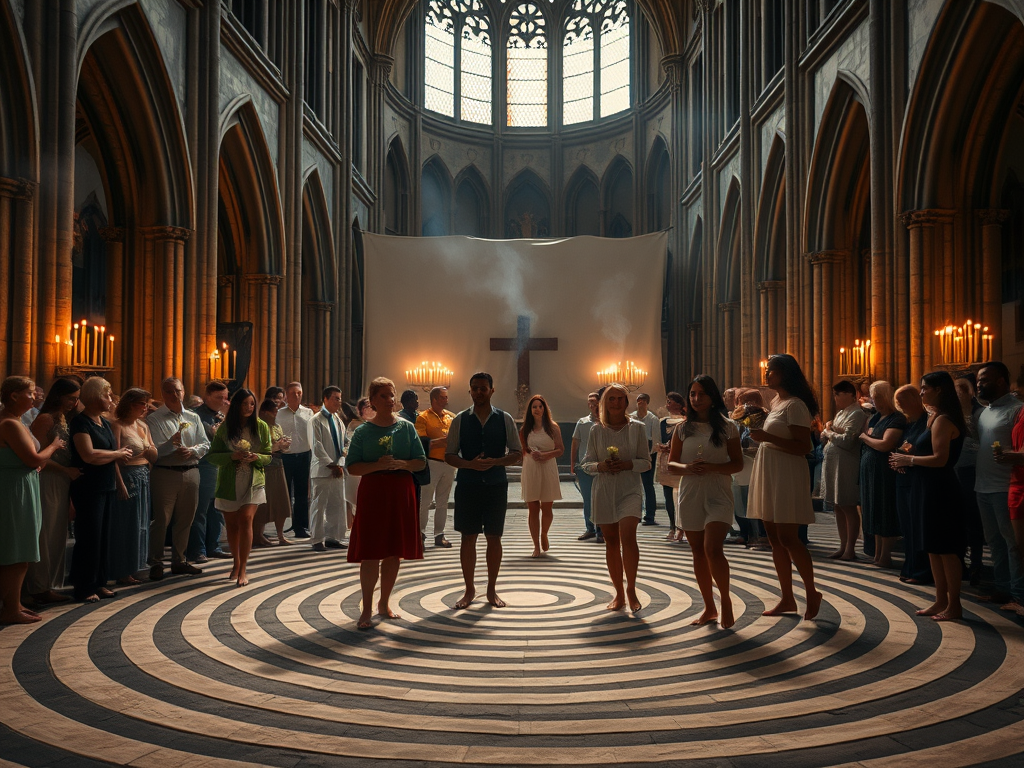
The labyrinth we are to walk is laid out in the centre of the nave. It is a 36-feet diameter canvas on which is a copy of the labyrinth at Chartres Cathedral. Because it is on canvas we are asked to remove our shoes before we enter it. While Judith is explaining to us, a verger is walking the labyrinth, censing it as he goes.

We are each given a flower, to be a symbol of whatever we choose and to do with as we choose. Judith explains that we are free to use all the cathedral, the cloisters, the cloister garden and the crypt as we choose, and to join in with others as much or as little as we wish. She then picks up the end of the twine and sets off slowly out of the transept and down the north aisle. Each of us in turn picks up and holds on to the twine so that eventually we are spread out along it like beads on a string. It gives me an unusual experience of connectedness.

Judith leads us down to the back of the nave, across to the west doors and then up the centre of the cathedral towards the labyrinth. In the subdued lighting the labyrinth looks very mystical, surrounded as it is with nightlight candles and wreathed in the smoke of incense.

There is a limit to how many people can physically walk the maze at any one time, and I am a long way down the line, so I leave the string and walk quietly out to the cloisters and the garden. In the evening light the stones glow, while the pool at the centre is darkly reflective.

When I return to the nave I remove both my shoes and my socks. It seems right to walk the labyrinth barefoot. It is a tightly interlocking pattern. At first I head towards the centre, and then the path turns away from it, and continues on a complicated twisting route. I need to concentrate, or I wobble or nearly miss the path. I try looking up and out across the labyrinth, but this confuses my eyes as there are so many lines. So, unless I am very near the edge of the maze, I keep my gaze within quite close limits. I am short­sighted: I wonder how it feels to someone with long sight?

As I walk I keep passing some people regularly, others I never encounter, and yet more are near at intervals and then at a distance. I often have to turn sideways, or dip aside so that someone on an adjacent path and I can pass without knocking each other off our route. One lady is dancing her way around the labyrinth, swaying along to the music she can obviously hear in her head.

It takes a surprisingly long time to reach the centre – it is quite a long walk. Most people seem to stop there for a while, sitting or standing in the small space to pray, or reflect. I feel quite claustrophobic at the centre of the labyrinth, perhaps because of the number of people in a small space.

I would like to walk it alone, or with one or two others only, to see how different an experience it might be.

Some people have placed their flowers round the edge of the labyrinth. Many leave them at the centre, but mine is still in my hand as I start on my return walk. I have realised what it signifies for me, and therefore where I wish to leave it. There are fewer people on the labyrinth as I walk back. At times I go quite a distance without meeting anyone, and I am aware of the pattern stretching away from me, and then the shadowy spaces of the cathedral beyond. I feel a sense of relief when I reach the end, almost as though I am escaping…

Perhaps I am escaping to something. Still barefoot, I walk across the cold stone floor, and up the steps into part of the cathedral that is unlit. But I know where I am going, and there is enough light shining through the arches and tracery to find my way. I take my flower and place it quietly, gently, in my chosen place, and open my heart to God, and make a promise. This is why I came. This is why I am here.

After a while I return to the nave and reclaim my shoes and socks. I walk towards the west door and sit in one of the stone seats built into the west wall. The building is transformed by the dim light, the wafts of incense: the lack of chairs or furnishing. A lady is dancing quietly, caught up in the atmosphere of this magical, mystical space. One person is walking the labyrinth alone, moving within the circle of lights and flowers.

We all move towards the maze, and gather round it. We can just reach to hold hands and encircle it. There is chance for people to speak, to pray, to share. Then we bless each other in the words of the Grace, eyes meeting eyes across the maze, the candle flames flickering on our hands, on our faces. We know we have been blessed indeed.


©Deidre Morris August 2001 magazine

Image generated with AI

Posted on

Loss of Silence – Dealing with Tinnitus 

First published in the April 2002 magazine but still very relevant. 

“Avoid very noisy places and totally silent places”… so reads an article on tinnitus and hearing problems. 

And yet for years silence for me has been a natural environment – a bit like putting a fish back in water – and prayer largely silent. If there were times when I found silence difficult I could take comfort in or be inspired by the wisdom of the Bible, of our spiritual writers or of personal friends, especially within a local Julian Meeting. 

Recently, however, I have experienced a more intractable problem. The slight hearing loss which began to be apparent in my early forties is worsening and for two or three years I have been increasingly bothered by tinnitus. At first the noise – variously described as ringing, tinkling, roaring, a hissing sound like escaping gas – was not too intrusive and did not greatly affect my times of quiet meditation. But the noise and the deafness are worsening and silence is becoming quite difficult.  

When the opportunity came of spending a few days with a small community with a listening ear available, I decided that I wanted to try to address the hearing problems and the increasingly distracted quiet times and try to find some coping mechanisms. Being away from a busy life and staying with very caring people was a good beginning. Someone to talk it over with was a real help and it left me feeling a shift in my position and renewed hope. I could actually do something positive about this. I came away with practical suggestions, for example learning to lip read and with details of a chaplain for deaf people who proved to be a valuable source of suggestions and encouragement and who has supplied literature and addresses. 

The breathing space and support of the community left me in a better position to address the problem of the loss of silence in prayer. I realised how thin and short my set-aside prayer time had become since the problem worsened and that l was in fact beginning to avoid much silence. One of the difficulties is that though more apparent at some times than others the tinnitus is always there. I realised I was beginning just to sit and listen to the noise and it did not feel as if much loving attention was going on. 

“Quiet time” was becoming an endurance test. Strangely I would have expected the solution to be rather similar to managing a noisy external environment, but I found this approach was no help. The noise was interior and I seemed to have lost the inner silence that can exist regardless of noise outside. It was more akin to managing chronic pain or grief than to managing a noisy environment. 

All sorts of difficulties such as health problems or family worries affect our prayer, but for me a significant part of the difficulty of managing tinnitus, which makes it different from life’s other difficulties, is that my own body seemed to be destroying the essence of prayer – silence – and to be in conflict with my deepest desires. And the result was a sense of guilt and frustration. I even wondered if I should give up silent meditation. Was I making an idol of silence? God is not bound by our silence any more than he is defined by our words. Nor are his love and power. Everything changes and our relationships change and hopefully grow so perhaps the quiet times needed to change. 

As I thought and prayed about this I became convinced that I needed a different place – not necessarily physically; but if I used my imagination I could perhaps create a place where I could more comfortably meet God – a place where the background noise would mask the distracting racket going on in my head and make it less obvious. I experimented with this over a period of a few weeks. Two environments have been persistently helpful and have remained a resource now that the problem has eased. They had almost a “given” quality. The first was a high waterfall in a tropical setting – very damp, green and bright with colourful birds and a roar in the background which blended with the unwelcome noise, making it almost unnoticeable. As I revisited this place during successive prayer times I noticed that the site was now inhabited by two people standing not far from the falling water. In fact close enough to be getting rather wet from the spray. I could not recognise them. Their features were not discernible and they were rather stylised. One had his arm round the other, inclining his head to try to hear what the other was saying. Intuitively I knew these for Christ – who was the listener – and myself. On further reflection it seemed that in this picture Christ was saying “I will accept your limitations and inhabit your noisy place.” 

The second place was on a shingle beach in an English winter where the breaking waves were crashing on the beach, pounding the shingle and sucking the stones backwards as they retreated. There was wind and salt spray. Unlike the first place there was an absence of colour – sea, sky and beach being various shades of grey. Again, after a few visits there, the scene began to be peopled this time with a group of people – either a family group or friends usually walking but not attempting to say much as the wind took their words away. An atmosphere of quiet companionship invariably settled on the group. They have come to symbolise the people who over the years have shared the silent spaces with me and the people who do so still. 

As all these things had their good effect and I felt more at ease, I began to resume my normal habit of using relaxation and centring exercises as a way of settling into silence before any words or reading, though giving more time to this than before. Gradually the sense of loss has faded and a feeling of thankfulness is returning and sheer relief. There are good days and bad days. On bad days alternating silence with slow reading helps. 

Wakeful nights are rather different. The quiet of the night and the horizontal position seem to make the noise of tinnitus more pronounced. My most useful aid is not vision but touch: a holding cross loosely held in one hand. Holding a cross is also helpful to me in a group meditation if I cannot hear the reading properly and a visual focus is not being used. 

The following resources have helped: 

People Need stillness by Wanda Nash. DLT, 1992 (there is also a relaxation tape with the same title)

At Ease with Stress by Wanda Nash. DLT, 1988  

Prayer in the shadows by Angela Ashwin. Fount, 1990 

Some of these may be out of print – copies may be available from:

Abe Books https://www.abebooks.co.uk/

World of Books https://www.worldofbooks.com/en-gb

Amazon sellers. 

RNID Royal National Institute for the Deaf https://rnid.org.uk/information-and-support/tinnitus/ 

© Gail Ballinger.  First published in the April 2002 magazine. 

Photo. Not edited.

Jason Rogers, CC BY 2.0, via Wikimedia Commons

Comments

If this is a problem that you share we would be interested to hear how you deal with it. In your personal quiet times, or in a group, what helps and what hinders?  What resources have you found? 

We have opened comments for our subscribers.  Your email address is not published. Comments are moderated before publication so there may be a small delay.

Posted on

August Magazine

Our August magazine is now available and the printed copy is with our Meetings and individual members. It is our last printed magazine. Details of how we plan to replace it are all in the magazine. You can read it online here together with our April magazine which also contains information about our plans for the future. We do need help to make that future happen. Details are all in the magazine pages 17 & 20.

If you subscribe to this blog to receive new posts as they are published but have not joined our membership please consider becoming a member to to receive news and updates and contribute to the discussions on the future of JM. This is free.

Posted on

The Lost Key

Christ_Handing_the_Keys_to_St._Peter_by_Pietro_Perugino_crop.jpg

Christ Handing the Keys to St. Peter by Pietro Perugino Public domain, via Wikimedia Commons

The Lost Key

Sufism, which is sometimes described as the mystical tradition in Islam, has a tradition of the ‘wise fool’.  Stories about Sufi teachers often tell a tale of the master acting in a foolish way in order to give a lesson about spirituality, and about the misunderstanding of those with less knowledge.  The fictional Mullah Nasruddin, who appears, among other texts, in South Asian children’s books, is such a teacher.  The tradition of the fool, the truth-teller, is also deep in western culture.  The following is a story told in many different forms in the Sufi tradition.

A Sufi master had lost the key to his house and was looking for it outside. He got down on his hands and knees in the field outside his house, searching for the key. Some of his disciples came along and asked what he was doing.

He said, “I have lost the key to my house.”

 “Can we help you find it?” they responded

“By all means”, he replied.

So they all got down on their hands and knees and started desperately searching, covering a wide area between them.

One of the disciples, after a fruitless search, said, “Master, do you know where you might have lost the key?”

“Yes,” he replied.  “I lost it in the house.”

Then why are we looking for it out here?”

“Isn’t it obvious? There is more light here.”

We have all lost the key to our house. We don’t live there anymore. We don’t experience the divine indwelling. We don’t live with the kind of intimacy with God that Adam and Eve reportedly enjoyed in the Garden of Eden and the Sufi master seems to have enjoyed before he lost his key.

The house in the story is the place where we should be living, close to God, aware of his love and care. Living elsewhere, in a world of confusion and distraction, is only forced on us because the key to our happiness has been lost.  It has not been lost outside of ourselves, but within.  Through the contemplative dimension of life, we need to look for it inside ourselves, where our true link with the divine is to be found.

Posted on

Life on a Spin a Reflection by Gary Bowness

Image Attribution Ian Tresman Wikimedia Creative Commons Licence 3.00

Image Attribution Ian Tresman Wikimedia Creative Commons Licence 3.00

Many years ago, at Blackpool Pleasure Beach, one ‘ride’ was strictly for the physically fit. It was a flat wooden disc about 20 feet in diameter and set at an angle of 45 degrees in the floor. When it began to rotate, the aim was to get to the pole at the centre.  As the disc rotated faster, anyone who failed to get to the pole got flung off. It is now banned as far too dangerous!

The principle of the ride was a basic law of physics: when any wheel rotates, the outer rim moves fastest of all. Half way to the centre and you are moving a lot more slowly. In theory, at the absolute centre, is a point which is totally still. So anyone who reached the centre pole could stand there quite safely.

This ride can remind us that in our own rapidly spinning world, God is the still centre. 

All around God is motion, sound, change, growth and decay – galaxies circling, seasons and years rotating, life developing and decaying. And at the still centre, where there is no variableness, is God, the same yesterday, today and forever.

One great characteristic of Jesus was His stillness. Busy, harassed, injured people found someone with neither clever chat nor idle gossip, neither vulgar boasting nor loud opinion. His life always seemed to rotate round a still central point, which gave Him balance and authority.

“Be still and know that I am God” wrote the Psalmist.

A Julian Meeting can be a time for us to try and do just that – to find the still centre of God in our own individual lives.

Of course, we’re all very much in the world, and its busyness. But it may do none of us any harm to be a little more silent than we often are: to be quick to listen and slow to speak. 

And the more silent spaces we give ourselves, the more we’ll give that still, small voice within each one of us the chance to be heard.
                                                                                                Gary Bowness